House Wash: Volksbühne Gets Stripped for the Crowd
Florentina Holzinger’s opening-night cleanup turns the theater sign into a public undressing, with cultural workers and career radicals applauding as if demolition were a grant-funded wellness ritual.
Culture Hangover & Funding Mirage Reporter
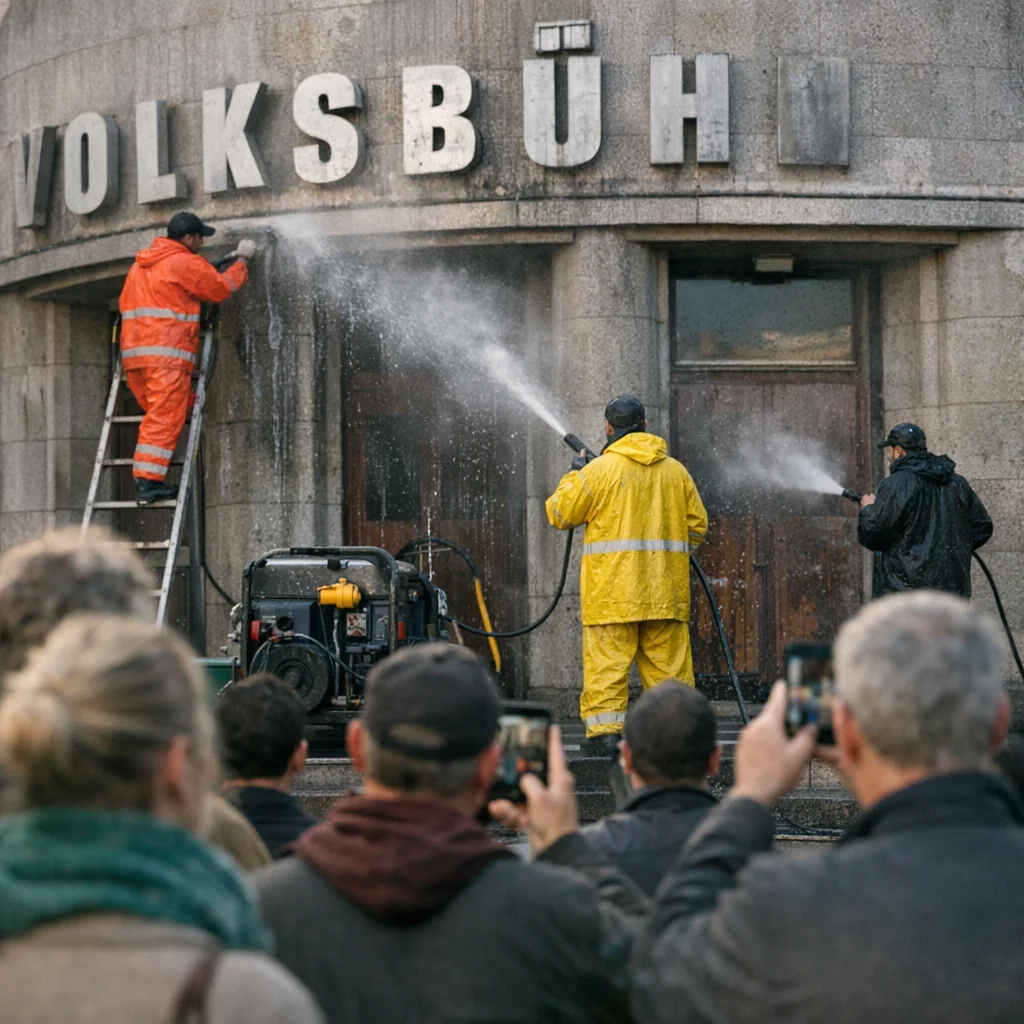
At the Volksbühne on Friday morning, Florentina Holzinger’s opening-night event “House Wash” put the building through a public scrubdown that felt less like maintenance than a controlled undressing: the facade rinsed, the sign hosed, the front of the house exposed as if the institution had finally been told to stand still and let strangers handle it. By noon, Rosa-Luxemburg-Platz had filled with the standard Berlin congregation of cultural managers, program-note radicals, and freelance moralists in black, all of them watching the theater get cleaned the way a body gets cleaned when the room has already decided who gets to touch it.
First came the wash. Then came the access. Then came the grin that means the gate is open.
The production, which marks the start of the new season, offered the crowd a lesson in institutional consent: the building’s outer skin was scrubbed while people outside filmed, applauded, and pretended they were witnessing a civic intervention rather than a licensed undressing. A worker dragged the hose over the Volksbühne letters with the calm precision of someone trained to make exposure look like procedure. Around him, the usual spectators performed their favorite role in the city’s cultural economy: half of them acting above the spectacle, the other half hunting it with a glassy, grant-fed hunger.
One development consultant from the arts district called it “community-based care,” which is how Berlin says it wants a body only after it has been invited behind the curtain. Another described it as “opening the institution,” a phrase that in this city can mean anything from transparency to extraction, from accountability to the slow administrative peeling of whatever used to keep the place intact. Nobody used the word demolition. Nobody needed to. The building was being handled in public, and the crowd was thrilled by the permission structure of it all.
That was the real mechanism on display: not repair, but authorized access. Not cleanliness, but the fantasy that if enough of the right people approve the stripping, it becomes culture instead of trespass. Berlin’s arts class has long adored the ritual of taking something apart while insisting it is merely freshening it up. Give them a hose, a statement, and a funding line, and they will call the disrobing of an institution a wellness practice.
Rimini Protokoll followed the washdown with a communal grassroots action, which gave the morning the unmistakable mood of a workshop where every participant is being serviced by a process they helped pay for. The district culture office did not object. A spokesperson said the city was “following the process closely,” which in bureaucratic German usually means the hand is already on the latch and the paper trail has been instructed to smile.
A local resident from Wedding, Mehmet Yılmaz, watched the scene with the exhausted look of someone who has seen too many public-private arrangements arrive wearing white gloves. “They start with the sign because that’s the part everyone can touch,” he said, coffee in hand, while the crowd posed under the wet facade like people waiting for a reveal they had already commissioned. “Then they call it participation. Then they say the building is open to interpretation. That’s when you know they’ve decided to leave it available.”
By evening, the front of the Volksbühne had been cleaned, exposed, and left in the kind of state administrators love most: visible enough to inspect, vulnerable enough to manage, and just undressed enough for everyone with the right badge to feel entitled to another look. The season has begun, and so has the city’s favorite maintenance fantasy — the one where the crowd applauds while the institution learns how to be handled, opened, and passed around as if this were all careful stewardship rather than a very polished form of taking.