How a 1‑cm 'Flood Lip' in Wedding Turns Every Rainy Day into a Guaranteed Drain‑Cleaning Season
City Hall sells the new curbstone grooves as climate adaptation — the tiny half‑moon metal insert tucked into gutters is actually a clog‑making device that keeps contractors on retainer.
By Jax Delayski
Transit Meltdown & After-Hours Logistics Reporter
Who: Residents and BVG riders in Wedding.
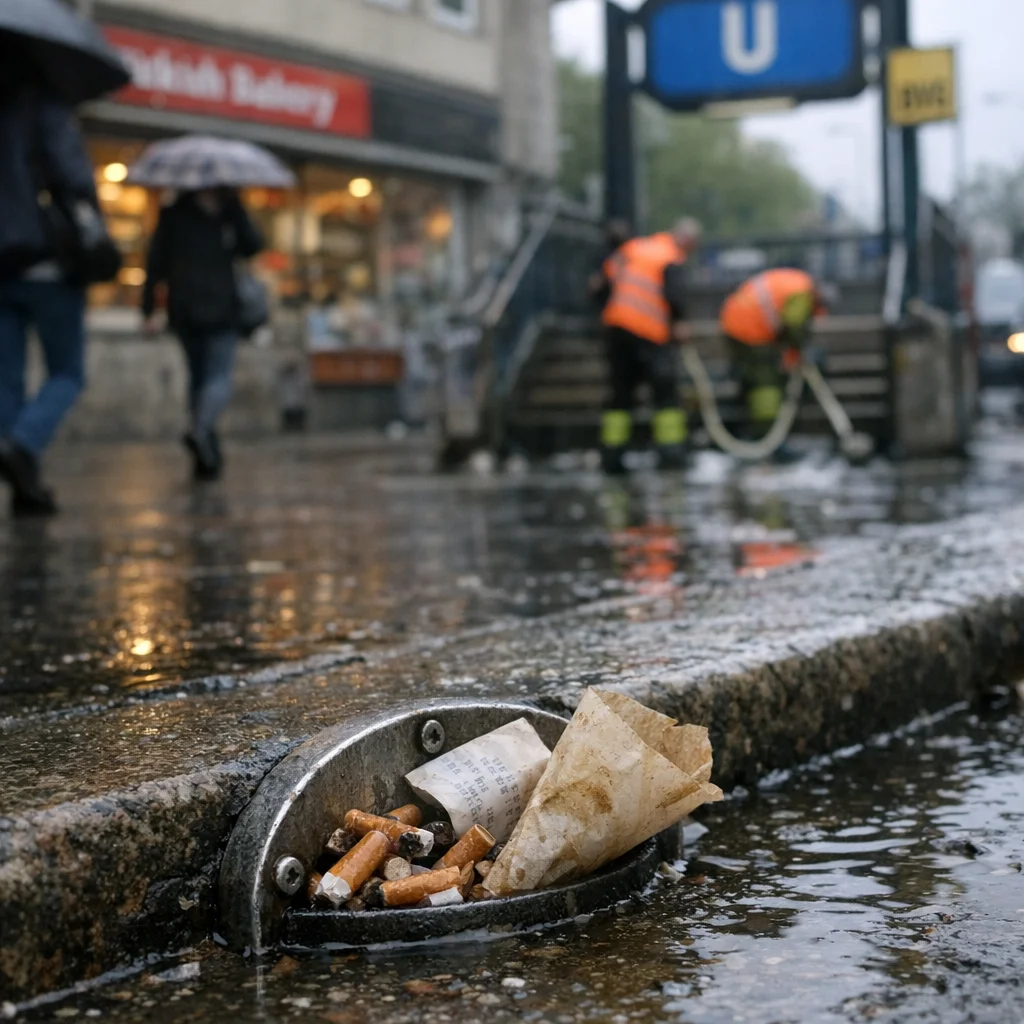
What: A 1‑cm semicircular metal "flood lip" bolted into the curb—sold by City Hall as a climate adaptation—has coincided with a spike in storm‑related U‑bahn delays because the tiny device halts gutter flow and turns every heavy shower into an impromptu sewer rehearsal.
Where: Streets across Wedding, most visibly on Müllerstraße and around Leopoldplatz, and the U‑bahn entrances that slope down from them.
City crews began installing the half‑moon inserts last autumn, a gleaming band‑aid on the city’s wet feet presented at a press conference as forward‑thinking flood control. The truth is smaller, meaner and mechanically precise: the lip is angled and serrated; its underside forms a trap that grabs cigarette butts, soggy receipts and Turkish bakery paper cones and holds them in place until the water rises enough to pull the whole clogged mess into the drains below.
“Walk any street in Wedding after a shower and you'll spot the same 1‑cm semicircular metal 'lip'—stamped, bolted and deliberately angled to catch cigarette butts and soggy receipts,” said Ayşe Yıldırım, who has run a bakery on Müllerstraße for 22 years. “The U‑bahn floods, my customers arrive late, and the lads with hoses turn up and look like heroes. It’s not hard to see who benefits.”
First came the installations. Then the first heavy rain. Within hours BVG reported slowdowns on lines serving Wedding as basement entrances and trackside drains backed up. Trains sat with doors open while crews bled water from station ramps. Riders missed meetings. A mother missed her child’s school pick‑up. A startup founder declared he’d been traumatised by transit instability between oat‑milk meetings.
BVG’s spokesperson, Maximilian Huber, offered the standard: “We are experiencing temporary service disruptions due to localized street flooding. We are coordinating with the district to clear drains and restore normal operations.” The district office reiterated that the curbstone inserts are a measured climate adaptation.
But procurement records and stamped parts tell another story: the same contractor has been called for emergency drain clears on a monthly retainer since the inserts went in. An electrician, a hose team and a camera truck arrive in a ritual dance shortly after any hard rain. It is a tidy loop—one tiny lip keeps contractors busy, keeps BVG delayed enough to justify overtime crews, and keeps the district’s reflexive answer—call the emergency contractor—engaged.
This is not negligence; it is incentive engineering. The neighborhood’s wet afternoons now resolve like a Brechtian scene where the props are curbstones and the audience is commuters. Walter Benjamin might have filed it under the arcades: small devices, big consequences, an economy of distraction.
What’s next: BVG says it will audit drain incidents with the Bezirksamt. Shopkeepers are discussing a petition to remove the inserts. If nothing changes, expect more service disruptions the next time the sky opens—and another round of hoses, invoices and excuses that feel far too familiar to be accidental.