How a Döner Shop on Soldiner Straße Outschooled Deutsche Bahn on Customer Service
Police in Wedding are investigating why Kadir’s Döner returns missed trains, apologizes faster than an S-Bahn announcement, and keeps a loyalty list that actually works.
Crime & Customer Service Correspondent
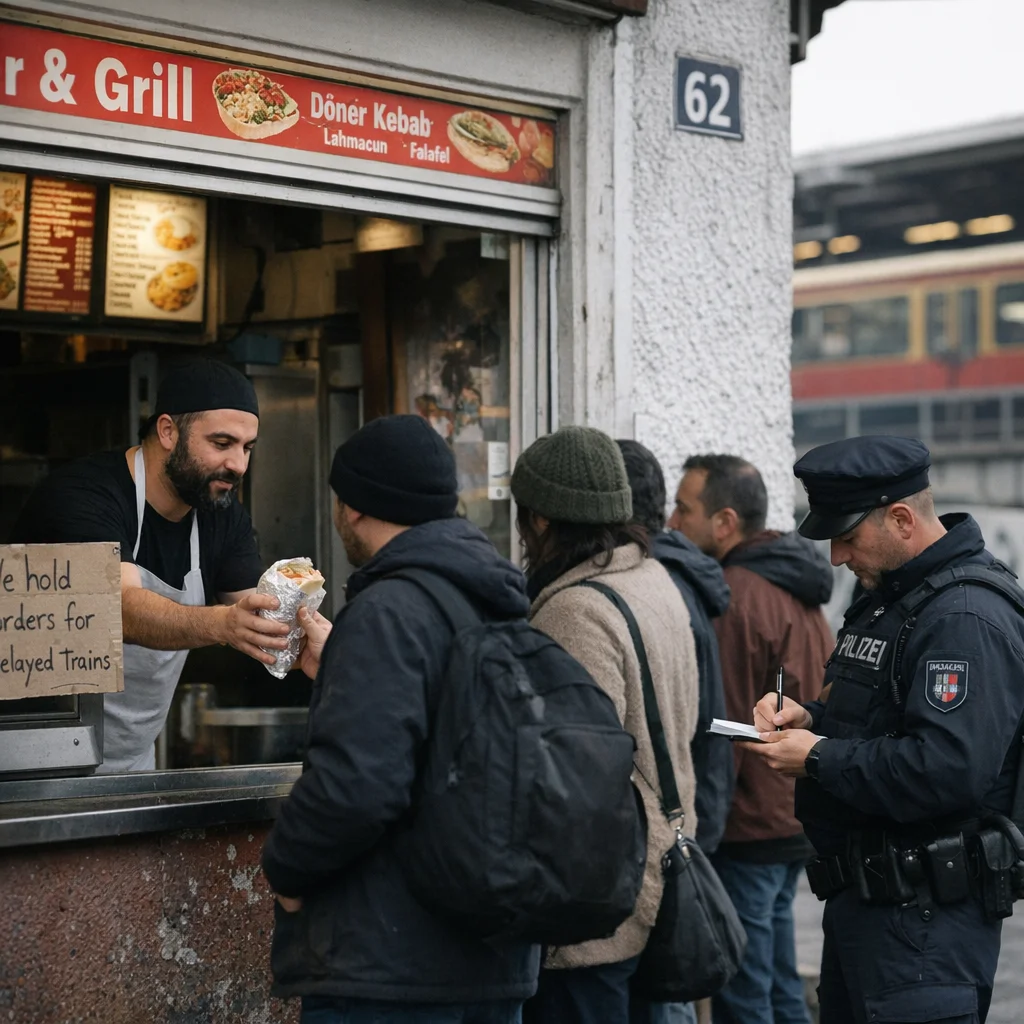
WEDDING — On Tuesday, Feb. 3, around noon, officers from Berlin Police Unit 34 arrived at Soldiner Straße 62 after an unusual set of complaints: not that a shop cheated customers, but that it was outperforming Deutsche Bahn.
“Kadir’s Döner has a waitlist on WhatsApp, a stamped loyalty card, and a refund policy that actually pays out,” said Kommissar Deniz Yılmaz, standing in front of a queue of commuters and office workers. “We need to know how a private actor—suspected of Clan ties, according to open records—has a customer-service model that runs circles around a state railway.”
Owners and employees denied wrongdoing. Kadir Demir, 42, wiped his hands on an apron and handed a wrapped döner to a woman who had just stepped off an S-Bahn at Gesundbrunnen.
“If the train is late, we hold the order. If it’s canceled, we give a free ayran,” Demir said. “We’ve been here 15 years. People trust us.”
Residents said the trust is tangible. “They call you by your name. Deutsche Bahn posts an automated apology and hangs up,” said Maria Schulz, 63, who lives at Soldiner Straße 14 and waits every morning with a cup of tea. “Kadir’s man came out to the platform last week and told everyone the train delay was a technical issue. Who does that?”
Deutsche Bahn conceded the PR deficit. “We are aware of reports that local businesses are offering customer communications DB does not. We are reviewing our service scripts,” said Anja Köhler, DB Customer Relations, in an email. “We reject any suggestion of improper cooperation with vendors.”
Police detectives, however, are checking whether the döner’s polished operations are simply good hospitality or a strategic soft-power play. Investigators are auditing payments, supplier invoices and whether station staff received favors—complaints that smell faintly of extortion or patronage.
The situation has opened a peculiar policy debate. For commuters it is a Brechtian scene in which a small shop performs civic competence better than an institution. For social theorists it prompts a Habermasian aside: the lifeworld here is being re-enacted behind a kebab stand.
Officials say the probe is routine; locals say it feels like a civic humiliation. “We’re doing a deep dive into the matter,” Kommissar Yılmaz said, with a firm grip on his clipboard. “It’s hard to swallow that people prefer a grill to a national timetable.”
Consequences could range from fines to a formal DB partnership—an arrangement that would make residents laugh and then, quietly, get back in line.