How Organized Crime Learned to Steam Milk on Müllerstraße
Neighbors and police say a string of artisanal cafés in Wedding are operating as fronts for clan-linked money operations; investigations and landlords scramble.
Night-Queue Economist & Low-Grade Vice Reporter
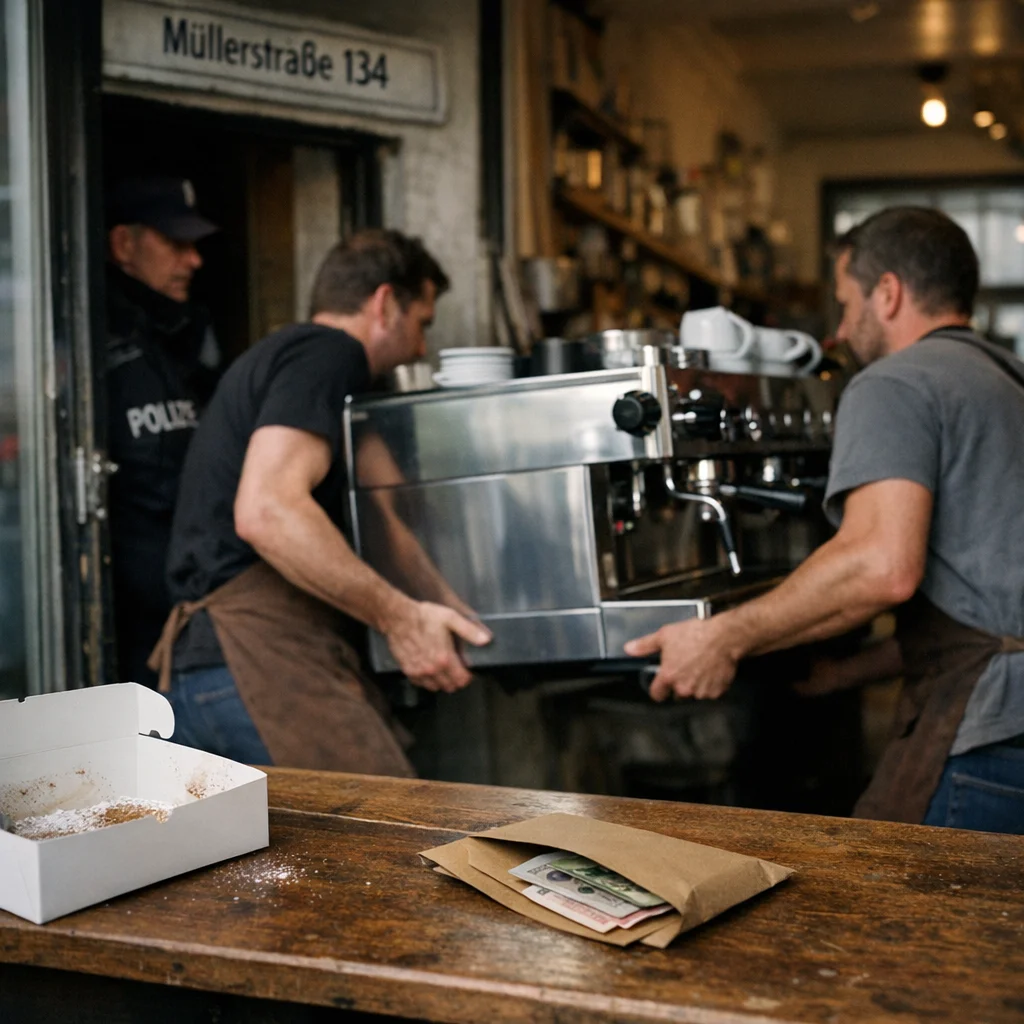
On Tuesday morning at 8:47am, residents outside Müllerstraße 134 watched two men in branded aprons wheel a stainless-steel coffee machine into a shop that the landlord had advertised as “perfect for creative concepts.” By 10:12am a barista in a hemp T-shirt had stuck a chalkboard outside reading "single-origin, hand-roasted." By the end of the week, the corner had become one of nine new cafés across Wedding that police now suspect are fronts for clan-linked money operations.
"We noticed a pattern: huge amounts of cash, tiny receipts, and pastries that never seemed to sell," said Kommissarin Anke Vogel, who leads the local unit at Polizeidirektion Mitte. On Jan. 29, 2026, at 07:15am, officers executed coordinated searches at three addresses — Müllerstraße 134, Seestraße 45, and Gerichtstraße 12 — and seized €47,600 in loose banknotes, a sealed safe, four mobile phones, and a ledger in Turkish and German. "The cash was folded into bakery boxes," Vogel told this paper. "It was hard to swallow as a coincidence."
Neighborhood shopkeepers say the cafés arrived at rent levels that made landlords sit up. "My son closed his döner counter last year because the rent shot up to €2,800 a month," said Mehmet Kaya, 63, who ran a bakery at Oldenburger Straße 21 for 28 years. "Now two floors below him is a 'third-wave' place that pays in cash and advertises 'community.'" Kaya paused. "Community, yes—community of contracts."
Detectives describe a basic model: clans purchase or lease small retail units, rebrand them with artisanal language, and report minimal sales while channeling cash through deliveries, catering contracts, or dubious supplier invoices. At Müllerstraße 134, investigators found invoices for "roastery services" sent from a shell company in Neukölln and a photograph album of supplier visits that read more like a promotional portfolio than bookkeeping.
District officials are scrambling. Ludwig Obermeyer, press contact at Bezirksamt Mitte's commerce office, said inspectors would tighten checks on cash-intensive microbusinesses. "We are penetrating the market structure with targeted audits," Obermeyer said. Tenants' associations criticized the response as overdue: "There has been stiff resistance from owners who prefer quick rents to long-term tenants," said Anja Richter of Mieterverein Wedding.
For some locals the spectacle feels like a Situationist prank: registers shimmed, menus as mise-en-scène. Walter Benjamin's flâneur would find it perverse — shopfronts performing authenticity while real livelihoods are pushed out. Whether artful croissants or bad coffee, the consequences are specific: long-time families displaced, landlords enriched, and a police dossier that grows heavier every weekday morning.
"We are conducting a deep dive into the matter," Kommissarin Vogel said, careful with language. "This is about following money, following people, and following the receipts."
At 16:00 on Wednesday, Müllerstraße 134 had a queue, a line of young people arguing about milk alternatives, and a manager counting cash in a paper bag behind the counter. The bag was closed when officers arrived two days later.