“I Just Need a Quiet Place for My Crypto,” Says Wedding Founder, Paying in Cocaine for an Ex-Art Studio Desk
As artists get priced out of their own imagination, one former print workshop in Wedding becomes a sanitized hamster cage for men who call Excel a “creative medium.”.
Gentrification Symptoms & Pretend-Creative Economy Reporter
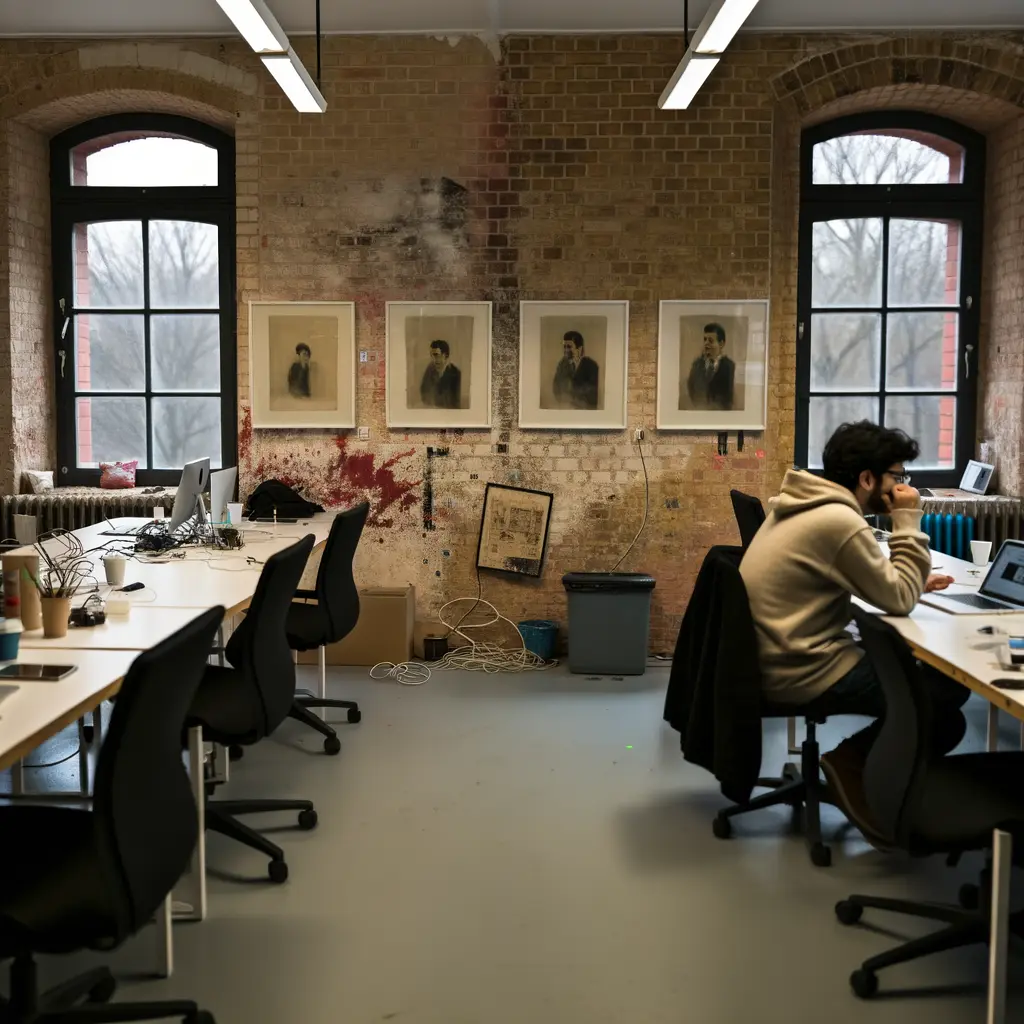
The Great Migration: From Canvas to Candor-Free KPIs
Wedding’s creative spaces are being repurposed in the usual Berlin way: reverent slogans taped onto a ruthless invoice. Where a sculptor once chipped away at stone like a person processing a childhood, a fintech founder now chips away at a seed round like a person processing that he owns two Patagonia fleeces and no internal organs.
A former print studio near Osloer Straße has reopened as “a boutique focus habitat” for startups, featuring industrial beams, thoughtfully exposed brick, and the emotional exposure of men who only apologize to their LinkedIn audience.
“It’s not gentrification,” insisted 32-year-old founder Liam, whose accent is pure international school and whose moral compass points unerringly toward the nearest matcha. “It’s adaptive reuse. Like... Duchamp.”
Yes: he referenced Duchamp while signing a six-page sublease he didn’t read. If conceptual art had a Ninth Circle, it would include an LLC.
Coworking Amenities, Now With Full-Spectrum Shame
The space advertises “residency energy,” a phrase that tries to penetrate the bureaucracy of your feelings while pretending not to have any. Desks are named after former tenants—mostly painters—who are now living in distant districts where the radiator works but the hope does not.
The amenities include:
- A “silent room” that is not silent, but has softer guilt
- A podcast booth used exclusively for recording men describing themselves as “a problem-solver”
- Free sparkling water for people who pay rent the way the city pays attention: sporadically and late
To foster “community,” new members must complete a bonding ritual: making intense eye contact over oat-milk coffee while both parties pretend they have never taken cocaine at 4 a.m. and then still answered emails.
Witnesses report one tenant attempted “ethical blow,” which is just regular cocaine plus an HR seminar.
Local Commerce Adapts: Döner, Then Disruption
Nearby Turkish businesses have adapted in real time, because they have survived every trend from low-rise denim to minimalism to that thing where everybody started "curating" their groceries.
A neighborhood döner shop began offering the “Founder Menu,” a package consisting of:
1) one dürüm you can eat one-handed during a video call, and 2) a tissue for when the investor says “circle back,” and 3) a mint, to cleanse the palate of personal integrity
“Artists used to argue about Adorno,” said the shop owner, glancing at the coworking entrance with a patience that could qualify as urban policy. “Now these guys argue about valuation like it’s theology. At least the artists tipped.”
A Dialectic of Brick, Light, and Self-Deception
This is Wedding, so of course the whole transformation is dressed as a moral project. There are potted plants performing resilience, walls painted “calming sand,” and a small library shelf containing one copy each of The Creative Act and The Lean Startup, placed like contradictory scriptures. Marx would have enjoyed the spectacle: the means of production upgraded to a Herman Miller, while the worker remains a nervous mammal with an inbox.
At 6 p.m., as people in all black drift past the entrance looking half-asleep and maybe still high, the office occupants claim they’re “not part of nightlife,” despite resembling the day-shift mirror image of it: same stare, different playlist, identical thirst.
A resident who requested anonymity—because in Wedding everyone requests anonymity, including the cats—summed it up: “They’re leasing our past so they can feel original. It’s like Proust, but instead of memory it’s expense reports. Hard to swallow, but very on brand.”
A New Kind of Creative Space: One You Can Invoice
The real tragedy is not that old studios become offices. It’s that everyone is required to speak about it like it’s progress. The founder gets to feel artistic. The landlord gets to feel visionary. The artist gets to feel unemployed in a more aesthetic light.
And Wedding, as always, absorbs the punchline, keeps walking, and buys another dürüm.
In a city where everyone wants to be transgressive, the only truly radical act left might be this: pay rent on time, create something ugly and honest, and don’t do cocaine in a building that still smells faintly of turpentine and delusion.