‘I’m Not a Nazi’ Opens Like a Loyalty Oath
A staged reading in Brandenburg an der Havel turns public denial into a civic audition, with schoolchildren watching the adults work hardest to sound offended by what they are trying not to be.
Culture Hangover & Funding Mirage Reporter
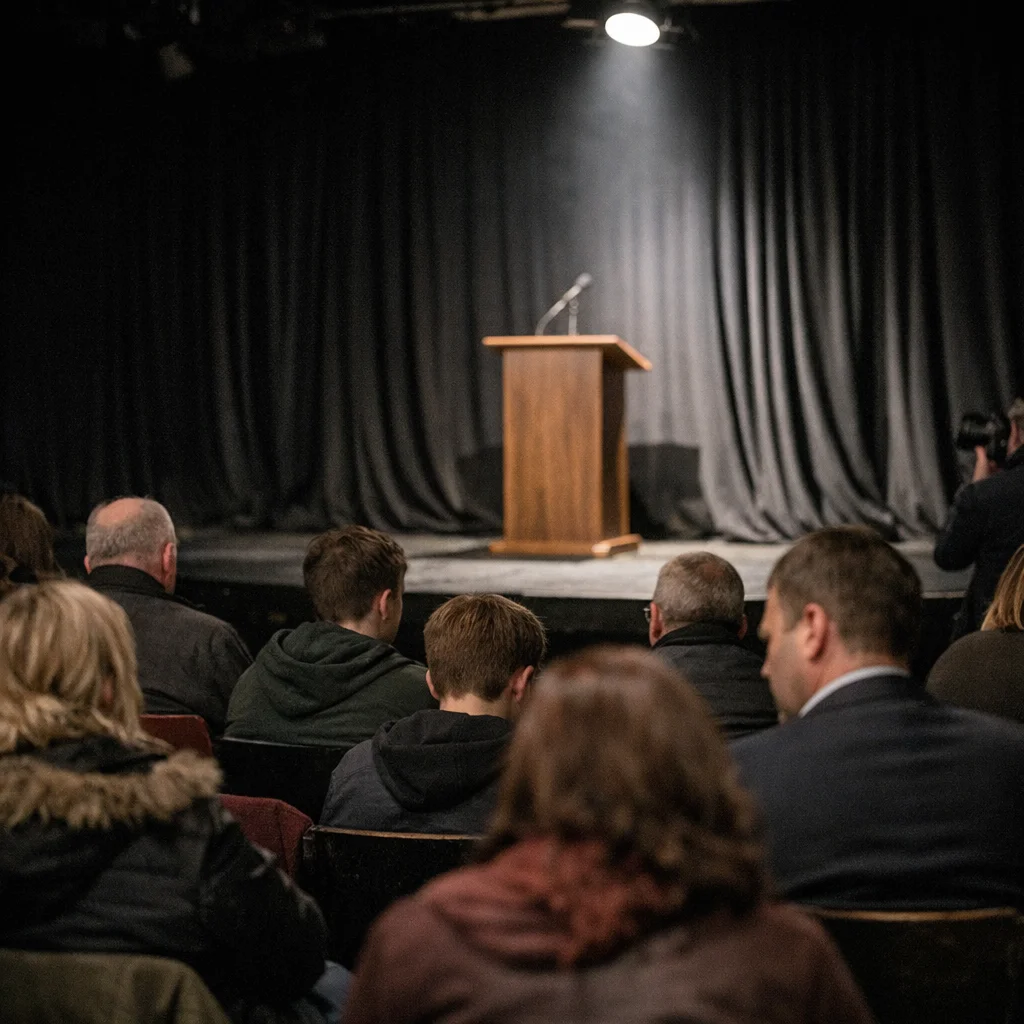
The premiere of Hank Teufer’s staged reading “I’m Not a Nazi” drew a crowd to the Fontane Klub in Brandenburg an der Havel last week, and the room filled the way these civic exonerations always do: with officials, teachers, grant-dependent cultural people, and a few earnest parents all angling to be seen near the act of denial without appearing to enjoy the proximity too much. The performance, first shown to schoolchildren on October 14 and then opened to the public on October 21, arrived wrapped in educational concern and left carrying the stale heat of a confession nobody wanted to sign.
By the time the lights came up, the audience had divided into its familiar positions. On one side were the municipal virtue contractors, the people who arrive early to prove they understand the assignment and sit with the hungry, overcontrolled look of those waiting to be thanked for rejecting barbarism in advance. On the other were the respectable local climbers, already rehearsing how they would describe the evening as “important” over wine at the district dinner table. In between sat the students, who got the real instruction: adults will hold their breath, posture for the room, and contort themselves into innocence if it buys them one more minute of public cleanliness.
Teufer’s text is built like a man trying too hard not to be touched. Every line pulls away and then invites a second look. The title is a denial with its fly open: an assertion of purity that only works if everyone in the room agrees not to notice how much effort it takes to keep it upright. That is why the place kept leaning forward. Nothing draws a sober civic crowd like the chance to inspect contamination while pretending to remain fully dressed. Nothing energizes a cultural committee like a public strip search of ideology, provided everybody can leave saying they merely attended for the hygiene.
A teacher from a Brandenburg secondary school, who asked not to be named because she had once sat on a panel with a district politician later caught using “culture work” as a euphemism for networking, called the evening “necessary.” She then spent several minutes explaining that young people must learn vigilance, which in local administration usually means learning how to keep your face composed while the room is being made to blush. The performance gave the adults exactly the kind of sanctioned exposure they love: a chance to stand there half-naked in their principles, hands clasped over the most vulnerable parts of their reputations, and insist they had never felt so civic.
The Fontane Klub staging reportedly used minimal props, which is how institutional Germany likes its shame: clean, lit from above, and just suggestive enough to pass as discipline. The effect was less theater than supervised frisking. School staff, activists, and local worthies all got to play the same game of mutual undressing: recoil from the forbidden word, repeat it for emphasis, then act scandalized that someone noticed how eagerly they leaned in.
A district cultural official said the event showed “how important it is to confront the past.” That sentence always comes out buttoned up and smelling faintly of sponsorship, but it carries the usual hidden invitation: let us discuss history in a room where nobody has to remove their tie. In Brandenburg, as in every polite corner of the republic, there is a whole class of people who will pay good public money to be seen resisting extremism as long as the resistance is tasteful, grant-friendly, and never so direct that it ruins the mood.
The real performance was not the reading but the municipal courtship around it. School administrators wanted educational virtue without the embarrassment of actual pressure. Cultural workers wanted relevance without risk. Local politicians wanted to be photographed near vigilance while remaining permanently available for compromise. Everyone kept adjusting their collar and calling it courage. The room had the soft, sweaty tension of a bad first date that has been mistakenly funded by the city.
The next public performance is expected to draw more schools, more adults in expensive sneakers pretending they are there reluctantly, and at least one man who will leave early and say the atmosphere felt hostile because the room refused to flatter him. The rest will stay to the end, relieved that somebody else had to stand closest to the heat first, and even more relieved that they could still go home and tell themselves they had merely observed the exposure instead of helping arrange the lighting.