“I’m Not High, I’m German”: Wedding Commuter Mistaken for Speed Casualty Outside U6 Seestraße
At 8:47 a.m., a 32-year-old claims his hollow stare, trembling knee, and surgically precise jacket were misread as stimulant activity—when he was “just tired and punctual.”.
Daylight Misrecognition Reporter
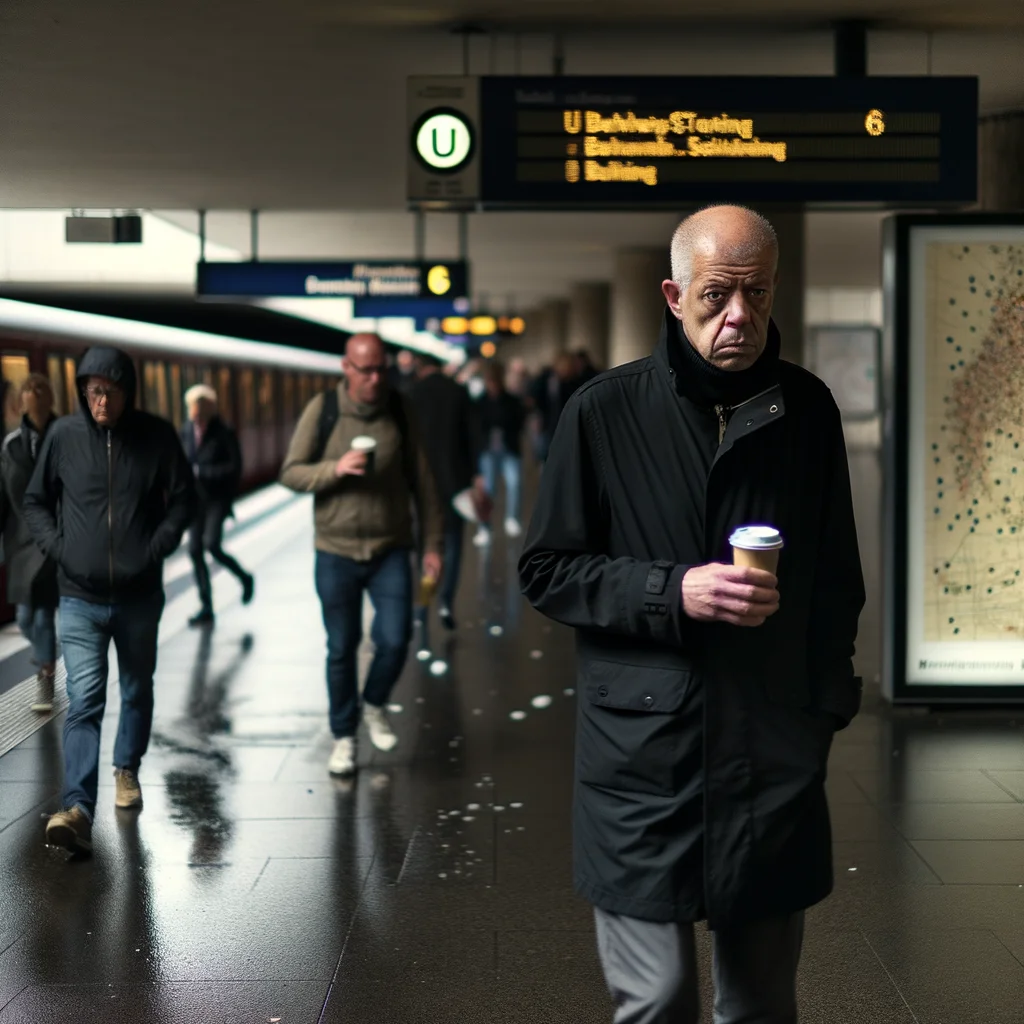
A familiar look, and the neighborhood got it wrong
On Tuesday morning at 8:47 a.m., regular commuters outside U-Bahnhof Seestraße (U6) watched a man in an ironed black jacket sway gently beside the BVG elevator, eyes half-open and jaw working as if negotiating with invisible chewing gum.
Several bystanders concluded—confidently, and with the relief of people who love pattern recognition—that the man was on speed.
They were wrong, at least according to the man.
“I’m not high,” said Jan-Erik Fahlbusch, 32, speaking to The Wedding Times at 9:18 a.m. while waiting for a replacement bus at the corner of Müllerstraße and Seestraße. “I’m German. This is how exhaustion looks when it has health insurance.”
The method: purposeful deterioration
Fahlbusch, an insurance back-office specialist from Reinickendorf currently subletting in Wedding, has become locally notorious for what one neighbor described as “a chemically literate face on a strictly legal schedule.”
Witnesses at the Späti on Müllerstraße 108 (where he bought a coffee and two plain bread rolls at 7:12 a.m.) reported classic “scene” markers: rigid posture, micro-adjustments of sleeves, and the kind of wide-eyed vigilance typically associated with bathrooms at Golden Gate—yet paired with the meek obedience of someone who still fears crossing on red.
“It’s like watching a productivity coach cosplay a raccoon,” said Emine Kaya, 54, who runs a nearby Turkish grocery on Togostraße and says she first noticed him last month. “My son parties. I know the difference. This guy looked worse. That’s the scary part.”
The incident that forced the issue
The situation escalated when a well-meaning newcomer—identified by residents as “a man with a tote bag that said ‘Radical Rest’”—approached Fahlbusch and offered him magnesium, a business card for a somatic therapist, and directions to an “after-hours integration space.”
Fahlbusch declined.
“I had to set a boundary,” he said. “Firmly. Stiffly, even. Because if you give people an inch in this neighborhood, they try to take you for a deep dive.”
According to BVG security staff stationed near the platform at 8:55 a.m., a second passerby called the police to report “a man clearly in orbit.” The responding officers did not file charges, but asked Fahlbusch to drink water “and consider sitting down somewhere normal,” a phrase that suggests both empathy and threat.
A spokesperson for Polizei Berlin (Abschnitt 36) said in an email that afternoon that officers are trained to distinguish “fatigue, intoxication, and general Berlin facial expressions,” though acknowledged “gray zones during rush hour.”
A city where the body is evidence
Nightlife workers in Wedding say confusion is now inevitable. The neighborhood’s daytime workforce increasingly shares a physical vocabulary with its weekend casualties: cracked lips, dark circles, and a gaze that suggests they’re remembering an entirely different life, possibly one involving minimal Slack notifications.
“What people forget,” said Baris Arslan, a bakery employee on Brunnenstraße who starts at 4:30 a.m., “is you can look like you’re coming down without ever going up.”
Urban sociologist Dr. Wiebke Römer, reached by phone at 6:04 p.m., framed the matter bluntly. “Walter Benjamin wrote about the flâneur drifting through the city. In Wedding, the modern flâneur doesn’t drift—he dissociates, while maintaining office hours.”
As for Fahlbusch, he insists there is no art to it, only practice.
“I’m not trying to imitate anything,” he said, boarding the M27 at 9:41 a.m. “I’m simply performing the only remaining luxury: functioning while visibly collapsing.”