In Wedding, New Right‑Wing Youth Clubs Sign Up — And the Cafés Are Taking Notes
Generation Deutschland chapters pop up across Berlin and Brandenburg; in Wedding the recruitment looks suspiciously like a badly branded meetup, and everyone is pretending not to notice.
Neighborhood Politics Correspondent
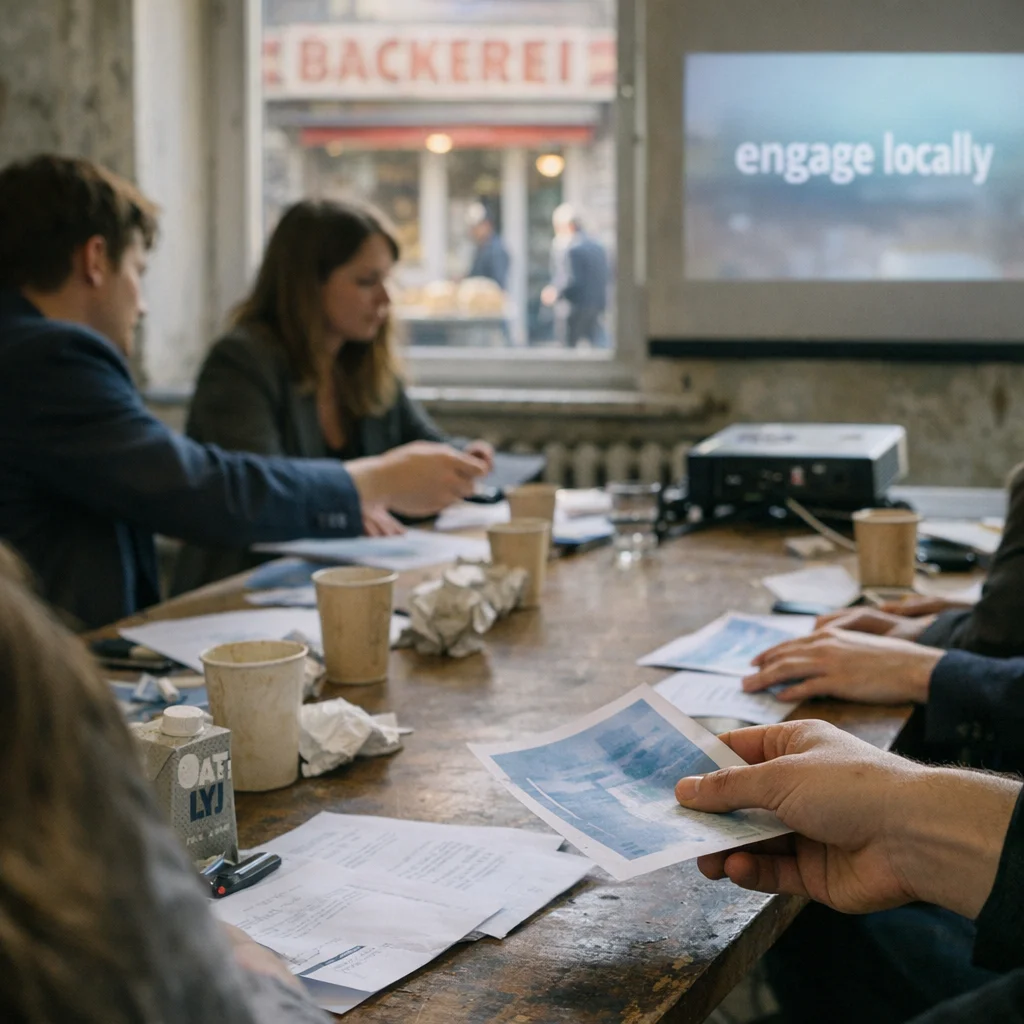
A blue flyer on a radiator
They arrived like any other unwanted trend: quietly, with nice typography and a well-produced PDF. "Generation Deutschland" — the youth cells the national press just noticed forming in Berlin and Brandenburg — have started knocking on Wedding's community-center doors, booking the cheapest meeting room for two hours, and expecting an audience.
The scene is almost cinematic: a long table, Polish notepads, a PowerPoint that pauses dramatically on a slide titled "engage locally," and a man in a blazer who seems surprised that the oat‑milk cappuccino machine doesn't accept cash. The only thing missing is a sponsor logo from a co‑working space.
How the spectacle meets the kiez
If Guy Debord had to describe it, he'd probably call it a moment where the spectacle eats the street. The far‑right youth groups are attempting the same aesthetic conquest every gentrifier practices: control the narrative, own the Instagram, and make civic life shallow enough to be monetized.
Wedding's response is predictably messy and deliciously awkward.
- The co‑working on Müllerstraße (no, not that Müllerstraße — everyone has a Müllerstraße) offered a "community outreach" slot for a fee. The offer included free Wi‑Fi and an intern who would tweet on behalf of democracy.
- A tenants' assembly, which usually argues about radiator heat and laundry schedules, pivoted on a Wednesday night into a Kafkaesque registration debate at the Bürgeramt: do you need a permit to hand out leaflets or just a moral permit? The forms insisted on both.
- Two Turkish families petitioned to translate the PDF into Turkish and Greek, partly to understand the spiel and partly to add better fonts.
A local barista observed the meetings with a kind of weary anthropological interest: "They talk like a startup trying to launch a state. Nobody's mother is proud."
Recruitment with a smile and a spreadsheet
These youth cells have learned one thing from Berlin's reinvention industry: presentation matters more than substance. Their flyers are airy; the copy reads like a bad app onboarding flow: "Join us. Improve your future. Discuss. Act." There is an aspiration to speak fluent municipal policy while never touching a rental contract.
Inside the room, organizers practice earnest phrases that will sound heartfelt in a podcast: "We want to preserve cultural identity" — the modern euphemism for wanting a part of the city to stay small enough to control. They talk about "community standards" while the people projecting those standards are still figuring out where to park their cargo bikes.
It's tempting to laugh. It's harder to swallow when rent increases follow polite conversations.
The gentrifiers' dilemma: convert, co‑opt, or pretend it wasn't personal
Local creatives react like a market research team handed a crisis brief. A design collective offered to "help reframe the message" with a palette of troublesome pastels. A founder with a podcast suggested making a two‑part series: "From Pitch Deck to Public Square." The irony is delicious and slightly obscene — everyone wants to be the author of the narrative, even the people who'd sooner privatize the public.
Meanwhile, long‑term residents of Wedding are doing what they always do: managing, resisting, and making tea. One retired teacher volunteered to sit in on a meeting and asked only for a biscuit and the truth. She responded to the group's policy talk by reading aloud a paragraph from Walter Benjamin about the flâneur; the organizers didn't know whether to applaud or record it for content.
A political therapy session with bad acoustics
This is not a million‑person movement. It's not even strictly local politics — it's the national politics of identity reduced to the size of a rented room and a bad projector. But for Wedding, a neighborhood where Turkish families, long-term tenants, and new arrivals live cheek‑by‑jowl, even a small presence matters.
There was a town‑hall style meeting at a community center where the atmosphere felt like a therapy session that had been booked for two hours and extended to three. Speakers from both sides tried to make their points. The highlight was a perfunctory demand to "penetrate the bureaucracy" — a phrase that landed oddly in a room accustomed to actually living with the consequences of municipal decisions. It had a sexual undertone that nobody dared lean into, and a bureaucratic literalness that made everyone chuckle nervously.
How Wedding keeps doing what it does best
What will happen next? Probably the usual: lots of talk, a few petitions, one petition that mysteriously gains signatures from people who don't live here, and some evenings of earnest argument in cafés that charge too much for sympathy. The organizers may find a local base, or they may melt away like every other ill-fitting trend that Berlin has seen — replaced by yet another wellness pop‑up promising "community resilience."
From a more philosophical angle, the episode reads like a Hegelian dialectic with a bad font: thesis (old neighbourhood), antithesis (new ideological actors), synthesis (something that looks suspiciously like a brand collaboration).
Either way, Wedding will absorb it. Absorption here is not reconciliation; it's the slow folding of new noise into existing rhythms — like a guest who never quite learns how to use the radiator, but insists on offering unsolicited feedback about your wallpaper.
Final note: don't outsource your outrage
If you live in Wedding and feel worried, do the normal things: talk to your neighbors, go to the community meetings, and maybe, for once, listen to the retired teacher who reads Benjamin out loud between sips of tea. Outrage is cheap online; local organizing is hard, sweaty, and requires more than a polished slide deck.
And if a well‑dressed recruiter offers to teach you "civic engagement" for €15 plus VAT, ask if that includes coffee and a refund policy. Either way, keep your eyes on the rent and your foot in the door.
Author's note: If you're reading this and thinking "both sides do it," remember that cynicism is not a strategy — it's a seating plan. Take a deep dive, make a plan, and consider that some problems are too hard to be solved by a hashtag.