‘Invest in Berlin’ at the Kombucha Altar
A new generation of founders is selling spiritual resilience, social impact, and “community” from shared desks that smell like wet socks and investor fear.
Civic Hypocrisy & Neighborhood Compliance Reporter
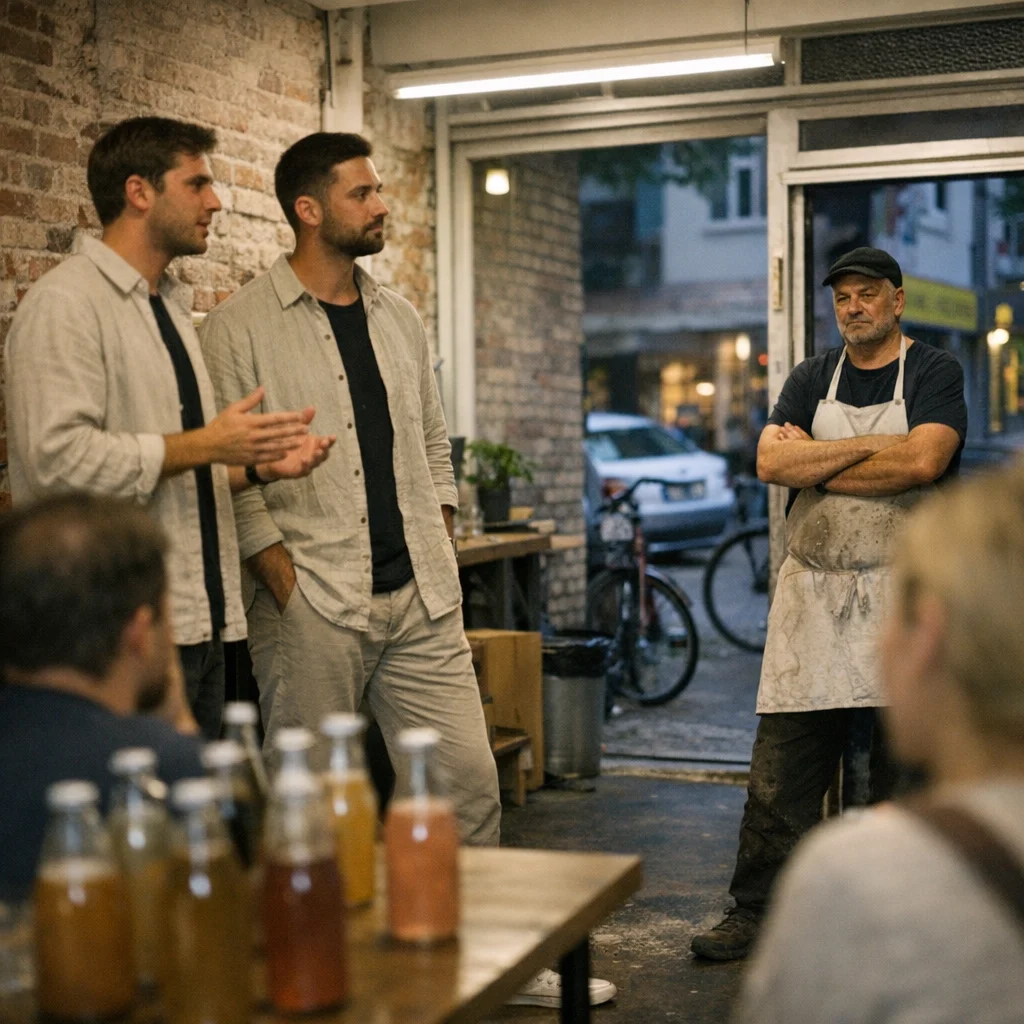
Founders in linen, locals in the dark
The latest “Invest in Berlin” pitch night in Wedding drew founders, freelancers, and a few bored investors into a shared workspace near Leopoldplatz, where the kombucha was warm, the mission statements were cold, and every third sentence sounded like a confession delivered through a mouthful of oat foam and rented self-respect. The event, held in a converted former shopfront with exposed brick, a flickering neon plant, and a security camera posing as design, was marketed as a celebration of “community resilience.” What it actually celebrated was the oldest Berlin hustle: arrive in a working-class neighborhood with a tote bag, a vocabulary full of kindness, and the private intention of turning the rent into a weapon.
By early evening, the room was full of men in soft shoes and women in overwashed linen calling themselves builders, though most had not built anything except a bridge between their student debt and someone else’s tenant list. Their accents had that polished Berlin wobble — half English, half performative fatigue, with the occasional little upward lilt of a person trying to sound humble while hunting for a lead. One founder, cheeks pink with the exertion of seeming relaxed, kept tugging at the hem of his beige overshirt as if class itself were creeping up his spine. He said his app would “connect communities,” which in founder dialect means: we would like access to your neighborhood without the inconvenience of your actual neighbors.
A few blocks away, a bakery owner from Müllerstraße wandered in after closing, still smelling faintly of flour and sugar and the honest fatigue of someone who works with his hands instead of his adjectives. He looked at the pitch deck projected over a wall that used to hold a shelf of bolts, and asked whether the “community” in question was expected to pay, smile, or simply disappear on schedule. When one founder told him the platform was “about empowerment,” the man nodded with the exhausted precision of someone hearing foreplay from a stranger who cannot find the zipper.
The evening’s real obscenity was not the jargon, which at least had the decency to be obvious, but the way everyone in the room collaborated to make extraction sound like neighborhood care. They praised “horizontal structures” from behind rented tables, discussed “social impact” while staring at market-size slides, and spoke about “listening to the community” with the expression of men trying very hard not to spill their own ambition on the carpet. Their bodies gave them away before their decks did: polished sneakers too clean for the street outside, wrists bare except for one tragic watch, shoulders slightly pitched forward in that apologetic founder crouch that says, please let me take your money and still think of myself as a good person.
One district employee, speaking on condition of anonymity because she was seated next to two impact investors and feared being invited into a pilot program, said the city has become “very good at welcoming people who treat Wedding like a prototype.” She said the applications arrive with the same lubricated innocence every time: activate the storefront, animate the kiez, unlock local potential. Charming verbs, she added, for a process that usually ends with a hair salon becoming a concept store and the concept store becoming a complaint.
The landlords, of course, never miss a prayer meeting. They love these evenings because startup language gives them a moral laundering machine with good Wi-Fi. The intermediaries love them too: the co-working operators, the district consultants, the grant people who speak in circles about inclusion while quietly pricing out the people they claim to serve. Everyone gets a slice of the same soft, damp cake. The founders get an origin story. The city gets a press photo. The landlord gets a higher number. The neighborhood gets “activation,” which is what bureaucrats call it when they can smell the profit but not the shame.
The room applauded each pitch with the disciplined hunger usually reserved for layoffs and karaoke. A venture capitalist in a black T-shirt compared Berlin to “early-stage Brooklyn,” which is the sort of sentence that should legally require adult supervision and a light slap. Someone else invoked Walter Benjamin, presumably because mentioning a dead philosopher is the cheapest way to make rent-seeking sound like theory. Another founder, who kept smoothing his beard like he was trying to iron out a lie, described his product as “sustainable intimacy,” which was either a business model or a cry for help.
Outside, longtime residents moved past the venue with shopping bags, headphones, and the exact face people make when their own neighborhood is being translated by someone who has never had to look at a lease in German. On the corner near Leopoldplatz, a man balanced a crate of vegetables on a hand truck while two pitch-night survivors argued about “ecosystem building” like a pair of underfed priests. The contrast was almost pornographic: real labor in the street, fake labor inside, and in between a glass door through which the city kept selling itself to itself.
By the end of the night, three founders had exchanged cards, two had promised to “circle back,” and one had said he wanted to “give something back to the Kiez,” which in startup language usually means taking a lot first and leaving a tasteful residue. The next pitch night is already listed. The kombucha will probably be chilled this time, the humility will be cleaner, and the same audience — city staff, landlords, consultants, founders, and the rest of us pretending not to recognize the scam — will show up to watch Wedding get dressed up as opportunity while the rent tightens its hand around the throat of the room.