“It’s Still Burning Somewhere,” Says Director as Berghain Cigarette Documentary Tracks a Techno Butt’s Final Steps
‘Filterline’ follows one cigarette from a leather jacket in Wedding to the Berghain dancefloor, ending under a size-44 boot at 6:13 a.m.
By Vivian Glare
Nightlife Anthropology Dropout
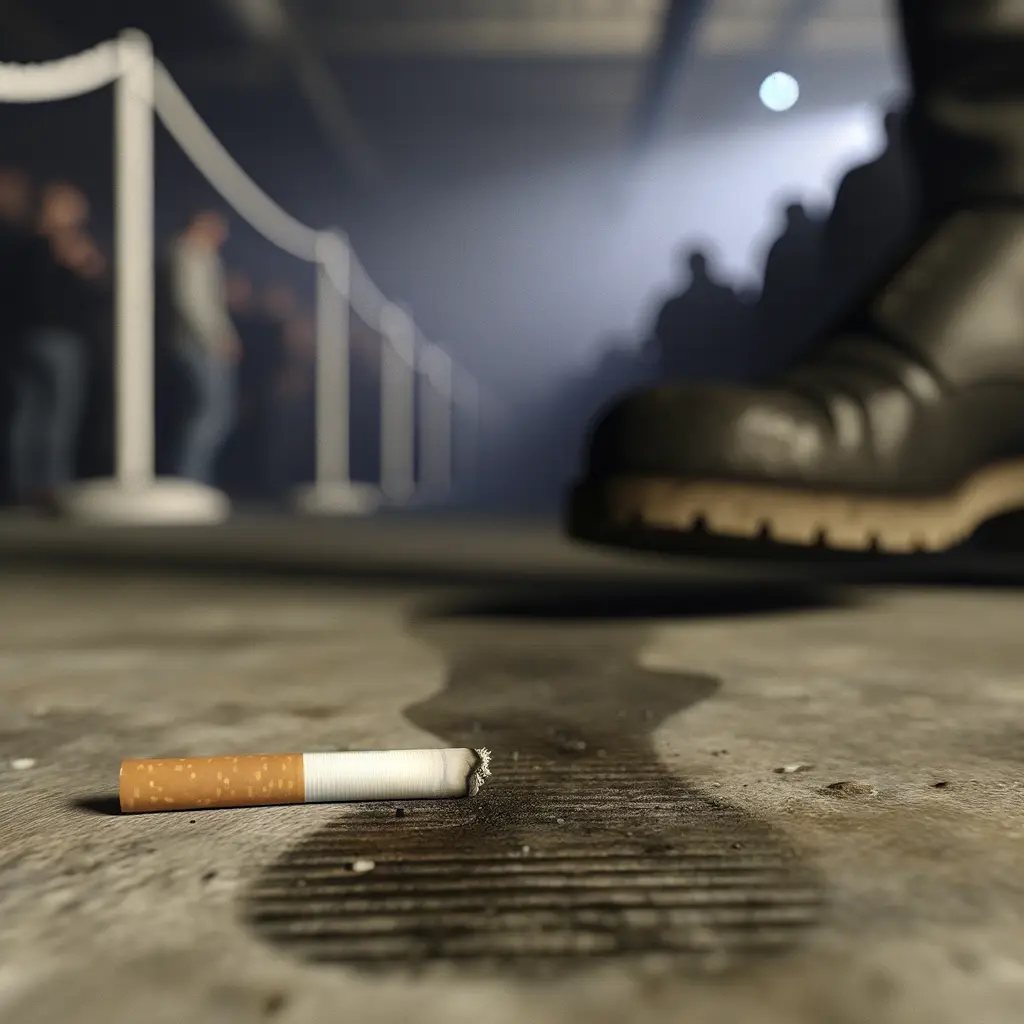
On Saturday, Jan. 13, at 4:22 a.m., a single cigarette named only as “Unit C-19” left the right pocket of a damp leather jacket at U-Bahnhof Leopoldplatz and began what a new documentary calls “a complete Berlin lifecycle: desire, neglect, flattening.”
The film, Filterline, premieres Tuesday at 9:30 p.m. at Sputnik Kino (Hasenheide 54, Neukölln) before a 12-hour afterparty “in an undisclosed corridor,” according to the invitation. Its subject is not a DJ, an influencer, or an author reading notes they printed five minutes earlier at a copy shop. It’s a cigarette destined to be dropped inside Berghain (Am Wriezener Bahnhof 1, Friedrichshain) and stepped on until it becomes architecture.
From pocket to threshold
Director Lene Marquart, 34, a Wedding resident who describes her work as “street-level anthropology with worse lighting,” followed the cigarette’s entire journey using a battery-powered macro lens, a tiny RFID sticker adhered to the paper, and what she calls “community informants” recruited outside a Turkish bakery near Müllerstraße.
“Berlin always pretends it’s beyond materialism, but we literally worship residue,” Marquart said Monday at a press preview held at Café Coffee (Müllerstraße 156), where staff requested that interview subjects stop shaking ash into the potted plant. “This cigarette had a narrative arc clearer than half the men doing ketamine deep-dives at 5 a.m.”
At 4:41 a.m., Unit C-19 was lit outside a Späti at Chausseestraße 48. The smoker, identified on screen as “S., freelance product ethicist,” takes three pulls, coughs politely, and calls the experience “hard to swallow, but culturally necessary.” At 5:02 a.m., it is carried in a clenched fist through the queue. The camera holds on hands for so long it becomes uncomfortable in the way of early Michael Haneke: intimate, clinical, and undeniably moist.
A doorman credited only as “M.” appears briefly. “People try to bring all sorts of things in,” he says. “Egos, weird vibes, sometimes their entire midlife crisis. Cigarettes are the most honest. They burn fast and still act like they own the place.”
The bathroom chorus and the flattening
Inside Berghain, the cigarette reaches its social apex at 5:37 a.m. in a bathroom corner “near the unofficial confessional stall.” Viewers hear overlapping testimonies—some possibly recorded on the edge of a comedown—about why someone would carry tobacco in 2026 like it’s contraband philosophy.
“It’s not nicotine,” says a clubgoer credited as Ranya, 29, from Wedding. “It’s choreography. You pull it out, you offer it, and suddenly you’ve got ten people orbiting you like it’s Solaris, but with eyeliner and speed.”
At 6:11 a.m., Unit C-19 is dropped beside a black boot print already stamped into the floor’s patina. At 6:13 a.m., a different dancer—witnesses estimated a “weekday-facing” German shoe size 44—steps down with what the subtitle team labels “stiff resistance.” The filter collapses. The camera stays.
According to Marquart’s production notes, the stomp was documented at 120 frames per second and “audited for foot accountability.” In one sequence, a club cleaner, Gökhan Arslan, 46, interviewed later at a döner counter on Badstraße, frames the final crush as urban planning. “Every floor tells you what gets respected,” Arslan said. “Here, it’s not ideas. It’s endurance. Cigarettes become history faster than promises.”
Public reaction: respect, disgust, funding
A spokesperson for the Berlin Senate Department for Culture, Malte Eberhardt, said the department did not fund the film but called it “a rigorous contribution to contemporary material studies.”
Film critics at the preview disagreed on whether Filterline is grim satire or sincere homage. “It’s basically a Walter Benjamin aura essay, but sticky,” said curator Daria Penzel, 41. Another attendee whispered that it’s “Debord for people who still have gum in their pockets.”
Meanwhile, a nearby Wedding Späti owner, Ebru Yildiz, 52, had practical concerns. “If this makes cigarettes trendy again, I’m raising the price,” she said. “My fridge is full, my rent is full, and Berlin already has enough people trying to look tortured on purpose.”
Marquart insists the film’s point is simple. “We document the cigarette because Berlin documents everything except consequences,” she said, adding that her next project may track a single baggie from Görlitzer Park to a ‘sobriety check-in’ table to a forgotten coat pocket. “Nothing disappears here,” she said. “It just changes hands, then gets stepped on.”