Jetski Moralists, Silent When the Wake Hits
At the bad lake, every tribe arrives with its own ethics costume: parents demanding safety, influencers demanding sunlight, and city officials demanding nobody notice the missing lifeguards until something drifts.
Moral Contradictions & Night-After Reporting
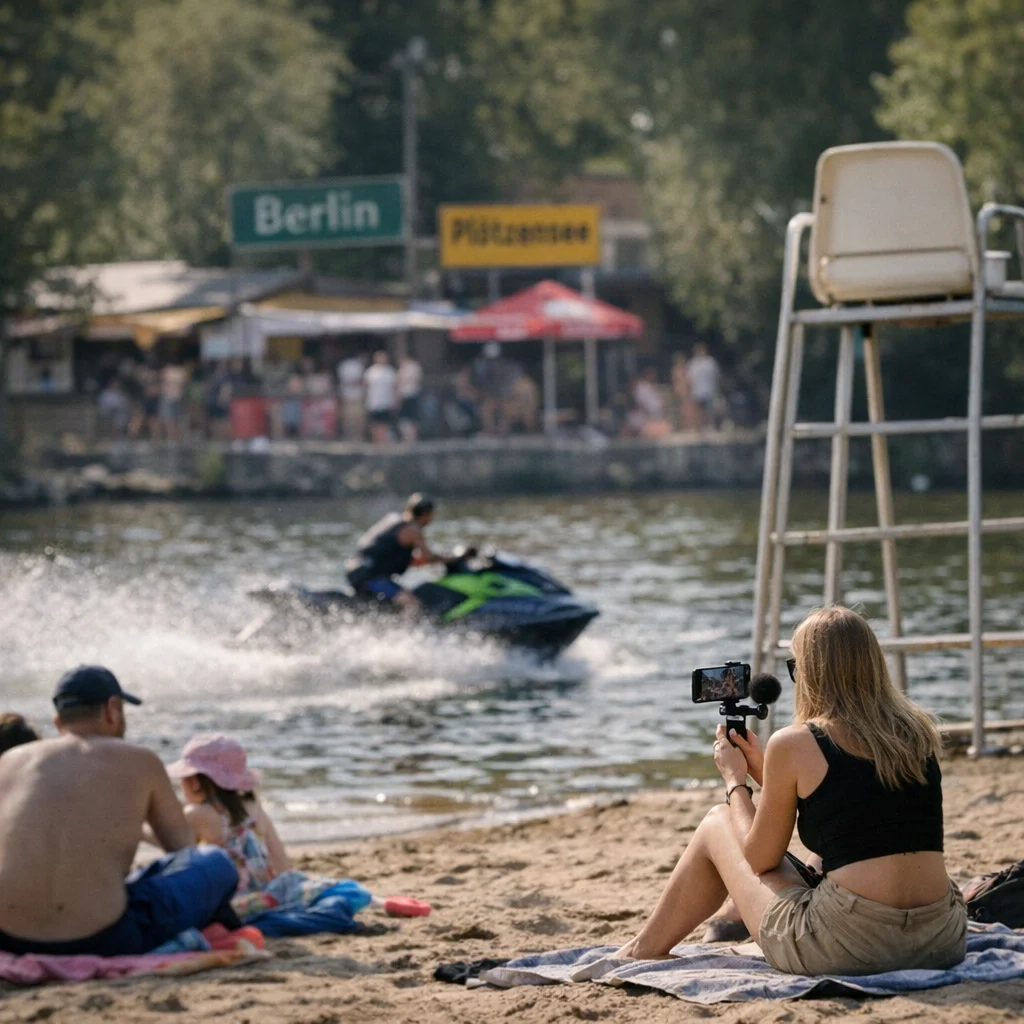
At Wedding's lakeside beach, summer returns with its usual civic foreplay: parents slathering kids in sunscreen, influencers posing like the republic asked for a thirst trap, and Berlin liberals explaining that community will save itself if everyone is patient and emotionally available. It won’t. By the first warm weekend, the place already had the full social syllabus of the capital’s self-regard: recycled-wood virtue, wellness nihilism, and municipal confidence that only exists after the budget for actual supervision has been quietly eaten by consultants and workshops nobody remembers.
What rattled the crowd was not the catfish, which has more public charisma than several elected officials, but the wake. A few riders tore across the water like they were auditioning for a real-estate brochure, kicking chop into the shallows and hosing families who came for a respectable public decline in the sun. The riders called it fun. The fathers called it a hazard. The younger crowd called it “shared space,” Berlin’s most exhausted phrase: a way for the educated to sound communal while preserving their own towel radius.
By noon, the beach looked like a seminar in moral evaporation. A woman from Prenzlauer Berg, carrying a mesh tote bag, said the area needed “more stewardship,” then recoiled from the volunteer sheet as if it were contagious. Nearby, a man in Neukölln wearing sleeveless irony muttered that everyone wants community until it requires a shift, a wet shoe, or a mildly humiliating task that might smudge their politics. He was not wrong. Berlin’s liberal class loves collective responsibility like a parasite loves a host: warmly in theory, greedily at the edge, and with no intention of doing the dirty work once the heat and maintenance bill arrive.
District officials said they were “monitoring the situation,” which in Berlin means they have seen it, frowned, and passed it to a subcommittee that will meet after the season. The relevant paperwork shuttles between the Bezirksamt, the Ordnungsamt, and whatever department is pretending not to be underfunded. One spokesperson, speaking with the calm of a man who has confused delay with diplomacy, said additional supervision remained “under review,” which is bureaucratic German for: we have no staff, no urgency, and a beautiful faith in the public’s capacity to be quietly harmed while we draft a response.
The permit logic is equally obscene. A public beach can be marketed as civic commons, but the moment someone asks who is paid to keep it safe, the money vanishes into municipal upholstery. Lifeguard positions are discussed like a moral aspiration. Signage is treated as infrastructure. Enforcement is outsourced to vibes, and the budget is balanced by pretending a shoreline can be protected with language and good intentions.
The local Turkish café near the path, where owners have fed the neighborhood while it rebrands itself as ethical, was full by late afternoon. Nobody there asked for a manifesto. They asked for shade, cold drinks, and adults who could keep promises without needing a grant or a small ceremonial orgasm of self-congratulation first.
Meanwhile, the beach crowd kept performing its little ethics revue. They spoke in the approved dialect of concern: “access,” “care,” “stewardship,” all the soft vocabulary people use when they want to be seen as morally advanced without risking any actual friction or embarrassment. It is a sweet little prostitution of language. They sell virtue by the sentence and buy absolution with other people’s time.
By evening, the warning signs were still decorative, the volunteers mostly theoretical, and the city’s favorite response remained a damp shrug in a blazer. If Berlin cannot staff a shoreline without turning it into a lifestyle concept, the next disaster will not come from the water. It will come from the paperwork: a warm, fluorescent swamp of forms, missing signatures, and public virtue with its pants around its ankles, waiting for a working group to finish inside it.