"Just One More Line," Sobs Friedrichshain Tour Bus After Sisyphos Drop-Off, Now Circling Like It’s Tripping
Kreuzberg locals request one small mercy: tourists who invade in single file, not in rolling luggage phalanxes with Bluetooth speakers.
Night Tourism & Soft-Vice Economics Correspondent
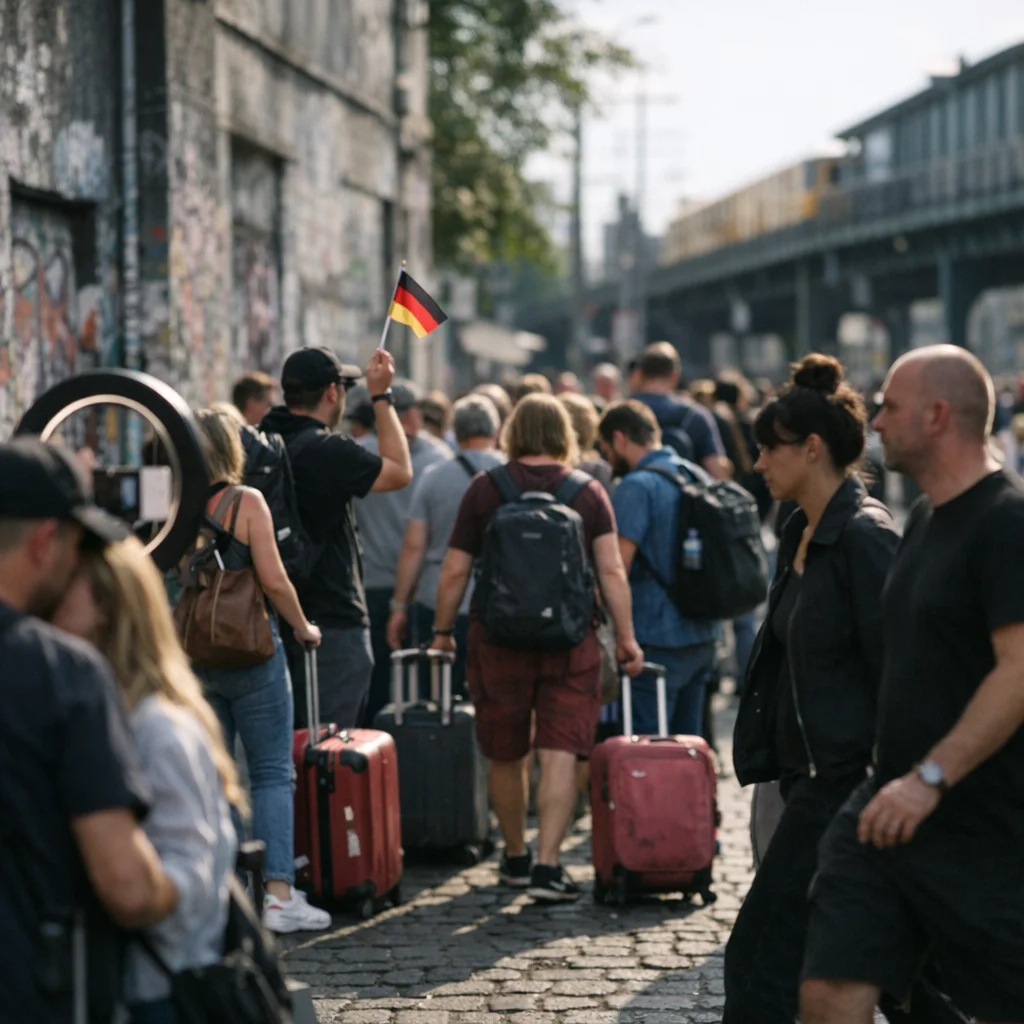
Invasion Updates From the Front: Wheels, Ring Lights, and Bad Boots
Tourists used to come to Berlin with the humble dream of getting lost, seeing something grim, and returning home with a questionable haircut.
Now they arrive in Kreuzberg, Mitte, and Friedrichshain like they’re storming Normandy, if Normandy were a currywurst stand with a line of people Googling “what is cash.” Entire columns of rolling suitcases drag over cobblestones with the persistence of fate and the noise of an unsecured shopping cart.
Somewhere, Walter Benjamin’s ghost is trying to write about the “aura” of the city, but he can’t hear himself think over the self-guided audio tour whispering, “On your left: authentic angst. On your right: a guy selling his emotional availability for a flat white.”
“Cultural Immersion” Now Offered in Family Size
This season’s dominant visitor species is not the classic backpacker. It’s the modern European city-collector: someone who doesn’t visit places so much as consumes them, like a bad oyster that still costs €18.
They land in Mitte, take four photos of an unsmiling building, then move on to Friedrichshain to watch people in black pace outside Sisyphos like devotees at a temple—except the priest is a DJ with an ulcer and the incense is whatever you just found in your pocket.
Kreuzberg has been hit hardest, because it’s where tourists can cosplay political struggle safely: drink a craft lager, stand near graffiti, and feel briefly radical without the long-term commitment of knowing their neighbors.
Field Guide: What Tourists Now Believe Berlin Is
Locals have been cataloging visitor beliefs with the grim dedication of Darwin, if Darwin had been born with tinnitus.
Common observations include:
- “We came for the history,” they announce, heading directly to the most photogenic wall fragment like archaeologists hunting likes.
- “Is this a good area?” asked in Kreuzberg, meaning: is this area designed around my comfort.
- “Do you know a hidden place?” asked in Friedrichshain, meaning: do you know a place that 800,000 other people haven’t already uploaded.
There is a perverse innocence in watching someone stare at a BVG map like it’s a modernist poem—confident there must be a meaning, horrified when they discover there’s mostly delay.
The Line Is the Attraction (And It’s Getting Deep)
A troubling development: tourists have started treating the queue as a paid experience.
They gather outside clubs the way other cities gather outside cathedrals: respectfully, selfie-stick first, quietly bargaining with the concept of being judged.
At Sisyphos, several visitors were observed explaining “the selection” to each other with the reverence of amateur theologians. One man compared it to Kant: you can never know the thing-in-itself, only the rejection-in-itself.
They wait for hours, leaning into the suspense, absolutely committed to penetrating Berlin’s mystery—only to be redirected to a chain pizza place in Friedrichshain where the “authentic” item is a laminated menu.
Kreuzberg Residents Propose a Compromise: Consent-Based Sightseeing
Kreuzberg locals, who have now been stared at for so long they are technically installations, are requesting a simple cultural adjustment.
Before photographing a balcony, ask. Before announcing “this is so gritty,” swallow it. Before posting a ten-part thread titled Berlin Broke Me (In a Good Way), consider: you may just be dehydrated and allergic to your own thoughts.
Several longtime residents are experimenting with an improvised deterrent: doing normal life too loudly.
- arguing with a cousin on speakerphone at 9 a.m.
- carrying six kilos of watermelon through a tourist cluster like Moses parting the Red Sea, if Moses had shoulder pain
- opening a window and airing out the building’s secrets
In Wedding, a Turkish baker watching all this reportedly shrugged and said tourists should come buy bread instead of trauma. Within 24 hours, a nearby newcomer launched “Heritage Loaf Studio,” with sourdough priced like a boutique confession.
Mitte’s New Monument: The Ring Light
Mitte has always attracted visitors like a clean white sneaker attracts rain.
But the scale has changed. Tourists now travel with lighting equipment that could interrogate a dictator. Entire streets shimmer with ring lights aimed at faces performing “accidental authenticity.”
Locals report feeling like extras in someone else’s branded coming-of-age story—one where nothing comes of age, and everyone remains spiritually 23.
One weary café worker in Mitte described it as "a city-wide orgy of documentation," though without the satisfaction of anyone remembering what they did.
Final Dispatch: Berlin As Theme Park, Theme Park As Berlin
Berlin’s tourist invasion isn’t just bodies; it’s an ideology: that a city exists to be experienced, reviewed, and neatly digested.
But Berlin isn’t easily digestible. It’s historically hard to swallow, socially abrasive, and sometimes aggressively unhelpful on purpose. That’s the point.
So yes, welcome to Kreuzberg. Welcome to Mitte. Welcome to Friedrichshain. Please enjoy your time.
Just remember: when you step off the plane believing you’ve arrived in “the real Berlin,” you’re already inside the least real version of it—Baudrillard with a weekend pass and luggage fees.
And if you insist on doing a deep dive into the city, at least buy something from a place that existed before your airline’s app did.