Kater Blau Keeps “Opening” Next Door as One Wedding Family’s Rent Goes Up on Acid
At 7:06 a.m. on Malplaquetstraße, the Yılmaz family found a fourth generation moving into their stairwell: a temporary club entrance, complete with bouncer, wrist stamps, and a bathroom queue.
Neighborhood Features & Domestic Security Correspondent
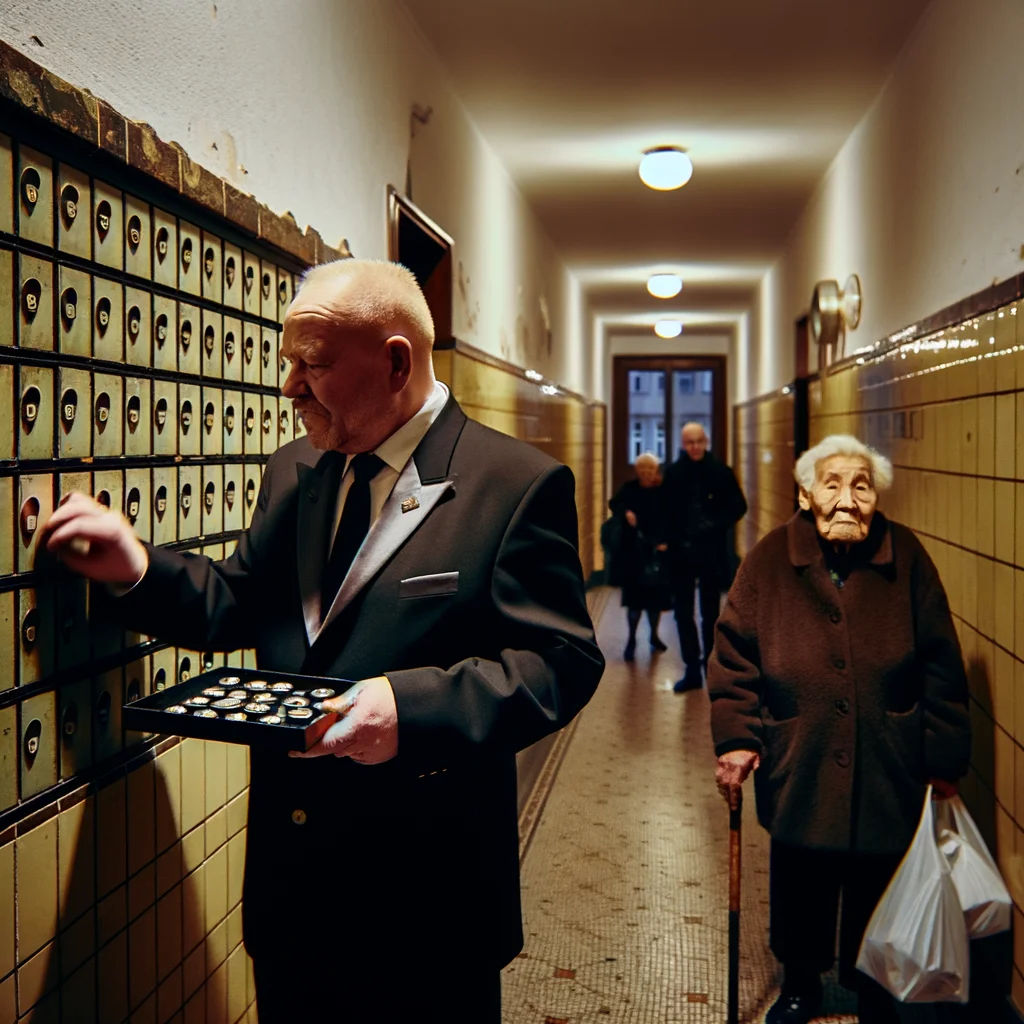
WEDDING — A three-generation lease meets a rotating fourth wall
On Tuesday at 7:06 a.m., residents at Malplaquetstraße 34 noticed a new velvet rope snaking across the entry hall of Hausaufgang B, positioned between the mailboxes and the baby stroller parking zone. Behind it stood a man in a black blazer holding a handheld stamp and a roll of black stickers commonly used to cover phone cameras. He identified himself only as “Sven, Door,” and declined to confirm whether he was affiliated with the nightclub Kater Blau.
For the Yılmaz family in the third-floor corner apartment—who have lived in the building for three generations—this was the first time their hallway had been formally admitted into Berlin’s night economy.
“We’ve had loud people, sure,” said Nermin Yılmaz, 68, who moved into the unit in 1974 with her husband İsmail when the rent was 143 Deutsche Marks and the bathtub still had “opinions.” “But this was organized. He looked at my grandson like he was deciding whether our family history was curated enough.”
A “temporary cultural entrance” with permanent consequences
The hallway installation began, according to building tenants, after property manager Hanno Krüger of Krüger & Partner Hausverwaltung circulated a notice dated Jan. 12. The notice, taped at eye level on the front door, announced “acoustic modernization measures” and advised residents that “a limited-period cultural tenancy will reduce perceived impact through community activation.”
Within 48 hours, neighbors reported an emergent choreography: a line of silent visitors in black coats on the sidewalk near U Amrumer Straße; intermittent bass vibrations at 9:40 p.m.; and, most notably, bathroom congestion.
“They kept asking where the ‘toilet situation’ is,” said Serhat Yılmaz, 42, a delivery driver who shares the apartment with his mother and two teenage children. “Our toilet situation is: we have one. They were knocking like it’s a shared resource. One guy offered me a mandarin and said he was ‘coming down’ and needed ‘a quiet stall.’ Like I’m a facility manager for strangers’ feelings.”
Residents on the second floor said the club-adjacent guests treated the building as a soft launch of intimacy. “Two men asked me if the stairwell was ‘the darkroom,’” said Claudia P., 33, who requested her surname be withheld because she “still has to take out trash.” “When I said no, one of them told me it was ‘a shame Berlin has gotten so conservative.’”
A bouncer’s assessment, and a family’s unwanted rebranding
At 11:18 p.m. Tuesday, in an interaction recorded by a tenant on Rehberge-tilted vertical video, “Sven, Door” appeared to screen residents returning home. Serhat Yılmaz, carrying groceries from a late shop run on Seestraße, was waved aside until he covered his phone camera.
“It’s policy,” the man said in the clip. “No documentation. Protect the space.”
The Yılmaz family said their apartment has become, inadvertently, part of an experience economy designed for outsiders to penetrate, then describe to friends as “authentic.”
“They look at our living room rug like it’s an exhibit,” Nermin said. “My mother brought that from Ankara. Now it’s ‘heritage texture.’”
On Thursday at 2:03 p.m., a private letter addressed to the Yılmaz family arrived from Hausverwaltung Krüger. It proposed a rent increase of 312 euros monthly “due to elevated location demand and newly improved cultural adjacency.”
“They told us our building now has ‘enhanced nocturnal infrastructure,’” Serhat said, reading from the page. “What does that even mean? The only infrastructure I see is sweaty strangers asking to borrow a charger.”
Officials deny everything with admirable stiffness
Contacted by phone Friday at 10:22 a.m., Krüger disputed residents’ characterizations. “There is no club ‘opening’ in a residential stairwell,” he said. “There is an arts-based circulation concept. People confuse sound with meaning.”
Pressed on the velvet rope and stamping, Krüger paused, then described it as “crowd-flow signage.”
A spokesperson for the local district office said they were unaware of any licensed event space at Malplaquetstraße 34, but acknowledged that enforcement priorities are “complex.”
“As Walter Benjamin wrote, the arcades were once private corridors that became public dreams,” the spokesperson added, before emailing a generic link to a complaint form.
By Saturday at 6:31 a.m., Nermin Yılmaz reported the velvet rope was gone, but the stickers remained on the doorframe “like a ritual marking.” The bass had stopped. The letter hadn’t.
“They leave no trace, except the kind you can’t scrub,” she said. “Our neighborhood changes, and we are asked to be grateful—hard to swallow, but apparently very modern.