Kebab Scorecards Become Wedding’s Favorite Love Language, Right Before Everyone Eats Alone Anyway
A late-night ranking ritual meant to “find the best döner” has devolved into laminated criteria, passive-aggressive bite reviews, and one very tired queue at Leopoldplatz.
Street Food Critic & Shame Anthropologist
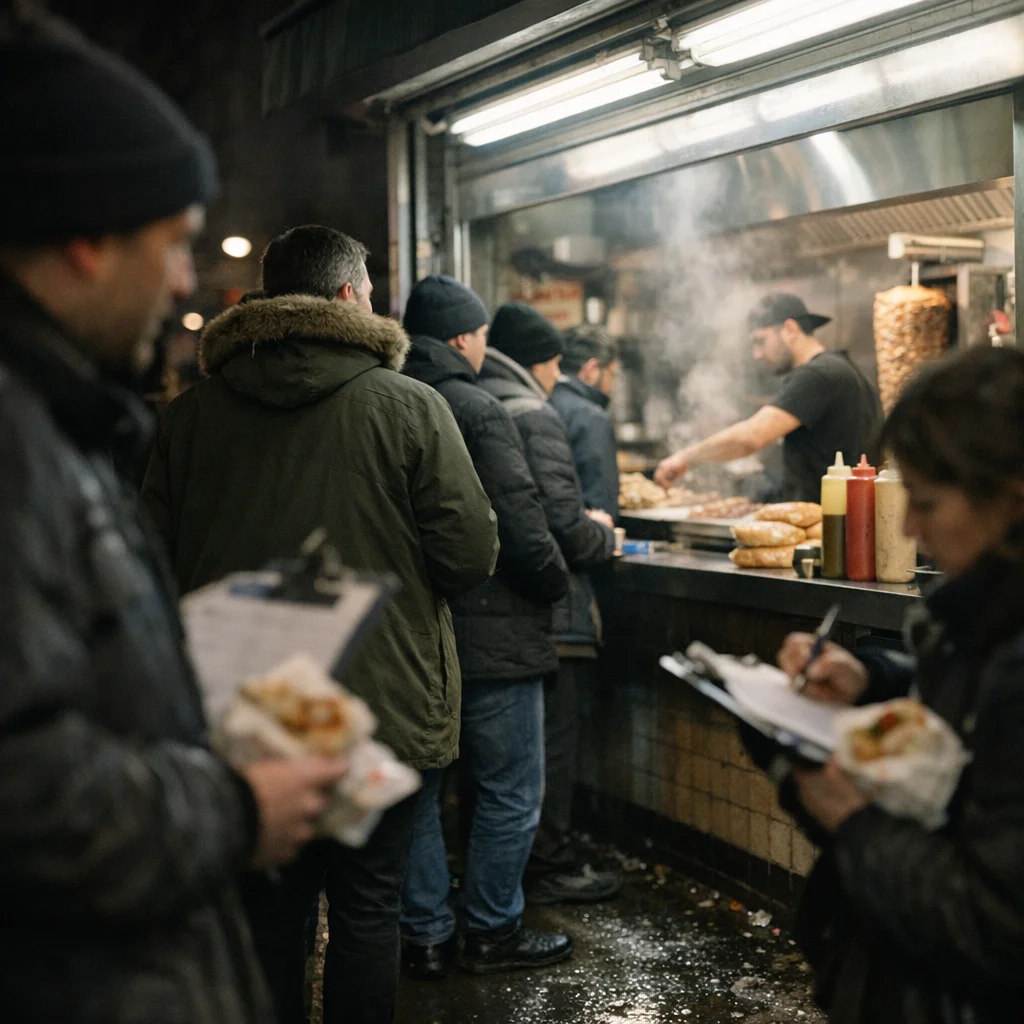
WEDDING — The neighborhood’s most reliable late-night institution—arguing about where to get the best döner—has been upgraded into what participants now call “a community ranking process,” a phrase that has all the romance of a parking ticket.
It began in the evening when a group of residents and newcomers gathered outside a busy kebab counter near Leopoldplatz, allegedly to settle a long-running dispute. By the time the first orders were called, the debate had acquired clipboards, color-coded scorecards, and the kind of smug certainty usually reserved for people explaining their composting system at a dinner party.
“Look, we’re not being elitist,” said Jasper Vonn, 29, who described himself as “döner-curious” and produced a laminated rubric titled Mouthfeel / Structural Integrity / Post-Bite Regret. “We’re just trying to be consistent. If the bread collapses, that’s a consent issue between thumb and sauce.”
Longtime residents, meanwhile, watched the scoring with the calm patience of people who have survived three decades of fashion cycles and one thousand earnest reinventions. “My uncle didn’t need a spreadsheet to know if it was good,” said Aylin Demir, a nearby shop worker who said she buys from whichever place is fastest when she’s starving. “They’re grading garlic like it’s a thesis defense. Everybody wants a firm grip on ‘standards,’ but nobody can hold eye contact when the line gets tight.”
The overlooked detail was logistical: the ranking crowd kept ordering “just one more” for comparison, forcing the kitchen into a loop of test portions and performative dissatisfaction. Workers began calling out numbers with the weary cadence of Greek tragedy.
A spokesperson for the district office, reached by phone, said they had “no mandate to regulate kebab discourse,” adding that public order concerns arise “only when arguments migrate from taste to territorial entitlement.” Police confirmed they were not responding, citing “insufficient evidence of a real emergency,” though one officer privately admitted the scene had “mounting pressure” and “a strong smell of opinions.”
As the night thinned out, the self-appointed judges announced a provisional top three—then immediately abandoned it when someone posted a new list in a group chat, like Plato discovering the cave had Wi‑Fi.
By early morning, the scorecards were greasy, the conclusions were reversible, and the only concrete outcome was a queue that moved slower the more people claimed to be “optimizing” it. Organizers said the final rankings would be released “soon,” pending another round of late-night fieldwork—and someone, somewhere, finally learning to eat without auditioning their personality.