Ketamine Test Strips Now Sold Between Energy Drinks and Cigarettes at Müllerstraße Späti
A Wedding corner shop quietly added harm‑reduction services this week; residents praise the practicality, officials squirm at the paperwork.
By Omar Felton
Kiez Features Reporter
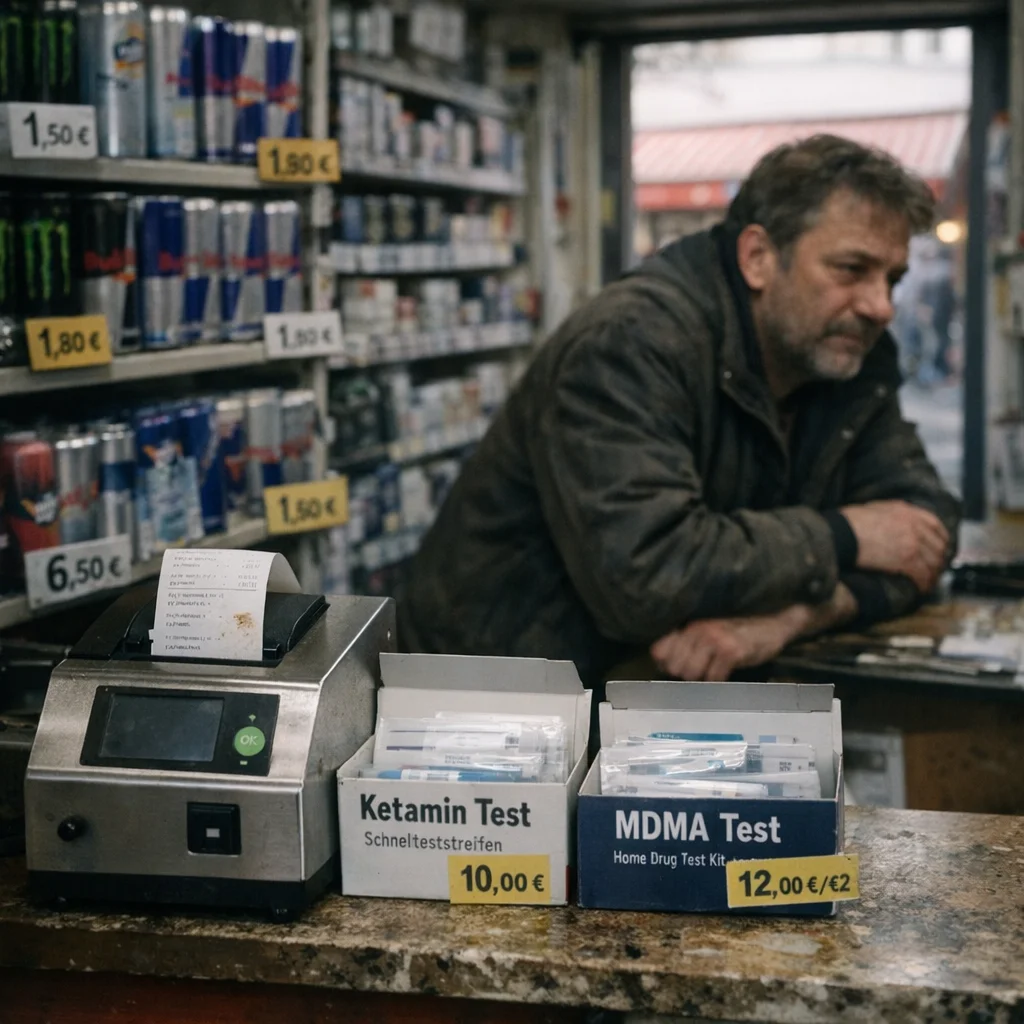
On Tuesday, sometime before noon, customers at Späti Kadar, Müllerstraße 137, noticed a stainless‑steel box sitting next to the cash register: a compact analyzer and a display of ketamine and MDMA test strips, priced in euro cents between canned energy drinks and a shelf of cigarette packs.
"People kept asking for it," said Ali Kadar, 42, who opened the shop in 2011 and whose family runs the nearby bakery. "We sell cold coffee, smokes, SIM cards—and now we sell certainty. It's less drama than a phone call to a clinic." Kadar said the shop had sold 74 strips in the first two days and that foot traffic rose by roughly 60 percent.
Neighbors reacted with the peculiar diplomacy Wedding excels at: annoyance softening into pragmatic acceptance. "My granddaughter told me not to be silly and to smell the paper," said Ayşe Yılmaz, 68, who lives above the shop. "Then she bought a strip and left me with the receipt. It smells of sesame from next door."
The receipt smell is not metaphor. Staff at the adjacent Turkish bakery, Özlem Bäckerei on Reinickendorfer Straße 22, discovered their thermal paper rolls had been swapped with those for the analyzer; every test now prints on paper that faintly smells of simit.
Public health officials described the move as predictable and administratively awkward. "Harm reduction is part of our strategy," said Dr. Lena Vogt, a spokeswoman for the Mitte‑Wedding Gesundheitsamt, "but a retailer offering on‑the‑spot analysis raises questions about certification, waste disposal, and data handling. We're penetrating the bureaucracy to get answers." Vogt confirmed an inspection scheduled for Friday.
Police officials said they had received "courtesy reports" but no criminal complaints. "If someone offers a machine that keeps people from ingesting dangerous adulterants, that's something municipalities should grapple with, not criminalize," said Officer Thomas Reuter, adding with a sigh, "but we might need clearer rules." His tone suggested both relief and the difficulty of getting one.
The Späti's customers are a cross‑section of Wedding's contradictions: a burly Turkish delivery driver buying cigarettes and a test strip in the same hand; a woman in a second‑hand blazer asking where the nearest co‑working space is; a man who hikes at night and pays cash for certainty.
For some, the scene reads like Walter Benjamin's arcades: small capital, sensory detail, survival strategies packaged as convenience. For others it is simply a small shop adapting to its market. Either way, Kadar's register rings and the paperwork begins—an efficient, uncomfortable little climax of civic improvisation.
"We are not a clinic," Kadar said. "We do what we can. People want to come in, get something tested, and go on with the rest of their lives. That seems…reasonable."