Landlords Want ‘Community’; They Mean Your Deposit
A fresh Berlin pitch for “mixed-use” living lets owners cosplay as urban caretakers while squeezing tenants with pop-up rules, volunteer charm, and rent hikes dressed as sustainability.
By Otto Spooner
Gentrification Investigator
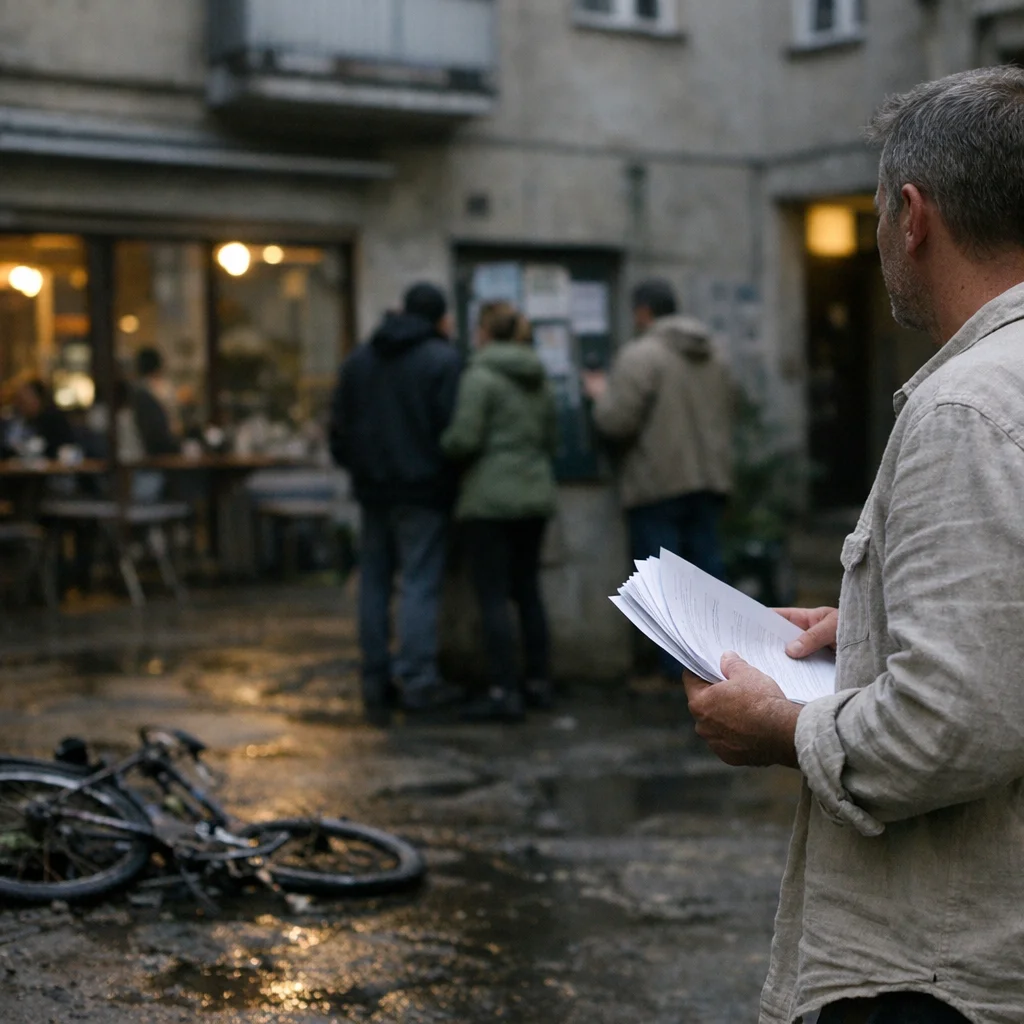
The Commons, Courtesy of the Rent Increase
In Wedding, the favorite business model is not housing. It is moral blackmail with plants in the lobby.
The building on the corner came dressed in the usual costume: mixed-use, community-minded, neighborhood-friendly, all the phrases that sound like a warm hand on your shoulder until you realize the hand is checking whether your wallet is still there. The owners did not call themselves landlords, of course. That would be too honest, too old-world, too close to the smell of cash and damp plaster. They preferred “property stewards,” which is what people say when they want credit for not actively setting the building on fire.
The ground floor hosted a café that sold filter coffee at prices normally associated with apology, a “shared workspace” with three plants, two freelancers, and the emotional temperature of a dentist’s waiting room, and a noticeboard full of words like sustainability, care, and neighborhood dialogue. Nothing says solidarity like a laminated sentence.
Upstairs, the tenants lived in the actual, unglamorous world: the radiator that clicked like a bad conscience, the hallway light that died and stayed dead, the shower drain that made a wet, intimate noise suggesting the pipes had seen too much and were beginning to tell on everybody.
When the kitchen sink backed up, the property manager — a man named Tobias who wore a linen overshirt, a vape like a badge of moral modernity, and the strained expression of someone permanently pretending to be above rent — replied to the repair request with a lesson.
Could the residents please first confirm whether the blockage was caused by “collective usage patterns”? Could they perhaps attend the next house meeting to discuss “shared responsibility”? Could they remember that the building was a “living community” and not merely a service surface to be consumed?
This is the administrative pornography of Berlin development: the owner slides a finger across the tenant’s life, then asks the tenant to apologize for being touched.
At the meeting, the hypocrisy arrived wearing sneakers and a calm smile. A sustainability consultant from Neukölln — expensive haircut, recycled tote, the facial expression of someone always one invoice away from enlightenment — explained that the building needed “better self-regulation.” Translation: less complaint, more unpaid labor. The tenants were encouraged to rotate cleaning duties, monitor noise “for the wellbeing of all,” and submit repair issues through a portal that turned basic decency into a personality test.
One woman asked why the courtyard trash still overflowed every Thursday while the rent had gone up twice in a year.
Tobias blinked with the wounded innocence of a man being accused of theft in a room he had already sold.
He said inflation was difficult for everyone. He said the neighborhood was changing. He said the owners believed in “long-term value.” He said a lot of things that sounded like foreplay for a foreclosure.
And there it was: the entire religious performance in miniature. The people with keys and leverage speaking in the language of care, while the people with actual lives were asked to be patient, flexible, grateful, and hygienic. Community, in this dialect, means you pay on time, smile during the meeting, and do not make a scene when the shower leaks brown water into your shoes.
The tenants were not being invited into a community. They were being trained.
Shared Values, Private Extraction
Berlin’s mixed-use gospel depends on a special kind of fraud: the idea that exploitation becomes kinder if you add some bike racks and a compost bin. Developers love it because it lets them sell austerity as lifestyle. Municipal branding bureaucrats love it because it makes the spreadsheet look like a mural. Property managers love it because “dialogue” is cheaper than maintenance and sounds better than eviction.
So the building gets a monthly neighborhood brunch, a book swap nobody asked for, and a rule about “quiet enjoyment” enforced with the zeal of a failed cult. But ask for a functioning boiler and suddenly everyone is speaking the language of process, assessment, and collective accountability — all the phrases that mean you should stop being needy and wait until the damage becomes architectural.
The cruelty is not loud. That would be vulgar. It is artisanal. It arrives in soft fonts and polite emails. It asks you to co-host your own subordination.
A man in the courtyard said he had once been told, after requesting window repairs, that he should be “part of the solution.” He laughed while saying it, the way people do when they have already paid to be insulted and are trying to make the humiliation sound like a local custom.
That is the whole trick. The landlord class in Wedding no longer wants to appear predatory. It wants to appear pedagogical. It wants to turn the tenant into a collaborator, the complaint into a confession, the rent hike into a shared journey. It wants you to call the extraction a process so that nobody has to say the ugly word out loud.
Meanwhile the building continues to smell faintly of wet plaster, stale coffee, and the kind of community that only survives when someone else is footing the bill.
Repair Request as Moral Theater
By the end of the meeting, the sink still did not work.
But the tenants had been given something more valuable, apparently: an opportunity to reflect. To self-manage. To understand the building as a collective body, which is a lovely idea until you notice that one side gets to be the mouth and the other side gets to be the anus.
Outside, Wedding carried on with its usual indifference. Kids chased a ball near the curb. Somebody dragged a crate of empties past the entrance. A delivery rider cursed softly at a locked gate. Life, in other words, continued doing what the branding materials never can: getting dirty, getting expensive, and refusing to be inspirational.
The owners will keep calling this community as long as it helps them extract one more euro, one more hour of unpaid labor, one more layer of compliance. That is the neighborhood’s real shared value: the rich get a vibe, and everyone else gets the bill.