Leopoldplatz Panel Turns into a Live Rehearsal for Saying Nothing
After US testimony captured headlines, a Wedding hearing found itself outmaneuvered by silence.
By Clara Brook
Imported Outrage & Kiez Satirist
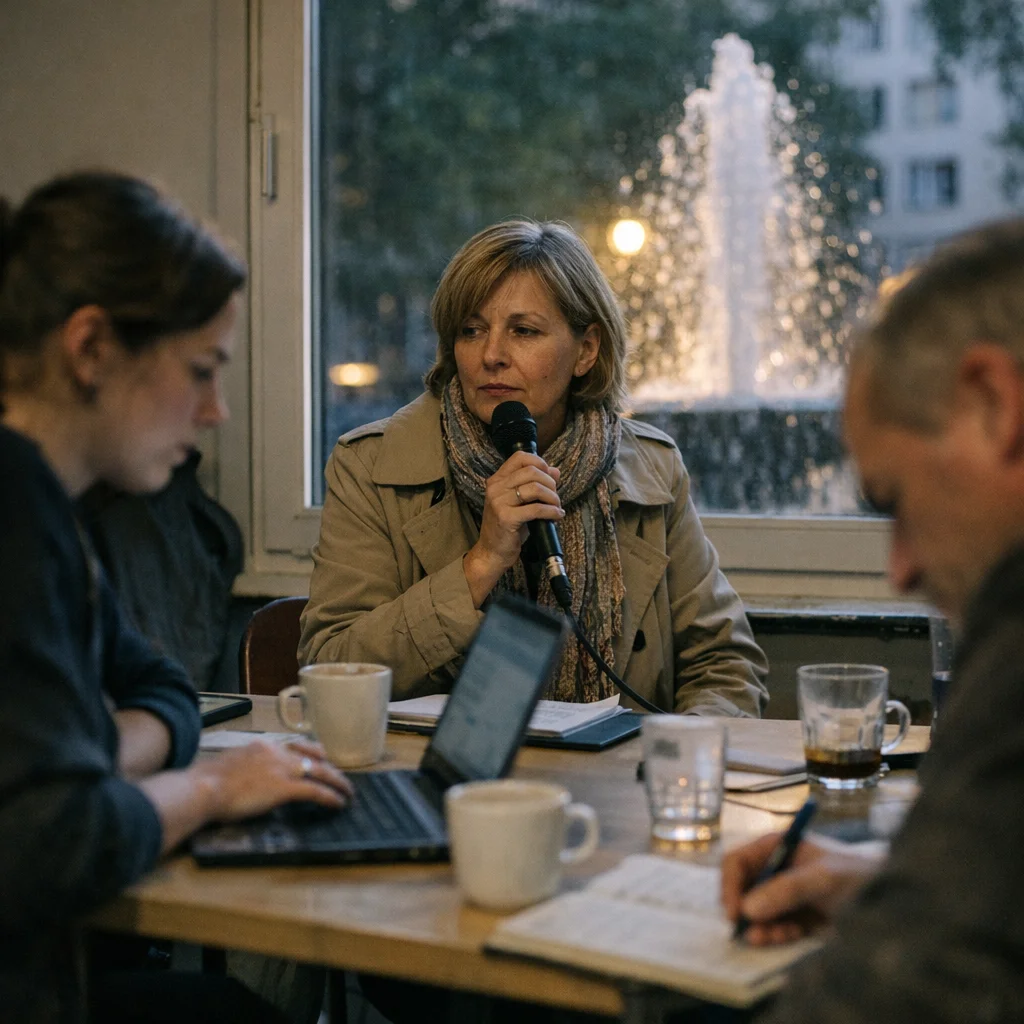
On Tuesday evening, while Americans debated whether a public testimony had been useful or merely theatrical, a modest community panel at the Kulturzentrum near Leopoldplatz staged its own Berlin‑scale reprise.
The meeting was supposed to be about a bafflingly generous donor who has been underwriting local cultural nights and private “listening sessions.” Instead, the invited guest — an elegant woman introduced as a “patron of the arts” who spends more time in private jets than on public disclosure forms — repeatedly declined to answer specifics. She offered long paragraphs about the importance of art, then shorter paragraphs about confidentiality. Eventually she adopted a posture familiar to anyone who’s watched parliamentary theatre: silence as strategy.
This was not merely evasive behavior; it was performed with the courtesy of a person who has rehearsed silence as a skill. Neighbors took notes; a well‑meaning activist attempted to press for donor names and travel logs; the woman smiled and supplied statements in the soft register reserved for bad news and cream‑filled pastries. The committee chairman blinked, smiled back, and moved on to the next agenda item.
Then something peculiar happened that made the room look less like a hearing and more like Beckett directing a municipal meeting. The Leopoldplatz fountain outside the window — an unremarkable, municipal feature known to cough at colder temperatures — began to repeat the woman’s nonanswers in a low, wet echo. Every time she said, “I cannot comment,” the fountain would burble the same phrase back, as if municipal infrastructure had finally learned to footnote evasions.
People started transcribing the fountain. A volunteer typed the echoes into a shared doc; a local journalist joked that Michel Foucault would have loved the panopticon if it came with better acoustics. The scene felt like Waiting for Godot with better lighting: everyone was waiting for accountability to arrive, and instead they received a municipal echo and a promise of a press release.
The takeaway — if there must be one — is that secrecy travels well. It crosses oceans, mutates into politeness, and settles into neighborhood meetings. Here in Wedding, silence can be polite, performative, and oddly photogenic. The donor’s ledger remains hidden, the fountain keeps its new hobby of recitation, and the committee will reconvene next month with pastries and another line of gentle questions that end exactly where the answers do: somewhere behind a closed door, neatly tucked away.
It was, in other words, a satisfying resolution for everyone who appreciates a good curtain call.