Long-Distance Lovebirds Could Decide Israel’s Vote
Thousands of Israelis living in the U.S. are flying back to cast ballots, turning patriotism into an expensive loyalty trip and letting home-country parties court voters who left the bill behind.
Moral Contradictions & Night-After Reporting
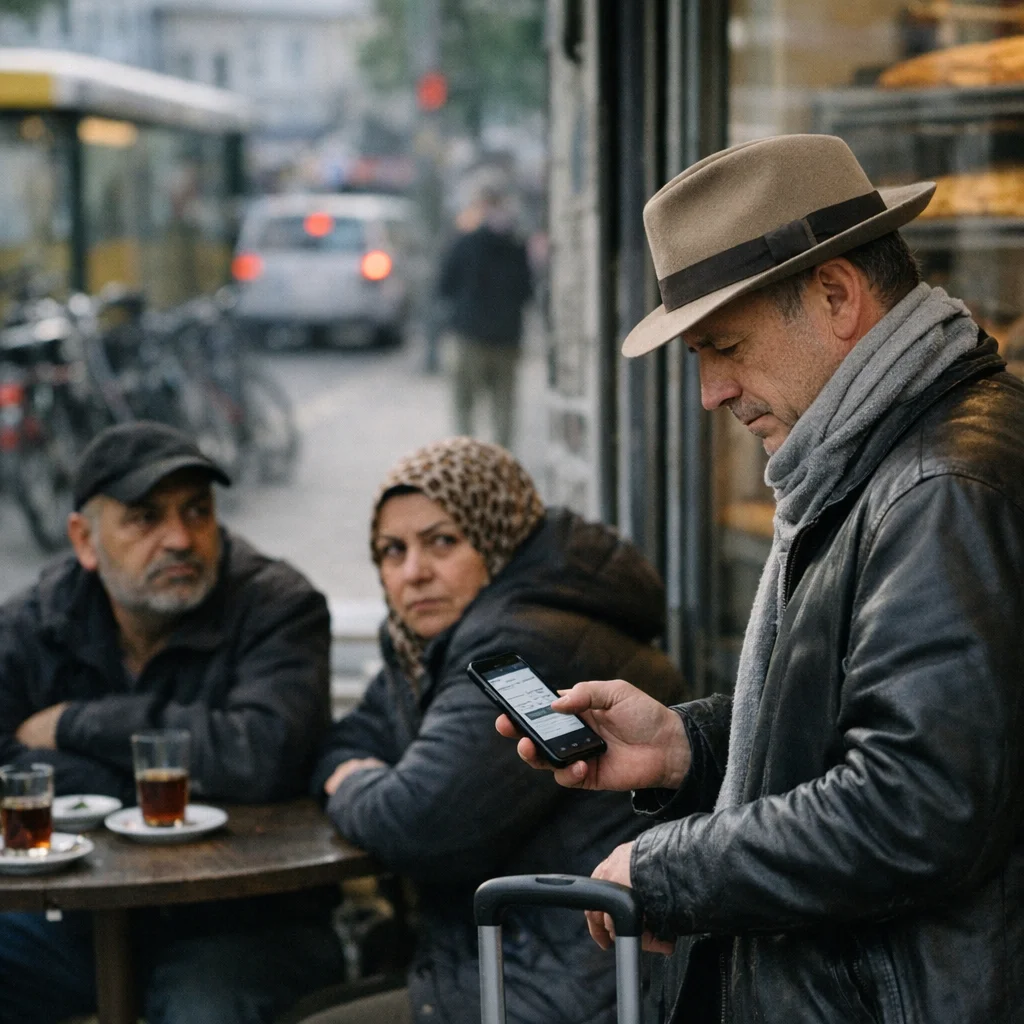
Berlin’s expatriate cousins keep the national tab open
The election fuss around Israelis flying back from the United States to vote is playing out in Berlin with the same oily choreography as every long-distance arrangement that survives on denial: someone leaves, someone stays, and both sides keep pretending the arrangement is still mutual because neither wants to admit who is paying for the pleasure. In Wedding, where every second café seems to be run by a man in a black turtleneck who says he “just came for six months” and is now on year three of borrowing local patience like it was free rent, the whole thing lands with a feral kind of clarity.
At a Turkish bakery on Müllerstraße, one customer in a linen jacket said he was “basically checking whether the home side still deserves access,” which is the sort of sentence only people with return tickets and expensive opinions can say out loud without immediately choking on their own self-regard. He spoke the way people do when they think distance makes them arbiters instead of absences. Behind him, two longtime residents laughed so hard they nearly dropped their coffee. One of them, Aysel Demir, who has lived in Wedding since the 1990s, said the visiting-voter ritual felt less like citizenship than a late-night text from an ex who moved away, got richer, and now wants one more round before disappearing again.
“They leave for better money and cleaner air, then come back to test everybody’s commitment like they’re doing a favor,” Demir said. “That is not loyalty. That is a power play with a boarding pass.”
The real institutional talent here belongs to the party operatives courting these voters. They are not building a political relationship so much as staging a national seduction on expense account fumes. First comes the flattering message: you still matter, your feelings still count, your accent still belongs to the nation. Then comes the guilt: if you really loved us, you’d get on the plane, stand in line, and prove it. By the time the ballot is handed over, the campaign has done what every manipulative lover does best — turned access into a test and obligation into foreplay.
That is why the whole performance feels less like democracy than a country trying to keep a partner from wandering off after the money is spent. The homeland wants to be intimate enough to govern and distant enough to avoid the inconvenience of being lived in. It wants voters abroad to remain emotionally available, financially sterile, and politically clean, like a lover who only shows up when the room is already made up and the dishes are already washed.
Berlin’s party people, expats, and political hobbyists recognized themselves immediately because the city is full of people who worship distance until it stops flattering them. They call it perspective when they are gone, then call it responsibility when they return to judge the mess. The moral posture is always immaculate. The bill, naturally, belongs to somebody else. In Wedding, that usually means the people who have been here through rent hikes, closures, and the slow conversion of ordinary streets into lifestyle theater for adults who still say “authentic” with a straight face.
A representative for a local migrant association in Wedding said the spectacle was familiar: the people most eager to talk about belonging are often the least willing to endure the daily friction of it. “They want the right to be desired without being depended on,” he said, requesting anonymity because he had already been invited to three panel discussions on inclusion and was refusing the fourth out of self-defense.
Israeli campaign volunteers, meanwhile, are reportedly treating U.S.-based voters like difficult lovers with family obligations: lots of flattering messages, a little guilt, and the hope that nostalgia will still do the heavy lifting once the plane lands. The pitch is all tenderness on the surface and leverage underneath. Come home for us. Prove you still belong. Let us use your loyalty once more, and then you can fly back to your separate life before the consequences start touching your shoes.
In Berlin, where emotional distance is practically a municipal language, that tactic is easy to recognize. Everyone wants to be missed. Nobody wants to be needed. And the ones who left first are always the most eager to define what devotion looks like from a safer zip code.
For local Israelis in the city, the election has become a small public theater of discomfort. Some are booking flights, others are posting long explanations about why they are not booking flights, and a few are practicing the old Berlin art of sounding politically serious while remaining permanently uncommitted to the room they’re standing in. The ballots may be cast elsewhere, but the performance of virtue is right here in the neighborhood, under fluorescent bakery lights and above the last decent döner places that haven’t yet been repackaged for people who confuse “community” with an entry-level branding exercise.
The tickets are bought, the speeches are polished, and the homecoming is already wearing perfume. Whether the voters arrive out of love, guilt, or the vanity of being wanted again, the arrangement ends the same way it always does: somebody gets used, somebody gets blamed, and the people who left last still want credit for how hard everyone else had to hold on.