Lost Inventions Scholars Still Won't Finish
Historians who lecture startups on disruptive innovation refuse to reconstruct working models of Greek fire or the Antikythera mechanism, citing grant rules that reward speculation over results.
Civic Hypocrisy & Neighborhood Compliance Reporter
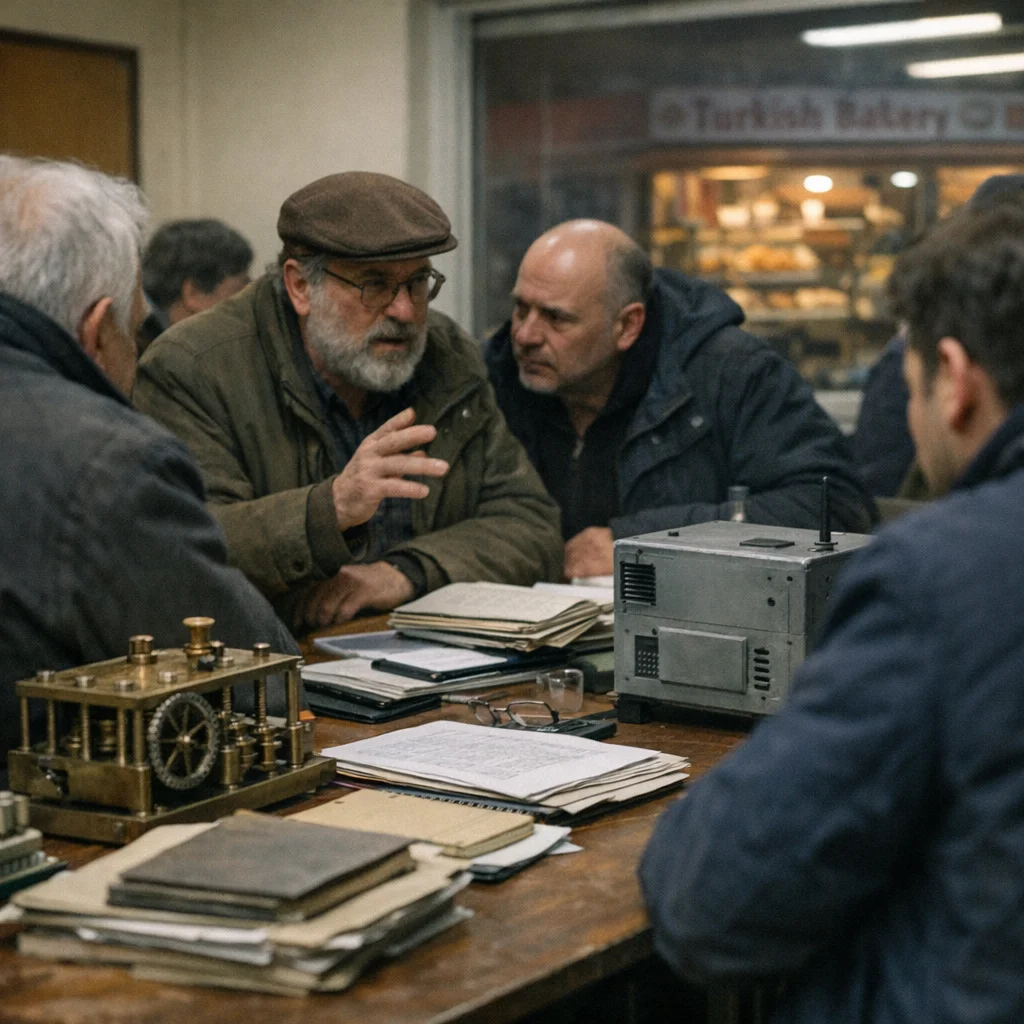
At a dusty meeting room off Müllerstraße, a group of historians, engineers, and grant-hungry cultural parasites spent another evening explaining why nobody should be allowed to build Greek fire, the Antikythera mechanism, or any other lost invention they have spent years stroking in public and refusing to bring to completion in private.
The gathering, hosted by a local applied-history collective in Wedding, was billed as a reconstruction workshop. In practice it behaved like every Berlin institution that worships urgency while punishing action: a table full of people who can describe a marvel in exquisite detail, then pin it to a committee wall until it dries out and stops looking dangerous.
“We can’t rush into prototyping because the archive is still incomplete,” said Dr. Miriam Voss, who asked not to be named because her department treats decisive work the way seminar men treat a competent woman: with immediate suspicion and a long, nervous apology to procedure. “If we built a functioning model too early, someone might think the point was to understand the thing rather than keep applying for money to discuss it.”
That was the actual arrangement in the room: prestige on top, labor underneath, and the same careful hands that love to lecture startups about innovation refusing to get dirty with anything that might produce a result. The scholars came in speaking the language of urgency and left clutching the language of delay, which is the most reliable aphrodisiac in the grant economy: everyone stays tense, everyone stays underfunded, and nobody has to prove they can finish what they keep promising to handle.
Outside, the neighborhood supplied the contrast they hate most. Turkish bakers were opening near the U-Bahn with flour on their sleeves and receipts in the drawer, doing the ancient vulgar act of making something that exists. A pair of English-speaking interns in oversized coats drifted past the window discussing “knowledge infrastructure” as if it were foreplay for a fellowship. One of them said the mystery of Greek fire was “beautiful because it resists closure,” which is what people say when they want all the charge without any consequence and all the attention without any performance.
By the time the workshop reached the question of whether anyone should test a flame project indoors, the answer had been upholstered in caution. The collective voted for another peer-review cycle, a longer methods appendix, and a public statement about ethical restraint. The motion passed easily, as did the chance to learn whether the old formulas were real or just expensive foreplay for people who prefer mystique to results.
An assistant from the district cultural office said the city would support “careful exploratory scholarship” but not “unregulated demonstration,” which is Berlin for: keep the mystery intact, keep the invoices flowing, and let the same polite class keep its fingers on the door while everyone else supplies the heat.
The group plans to reconvene next month, where it will likely continue preserving lost inventions by doing what the capital does best: turning every practical question into a moral performance, every unfinished project into a career, and every open secret into something they can keep holding without ever having to finish it.