Lost Property Gives Everybody Moral Authority
A Wedding neighborhood office has discovered that the easiest way to look civic-minded is to become the priesthood of other people’s umbrellas, headphones, and shame.
Civic Hypocrisy & Neighborhood Compliance Reporter
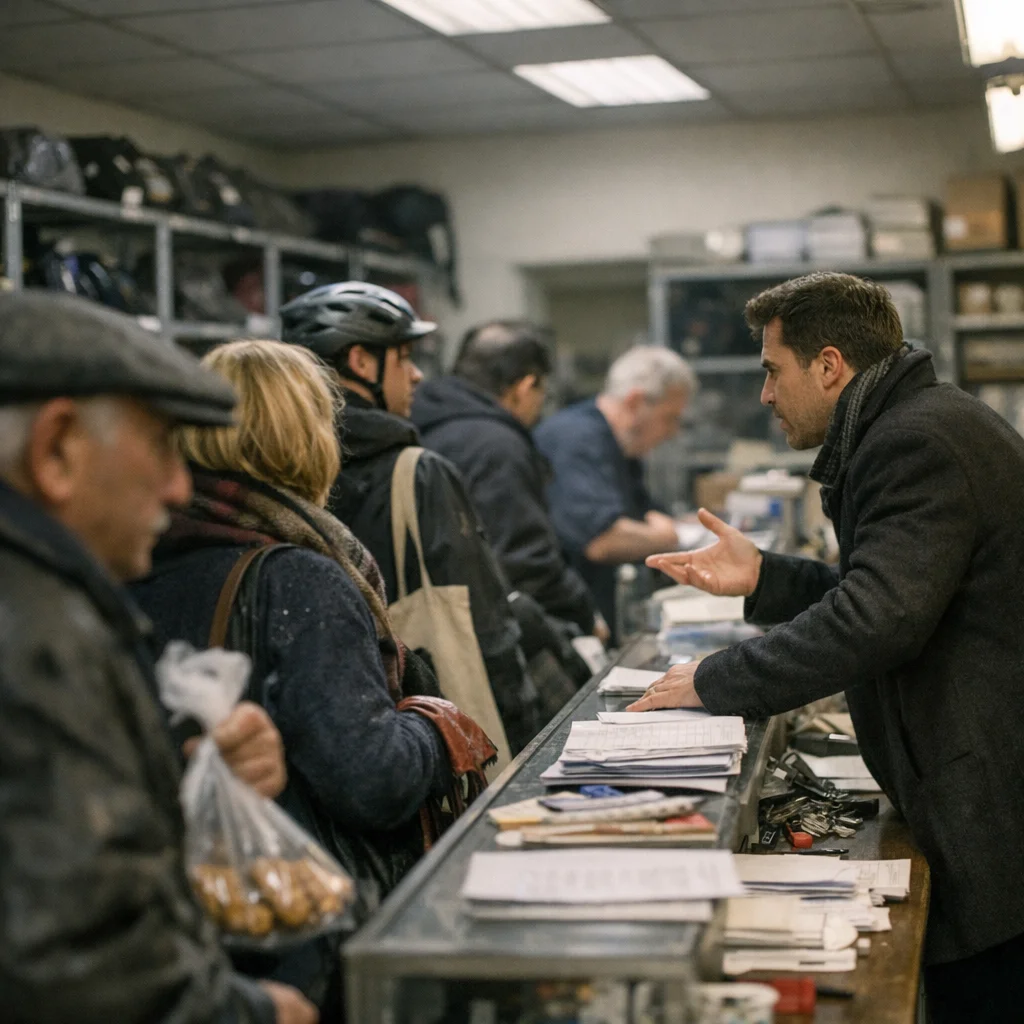
Missing, damp, and everyone suddenly deserves a podium
By noon, the lost-and-found counter in Wedding had already split the room into three factions: the people who think a wet umbrella is a civic emergency, the people who think it is a human right, and the people who arrive wearing expensive coats with that damp, freshly washed look of someone who has confused conscience with laundry. The neighborhood office on Müllerstraße has not solved anything, which is why it runs so smoothly. It is a little altar to administrative failure, and the staff know exactly how to preside over it: with fluorescent patience, dead coffee breath, and the calm pleasure of being the only adults allowed to decide whose misery counts.
The office is not merely processing lost property. It is distributing symbolic access to dignity, one grim little item at a time. Every reclaimed scarf is a referendum on class. Every missing headphone is a chance for someone to kneel theatrically before procedure and call it citizenship. The clerks, bless them, do not interrupt this performance because they are not there to stop the theater. They are there to sell tickets in exchange for a signature.
The first claimant, a woman from a newly renovated flat near Seestraße, demanded a “formal process” for her missing tote bag, as if the bag contained not receipts and lipstick but a constitutional injury. She had the polished, self-lacerating tone of the renovated-flat liberal: furious about inequality, thrilled by the acoustics of her own outrage, and dressed like someone who had paid extra to look morally available. She kept using the word “community” the way developers use the word “sustainable,” which is to say as a decorative lie attached to rent.
Ten minutes later, a Turkish grandfather arrived with a plastic bag full of pastries and the exhausted dignity of a man who has already been groped by inflation, bureaucracy, and every polished fool who mistakes humility for backwardness. He wanted an umbrella and, more urgently, a clerk who would not make him feel like an inconvenience with legs. He stood there in his ordinary jacket, smelling faintly of rain, sugar, and the long memory of being underestimated. He did not ask for sympathy. He had the better manners.
Then came the performatively anti-capitalist tenant: linen shirt, bicycle helmet clipped to the bag, the kind of person who says “I don’t care about possessions” only after checking whether everyone saw him say it. He was missing a pair of headphones and arrived with the pained expression of a man whose political identity had been interrupted by a trivial object. He wanted the office to understand that this was not about hardware. It was about late-stage capitalism, municipal neglect, and his personal suffering, which he delivered with the moist, intimate urgency of someone trying to turn a mild inconvenience into a public seduction.
By midafternoon, the clerks were performing sympathy with the exhausted competence of people who have read too much civic theory and still end up stapling forms. Their faces had that pale, fluorescent tautness that comes from standing between the public and its own self-regard all day. They do not merely hear complaints; they curate them. They know which claimant wants help, which one wants a witness, and which one wants to be seen losing something in a tasteful way. That is their real authority: not the power to return objects, but the power to decide whose need will be dignified as a problem and whose will be treated as background noise.
One municipal clerk, smug in the way only a person with a lanyard and a budget line can be smug, explained the process with a tiny smile that suggested the office had discovered the perfect civic anesthetic: delay. “People come in convinced their missing item proves something about the city,” she said, with the serene boredom of someone who enjoys being the judge in disputes that began with a scarf and end in social humiliation. “It usually does. Just not what they think.”
That is the local alchemy. The disappeared object is only the opening act. The real performance is the claimant, who wants to be seen as wronged, tasteful, and morally superior to the queue beside them. The right-wing pensioner blames immigrants for the nation’s lost order, as if a missing glove were evidence in a civilizational collapse and not just proof that he forgot the tram. The left-wing tenant blames capitalism for his missing bicycle light and expects applause for discovering that the system is cruel after using its infrastructure to arrive on time. Both leave with the same glossy resentment, each convinced they have suffered in a uniquely principled way. Berlin adores this. It lets everyone feel persecuted and interesting at once.
The office staff, for their part, enjoy the arrangement more than they admit. They are the priests of minor loss, and priests are never happier than when the congregation arrives already guilty. A lost umbrella gives them the power to weigh your manners, your clothes, your tone, your political vocabulary, your dampness, your entire flimsy claim to adulthood. The city calls this administration. In practice it is a controlled humiliation ritual with a stamp.
One man in a linen jacket insisted his headphones had been “taken,” then softened immediately when told they were found behind a radiator and smelled like cheap beer and panic. He accepted them with the wounded dignity of someone retrieving a private vice from public exposure. For a second, he looked less like a citizen than a man caught undressing in a mirror he had not paid for.
The office says it will keep the counter open longer on Thursdays, which is administrative language for admitting that Wedding will keep producing lost property and even more impressive excuses to feel superior. The scarves remain damp. The umbrellas remain symbolic. The clerks remain beautifully unbothered. And the neighborhood continues, as ever, to turn every forgotten object into a tiny public trial in which everybody gets to pretend they are the victim, the jury, and the only one in the room with clean hands.