Müllerstraße’s Amateur Dealer Co‑Op Pivots to Berghain-Style Management, Immediately Gets Shut Down by Its Own Internal Process
In Wedding, an overly organized street market for party supplies collapses under committees, minute-taking, and a moral philosophy dispute about profit margins versus “the collective.”.
Cash Economy & Respectability Reporter
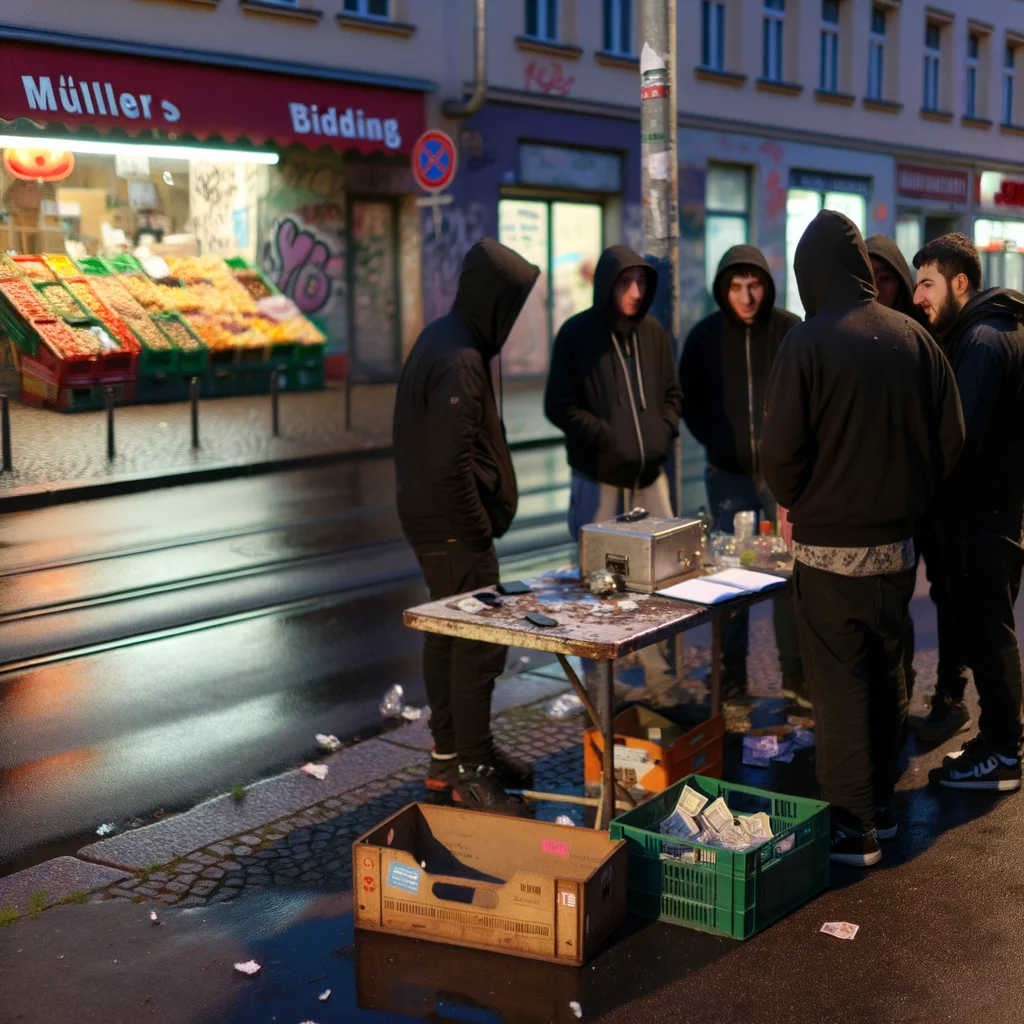
A very Berlin business model: decentralize everything, then worship a gatekeeper
Wedding residents this week briefly proved that “German efficiency” exists—it just hides in places the city swears it’s fighting.
A rotating group of self-employed night optimists (mostly in black, mostly dehydrated, mostly convinced it’s still Sunday) attempted to establish an “Amateur Dealer Co‑Op” near Müllerstraße: a tidy little system designed to reduce confusion, shorten awkward small talk, and ensure everyone gets exactly what they thinks they need before their “one drink” becomes a four-day anthropology project.
And then—because this is Berlin—it evolved into what insiders are calling “Berghain-style management.” Not the music. Not the room. Just the idea that all outcomes should be determined by one tired person with authority, eye contact, and the ability to say no without blinking.
The new governance structure: more meetings, fewer results, stronger smell
According to participants, the co‑op launched with three roles:
- Greeter: explains options like it’s a tasting menu
- Runner: fetches “inventory” with the grim focus of a DHL driver on their final warning
- Treasurer: holds the cash box with the sort of trembling responsibility usually reserved for a newborn
It worked for roughly 14 minutes—until someone demanded transparency, another demanded privacy, and a third demanded a “values-aligned framework that penetrates the harm cycle.”
Then came the internal audit.
The group began issuing badges (handmade, naturally), writing guidelines (nonbinding, naturally), and enforcing a “door policy” based on:
- footwear
- cheekbone geometry
- whether your outfit suggests you own a scanner
Members insisted it wasn’t exclusion—it was curation, like a contemporary museum deciding which works to display, except the museum was a street corner and the “collection” made everybody suddenly very philosophical.
A Turkish grocery store gets dragged into enlightenment
A nearby Turkish-run grocery—an actual functioning institution, still stubbornly living in real time—became an unwilling backdrop.
One worker, stacking fruit with the calm precision of someone who’s seen 40 types of Berlin nonsense, summarized the situation: “They’ve created a whole economy, and they’re still asking permission to touch the money.”
Shoppers described watching co‑op members ask each other, with intense sincerity, whether it was “consensual” for one person to count bills alone, and if that constituted “extractive behavior.”
An elderly local reportedly muttered something that sounded like Adorno in sweatpants: the culture industry has finally monetized hesitation.
It ended exactly how it deserved to end
The collapse came during what participants called a “deep dive into accountability” (hard to swallow, for everyone). The Runner alleged that the Treasurer was “holding power too close to the body,” while the Greeter was accused of “performative friendliness with predatory customer acquisition undertones.”
Finally, someone proposed the ultimate Berlin solution: a working group to determine whether a working group was necessary.
By the time the agenda reached Item 7 (“Can we rotate trust?”), two people had drifted away toward a nearby all-weekender, three had declared a boundaries break, and the cash box disappeared—either stolen, redistributed, or conceptually dissolved.
A philosopher’s postscript written on the back of a cigarette pack
Watching it unravel felt like a micro-staged rerun of Wittgenstein’s language games: everyone technically speaking, nobody meaning the same thing, and truth trapped somewhere between grammar and jaw tension.
Wedding remains undefeated: a place where illicit commerce can run like Swiss clockwork, until somebody tries to make it fair. Then it turns into a public seminar, with less seating and more sniffles.
Local authorities say they will monitor the situation.
Wedding residents say, with the hollow optimism of the professionally disillusioned, that a second co‑op is already being planned—this time with better security, fewer feelings, and a slightly firmer grip on reality.