Müllerstraße Splits Down the Middle as Old Shops and New Cafés Learn to Squint at Each Other
On a single block in Wedding, a line of Turkish-run grocers and bakeries faces a row of English-named cafés and co-working rooms; the truce is as fragile as a laminated menu.
By Mila Pavlov
Street Life & Gentrification Reporter
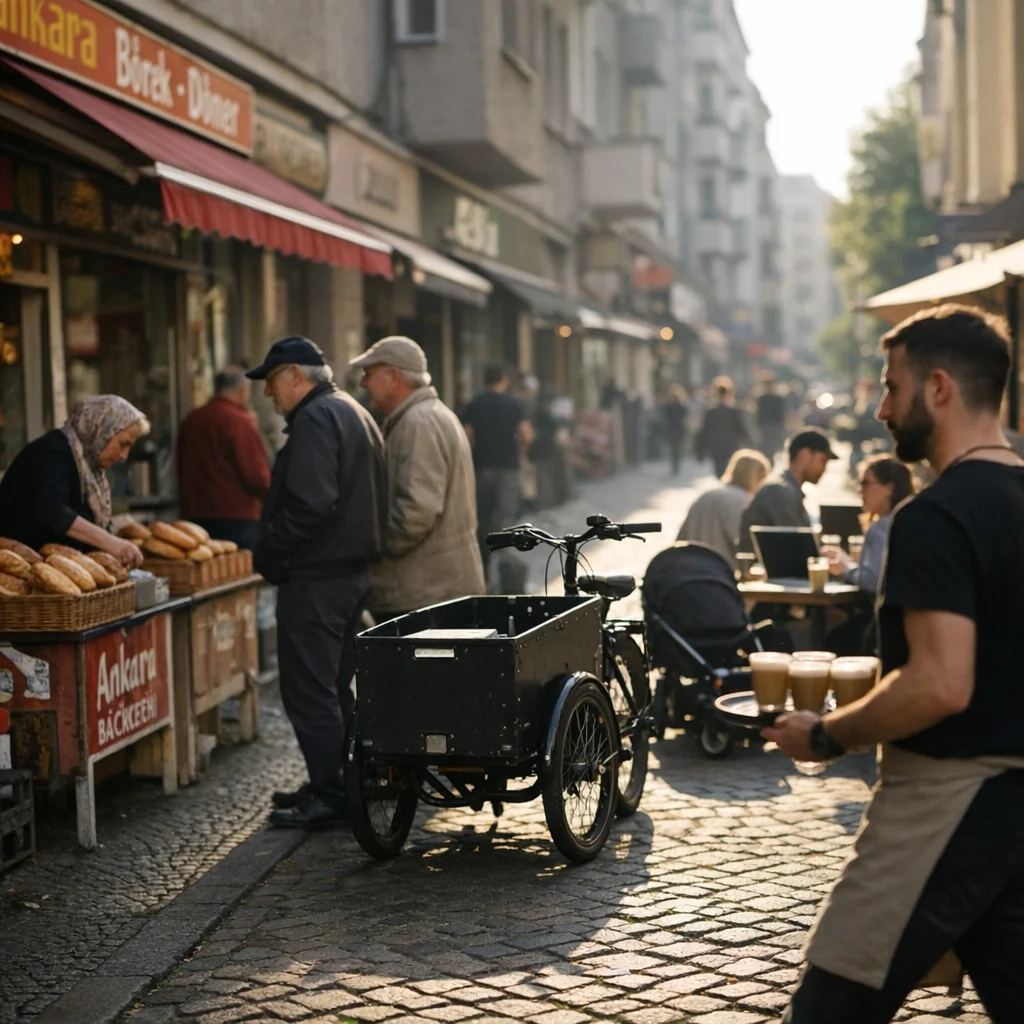
On Tuesday, sometime before noon, people walking Müllerstraße between Osloer Straße and Seestraße noticed that the street felt like a deliberately composed postcard of contradiction.
The even-numbered side — Müllerstraße 48–64 — remains a line of Turkish-owned businesses: Yılmaz Bäckerei (Müllerstraße 48), Erdem Market (52), and Çetin Tezgahtar’s haberdashery (60). On the odd-numbered side, minimalist signage announces Bean & Borscht (Müllerstraße 35), Pour Studio (41), and a co-working room calling itself Werkraum at 37. The two sides stare at each other across a narrow road as if waiting for someone to blink.
“People come for the culture and then buy the building,” said Fatma Yılmaz, 56, who has run Yılmaz Bäckerei for 28 years. “Last month the rent on my shop went up €200. I had to cut two shifts.”
Eli Thompson, 32, who opened Bean & Borscht in 2023, volunteered a sympathetic contradiction. “We curate neighborhood character,” Thompson said around 10:30 a.m. while wiping a poured-over filter. “Also, we had to raise prices because rent is a thing.” Thompson later posted a flyer for an afternoon “community circle” at Werkraum that asked participants to speak only in English.
Data supplied to this paper by the Bezirksamt Mitte — via a press officer who asked to remain anonymous — puts average commercial rents on the block up 62% since 2019. “We see a microcosm here,” said Bezirksstadtrat Martina Gern in an email. “Policy tools exist, but change is slow.”
Absurd rituals have arisen to bridge the difference. On Saturdays at noon, baristas set a single complimentary simit on the curb outside their cafés for any passerby; bakers answer by leaving a sealed oat-milk latte on a café table. The exchange reads like a performance piece: charitable, performative, and ultimately unpaid.
Neighbors complain about consequences more than aesthetics. Mehmet Erdem, 41, owner of Erdem Market at 52, said two long-term tenants were forced to move to Reinickendorf last month. “We are getting into tight spaces,” Erdem said. “Not just the shops. People who raised children here are squeezed out.”
The scene has a literary angle. “It’s a Calvino city,” said Lina Wittstock, a local features reporter, referencing Invisible Cities, “where each street tells two stories and neither pays the bills.” Walter Benjamin’s ruined arcades would recognize the palimpsest: small businesses under glass, big ambitions in small type.
On Monday evening, a tenants’ meeting is scheduled at the Bürgeramt Wedding at 6:00 p.m. Residents hope to establish a shop-rent mediation panel. If that fails, they warn of more transactional civility — polite negotiations with a firm grip on the situation and no appetite for real compromise.
For now, Müllerstraße keeps its divided face. People pass from sesame to espresso as if crossing an invisible border, and the street manages to be both nostalgic and disposable at once.