Marteria Keeps Europe Open for One More Night
At Max-Schmeling-Halle, the sold-out crowd treats nostalgia like foreplay: they want the old continent kissed, shaken, and left gasping before the future can get its clothes back on.
Culture Hangover & Funding Mirage Reporter
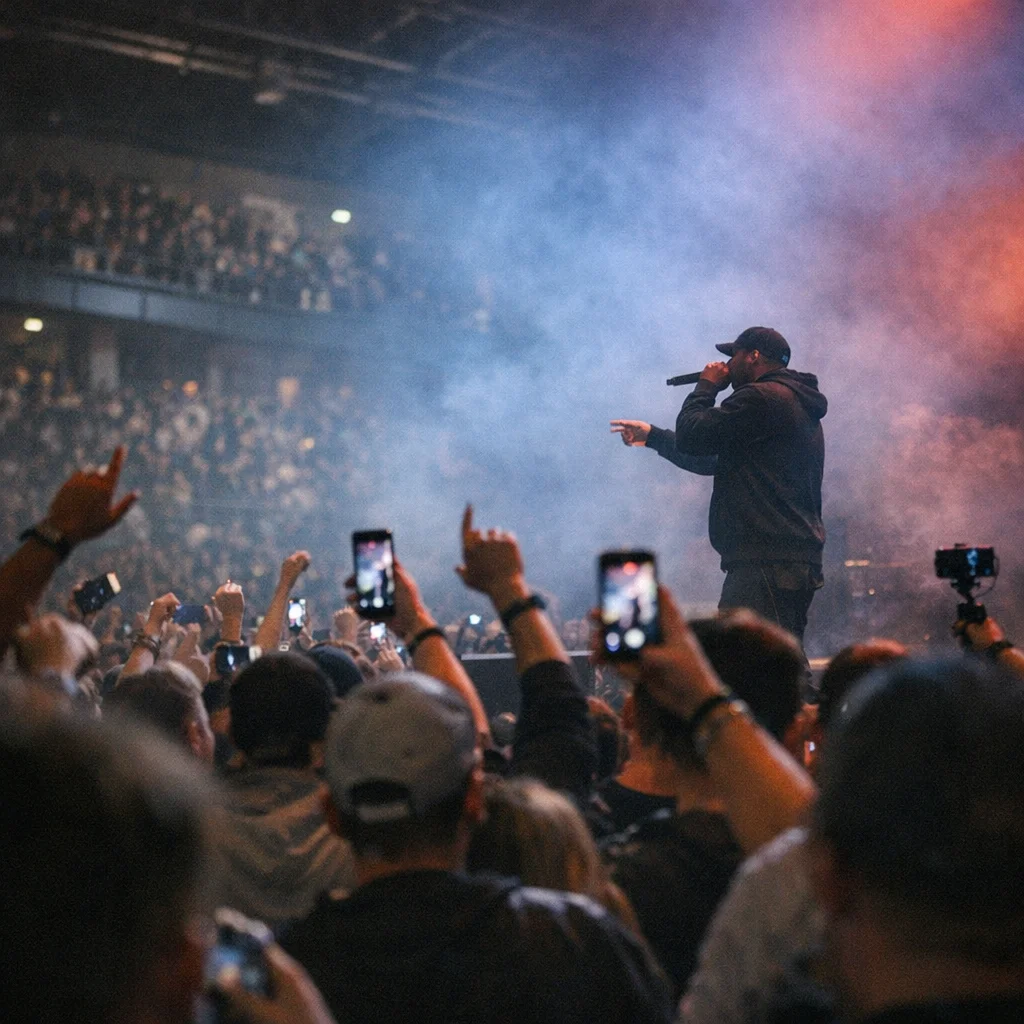
Marteria’s sold-out night at Max-Schmeling-Halle drew a crowd that looked less like concertgoers than a civic compliance board assembled to approve one last night of sanctioned longing. They came dressed in the soft uniform of Berlin’s educated middle class — black coats, clean sneakers, moral fatigue — ready to be handled by a man promising that Europe could still be opened, admired, and left a little wrecked without anyone having to admit they enjoyed the damage.
The hall itself helped. Max-Schmeling-Halle has the polished intimacy of a place that can swallow a thousand people’s regrets and issue them back as merchandise. Beer lines curled like patient alibis. The cloakroom moved with the efficiency of a border crossing. Sponsorship logos glowed above the bar like tiny state secrets. Everyone had paid to be told, with bass, that the old continent still had one more night in it if you knew where to press.
Marteria worked the room like a man offering a final authorized hookup between a tired empire and the audience that keeps insisting it’s beyond all this. He leaned into the mic with the calm of someone who knows the crowd is not there for politics so much as the thrill of being politically seduced by a safer version of collapse. Every chorus felt like a hand on the waistband of Europe’s nostalgia: a little tug, a little tease, then the same old structure standing there pretending it had consented to the whole transaction.
The audience loved the arrangement because it asked nothing vulgar of them except sincerity. That was the real kink in the room: guilt with good lighting. A pair of consultants near the soundboard mouthed the lyrics as if reviewing a risk document. Two women from Friedrichshain leaned into each other and laughed every time Marteria hit a line about the future, the laugh of people who know the future only arrives once the grant ends. In the back, a man in a heritage jacket raised his beer whenever the song drifted toward apocalypse, as if toasting the possibility that ruin might still be branded well enough to sell out another date.
The political material landed hardest because it did not ask to be believed, only desired. That’s Berlin’s favorite arrangement: ideology as foreplay, critique as mood lighting, the whole city pretending to be above the old continent while paying handsomely for one more pass at its body. The crowd took it in the way the city’s cultural class takes every crisis — first as a talking point, then as atmosphere, then as a ticketed event with a tote bag.
A man named Sören Maack, 41, who came over from Wedding with two friends and the expression of someone who had already watched his own generation inherit the mess, said he liked that the show did not try to clean Europe up. “Everybody here wants the same thing,” he said. “A safe way to feel dirty about the past without having to touch the consequences.”
That was the night’s real choreography. Marteria kept promising tomorrow in polished, measured doses, but the room kept pulling him back toward the old, familiar arrangement: the performer giving just enough danger to feel alive, the audience giving just enough remorse to feel innocent, and the venue cashing both sides of the contradiction before midnight. Even the applause had the rhythm of a compromised agreement — enthusiastic, hungry, and slightly ashamed to still be there.
By the end, the crowd was sweating through its own alibi. The chorus came around again like a familiar hand returning to a locked door, and everyone in the hall seemed to understand that this was not about Europe at all, or not only about Europe, but about the people who keep asking the future to wait outside while they get one more turn with the old body in the room.
Outside, the taxis were gone, the smokers had started bargaining with the cold, and the fans drifted off into Prenzlauer Berg and Mitte still humming the refrain as if it had absolved them. It hadn’t. It had only left them with the usual aftereffect: a warm mouth, a bruised conscience, and the certainty that they had once again paid good money to be opened by the thing they claimed to be leaving behind.