Mask Off, Rent Up: The Gallery Opens a ‘Safe’ Room
Wedding’s art crowd has discovered that public virtue looks best under admission fees, donor cocktails, and a security guard who can smell poor people before they enter.
Decadence & Art Abuse Correspondent
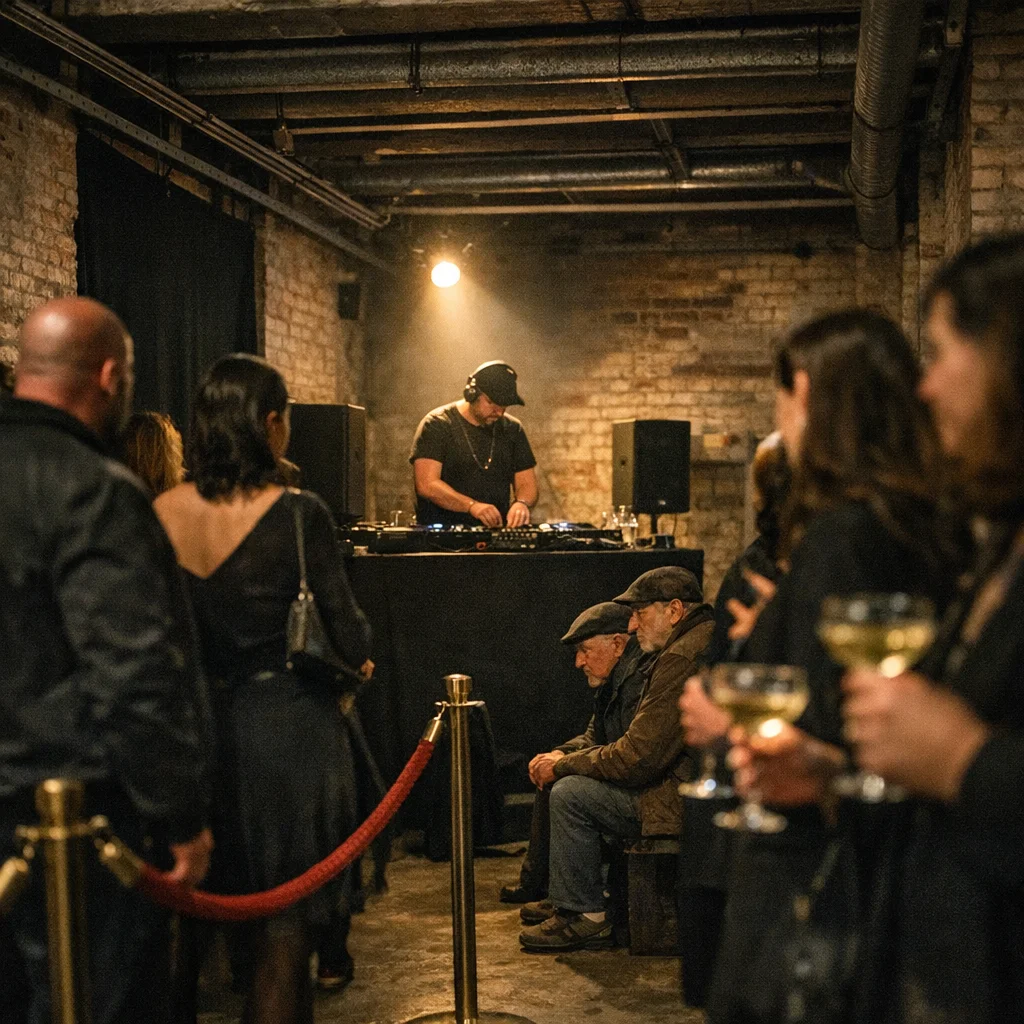
At a converted warehouse in Wedding, Berlin’s self-anointed cultural adults gathered this week for a DJ showcase that promised safety, inclusion, and a fresh moral solvent for everyone too rich to admit they still like being chosen. The room, marketed as a “safe space,” opened with donor cocktails, a panel about “access,” and a door line that could have been lifted from Kafka if Kafka had worked in nightlife and had a private sponsor.
By midnight, the gallery’s downstairs room was full of people in expensive black clothing, the uniform of the modern guilt aristocrat: all soft wool, dead-eyed irony, and a face that says “I oppose hierarchy” while their wristband quietly proves they paid to stand above it. A few longtime residents from the surrounding Turkish-run bars, late-night bakeries, and corner shops drifted in after hearing the bass through the brick. They found a polished installation, a cash bar with activist fonts, and a security guard posted at the entrance like a state secret in a tight shirt.
The guard did not need to speak much. The whole ritual was already written in the posture of the room: the glance at the shoes, the scan of the coat, the slow, lubricated pause before letting someone through as if admission were a favor and not a transaction. You could almost hear the class sorting click into place, one polite humiliation at a time. The gallery had turned access into a foreplay of denial.
“It’s civic culture with a cover charge,” said Deniz Yilmaz, 44, who lives nearby and had come in after closing his family’s shop on Müllerstraße. “They talk about openness like they invented it, then make sure the room stays full of people who can afford to feel guilty in public and call it solidarity.”
The night’s centerpiece was a DJ set announced as “community healing through sound,” which is one of those phrases that sounds radical until you realize it means affluent adults humping their own conscience against a subwoofer while somebody else tallies the receipts. The selector, wearing the solemn expression of a man who has read Adorno on the U8 and mistaken it for a moral credential, spent forty minutes building tension the way landlords build trust: slowly, expensively, and with one hand already on the exit.
Near the bar, a sponsor from a startup dressed as a foundation insisted the project was “about access, not exclusivity.” That may have been true in the same way a leather couch is about democracy: technically present, spiritually absurd, and mostly there to absorb spills from the people on top. The cocktail menu was printed in social-justice fonts; the prices were printed in the old language of veto power. Every glass looked like it had been approved by a committee with a private bathroom.
When asked why the cheapest ticket had sold out first, an organizer speaking on condition of anonymity because she had used the word “inclusive” in three grant applications and was already sweating through the fourth, said the room needed “stability.” In Berlin, stability usually means a velvet rope with better branding, plus a little institutional perfume sprayed over the smell of rent pressure and self-congratulation.
The official reaction was predictably tender. A district cultural office contact said the event showed “important private-sector engagement,” which is civil-service language for “please stop asking us to fund the scene we have already priced out and then advertised as community care.” Public language, grant culture, and private sponsorship all performed the same little ménage à trois: one partner wrote the apology, one wrote the invoice, and the neighborhood paid for the bed.
By the end of the night, the guest list had swollen, the moral poses had stiffened, and the bass had settled into that smug, rectilinear pulse favored by people who think Foucault was chiefly about guest management. The gallery’s next event is already advertised, and residents say they are bracing for more inclusion they cannot afford, more openness with a knife hidden in its blazer, and more cultural tenderness administered by people who would faint if they had to share a room without filters.