Megaphone on Legs Demands a Permit
Potsdamer Brauhausberg’s loudest protest prop is drawing a crowd of media, police, and civic chancers who all want to know whether outrage can be registered before sunrise.
Civic Hypocrisy & Neighborhood Compliance Reporter
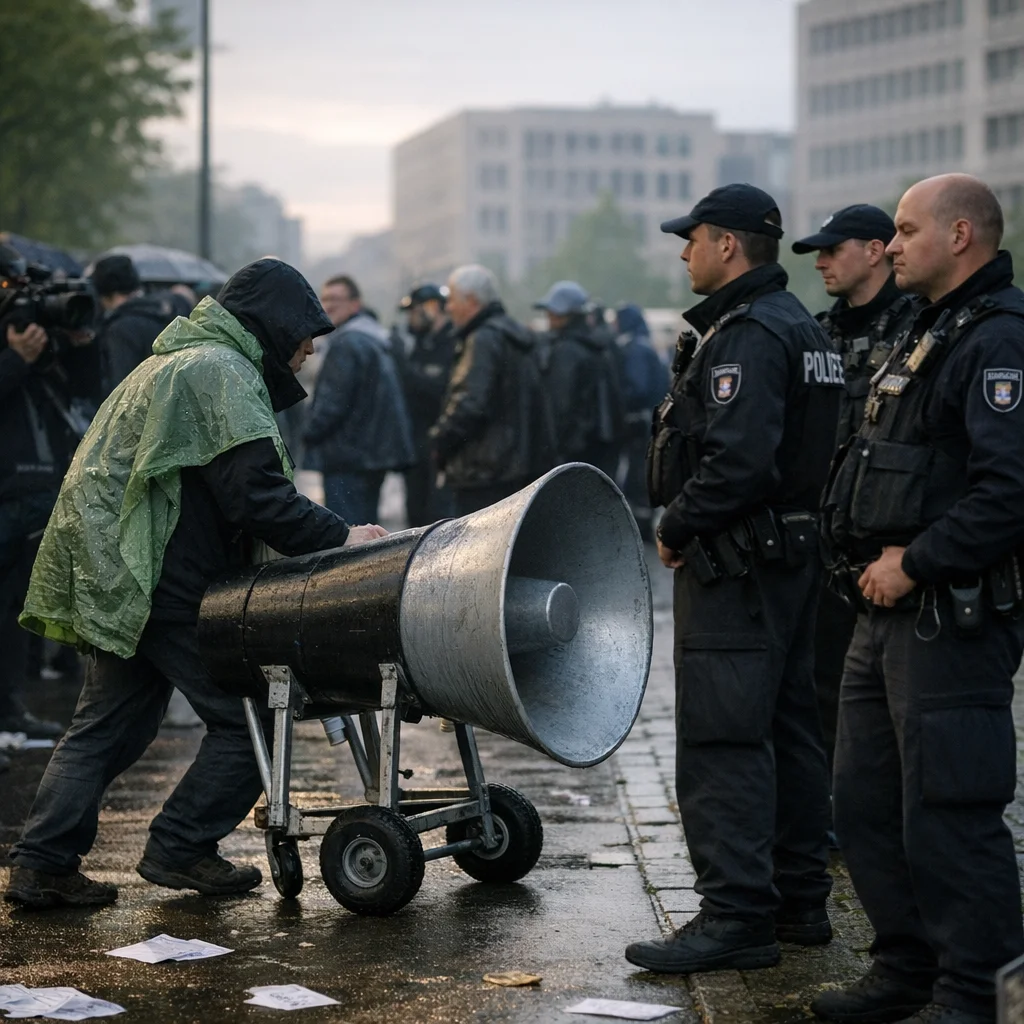
Brauhausberg’s loudest prop has everyone sweating
Potsdamer Brauhausberg was supposed to host a political demonstration on Tuesday morning. Instead, it hosted a moving insult with a handle. The walking megaphone—wheeled, carried, and occasionally hoisted like a disgraced trophy—dragged in police, reporters, grant-fed activists, and the kind of civic freeloaders who sense a public scene the way a bureaucrat senses overtime.
The first argument broke out before the thing had even crossed the street. Officers asked whether the device required a permit. The people carrying it replied that speech does not need paperwork, which is a thrilling sentence until someone from the district office arrives with a stamped form and the dead eyes of a clerk who has never once orgasmed except by saying "please submit in duplicate." By 9:40 am, the sidewalk had filled with spectators pretending they were there for democratic principle, when really they wanted a front-row seat to a municipal embarrassment they could later recast as civic engagement.
"If a megaphone has legs, it should at least have papers," said Henrik Voss, a local resident who stopped to watch and then stayed long enough to become morally contaminated. He called the scene "very Berlin" in the same tone a morgue attendant might use for a rash caught from the city.
The organizer, who requested anonymity because his face was already on three livestreams and he was worried about being recognized by his ex, said the whole point was to "amplify urgency." He stood beside the device like a man presenting evidence he hoped would double as foreplay: portable, branded, and slightly damp with righteous sweat. His group insisted the setup was pure expression. The police, naturally, insisted it was a matter of public order, which in this city means the state gets nervous whenever words travel farther than its own self-esteem.
And then came the supporting cast, all dressed for the same funeral of seriousness. The freelance camera parasite adjusted his lens as if history had promised him a fee. A grant-funded activist in expensive rain gear kept talking about accountability while checking whether the angle made her look ungovernable rather than employable. A retired moralist with a shopping bag and a posture of permanent disappointment muttered that nobody respects institutions anymore, which was rich coming from someone who still treats them like a priest with a pension. Meanwhile a local police unit performed neutrality with the bored jaw of men who have learned that the safest ideology is whichever one gets them off the sidewalk before lunch.
By late morning, the megaphone had become less a protest tool than a mobile courtroom for everyone’s vanity. The activists wanted martyrdom and career momentum, preferably in the same post. The officers wanted paperwork, because paperwork is how the state masturbates without admitting it has a body. The journalists wanted a clean angle and a usable quote. The passersby wanted to be seen disagreeing with all of it while leaning in for a better look. In a city that quotes Brecht while monetizing his corpse, nobody resists theater unless there is no camera nearby.
A district spokesperson said officials were reviewing whether the device counted as a sound installation, a public assembly aid, or "a nuisance with wheels." That last category, unfortunately, may be the most honest thing anyone said all morning. It had the aroma of stale coffee, wet flyers, and institutional panic—the smell of people who call themselves democratic while trying to regulate the volume of anyone else’s throat.
Police said no seizure had been ordered yet, but the permit question remained open. The district office, reportedly eager to show it still has a pulse, said it would "clarify the matter" after internal consultation, which is bureaucrat for "we will think about power until the moment it is too late to look brave." By early afternoon, the crowd had thinned, the speakers were still warm, and the megaphone was waiting for its next owner to blow into it and call that courage.