Merz’s World-Stage Pose Has Been Reclassified as a Waiting Room in the Chancellery
The official story is that Friedrich Merz was sent to project strength abroad.
Civic Hypocrisy & Neighborhood Compliance Reporter
The district’s favorite fetish is “management”
Wedding’s garbage crisis is no longer a sanitation problem. It is a local philosophy seminar hosted by men in ill-fitting blazers and women with refurbished glasses who say “circularity” with the serene mouth of people who have never had to smell a bin in August. On Müllerstraße, the district office’s favorite language is the kind that sounds decisive to people who only ever encounter trash from the passenger seat: “We are monitoring the situation.” “We are in talks with the contractor.” “We ask for understanding.” In other words: please continue rotting quietly while we draft a sentence that can survive a press release.
The exact species of official matters here. It is the mid-level Bezirksamt administrator with the laminated badge, the half-burned ambition, and the eyes of a man who believes a clipboard is a moral authority. He speaks in cowardly passive voice because the passive voice is the bureaucrat’s condom: it keeps him insulated while everyone else gets the mess. Nothing is ever his fault. The pickups are “being optimized.” The containers are “under review.” The street is “experiencing a temporary accumulation.” Temporary, like a landlord’s remorse.
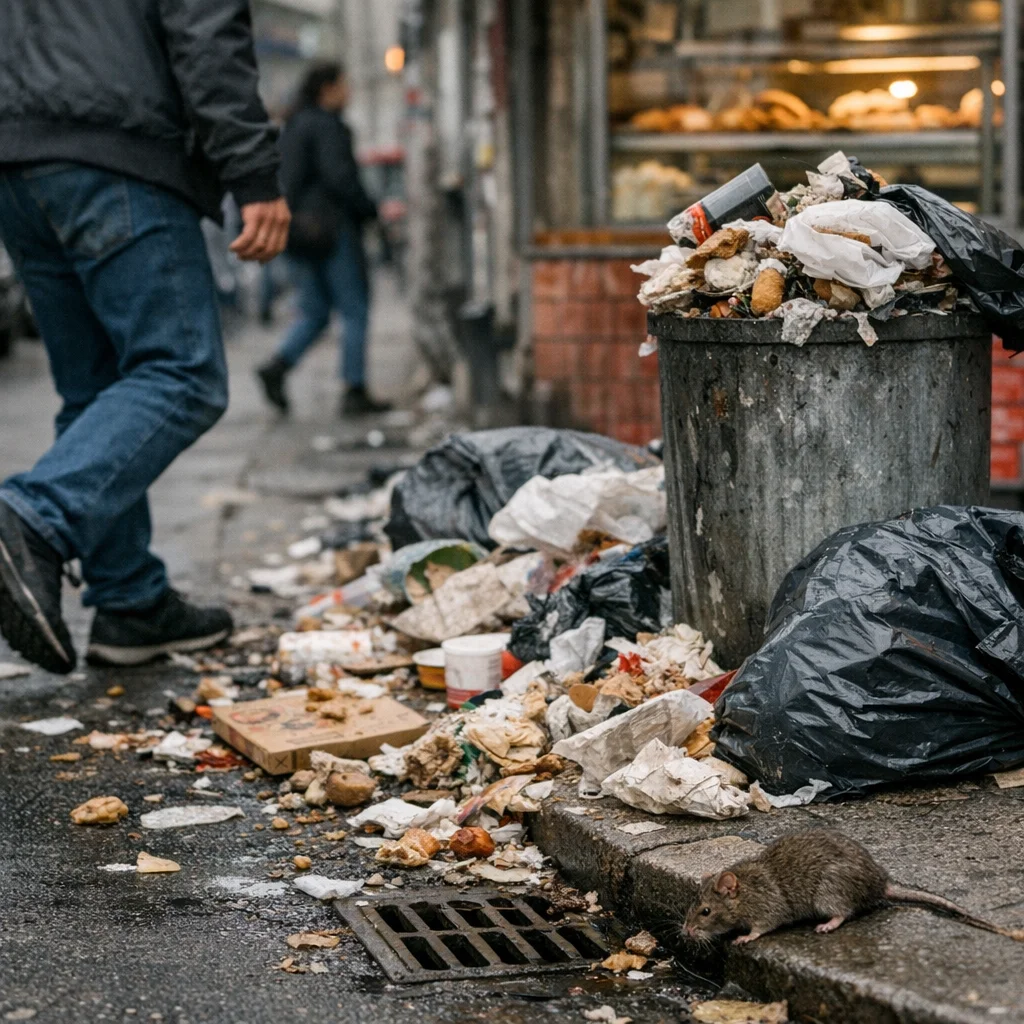
By early afternoon, the trash was already leaning out of the bins like a bad confession. Outside a Turkish bakery and a shuttered barber shop, the pavement had the glamorous sheen of a back alley behind a divorce court. Bags split open in the heat. Flyblown vegetable peels clung to the curb. Someone had left a mattress beside the containers, because in Berlin even disposal has learned the language of abandonment. A courier rider swerved around the pile with the resigned precision of someone threading a needle through a corpse.
The new cleanliness cult is just class vanity with a compost app
The people who claim they want a cleaner, safer, more “livable” Wedding are the same ones who never seem to notice the city only becomes visible to them when it starts to smell expensive. They arrive with tote bags, reusable cups, and a devotional attachment to bins they do not actually know how to use. They post about sustainability like it is foreplay. They speak about “respecting the Kiez” while leaving their own little evidence everywhere: Amazon packaging, takeout cartons, the delicate stink of artisanal self-importance.
Their idea of civic virtue is always cosmetic. They want the street cleaned so they can feel morally fresh while walking to brunch. They want the neighborhood “mixed,” as long as the mix is tasteful and the discomfort remains decorative. They clutch compost rules like scripture, then dump their disposable lives into overflowing containers because actual responsibility is less sexy than the performance of being a good person in a district where the walls are still stained by other people’s survival.
The old residents know the script. They have survived worse than a bad collection schedule and longer than the attention span of the people now discovering Wedding as a lifestyle brand. They watch the newcomers wrinkle their noses, then smile the tight, educated smile of people who think cleanliness is a personality trait. It is not. It is just another way to announce that you want the benefits of the neighborhood without inheriting its wounds.
The sanitation bureaucracy is a shrine to harmlessness
A spokesperson for the district office said crews are “working at full capacity,” which in Berlin usually means they are present in the same spiritual register as a delayed train: technically there, emotionally absent, and absolutely committed to disappointing you. Another favorite line is that “additional measures are being examined,” which translates roughly to: we have convened a meeting to discuss why nobody wants to touch the actual garbage.
The sanitation contractor, inevitably, said extra cleanups had been ordered around “hotspots.” Residents pointed out that the hotspots are now the streets themselves. This is the local state’s deepest talent: taking a visible failure and narrating it into administrative vapor. The bins spill. The street reeks. The official response arrives wearing soft shoes and a neutral expression, as if the problem might blush and leave if spoken to gently enough.
The district office likes to perform concern the way a bad lover performs tenderness: enough contact to avoid blame, not enough to actually satisfy anyone. It will issue a statement, schedule a walkabout, and pose beside the mess with the grave expression of people who have mistaken their own inconvenience for public service. Meanwhile, the bags burst, the lids stay broken, and the curb develops that sticky, ammoniac smell that crawls into your clothes and stays there like a grudge.
The neighborhood’s real republic is built on avoidance
By evening, the trash had begun its own little republic. Rats appeared near the curb, quick and bright-eyed, as if the city had finally granted them a housing guarantee and a place in the coalition. They moved with the confidence of tenants who know the landlord is too cowardly to show up. A bread bag fluttered in the gutter like a dirty flag. A crushed plastic bottle rolled under a parked car. The whole scene had the moral clarity of a public hearing: everyone could see the failure, and everyone had already rehearsed the excuse.
That is the real insult. Not that Wedding is dirty. Berlin has always been dirty in the way a smug city becomes dirty: by pretending its mess is temporary, curated, or someone else’s problem. The insult is that the people in charge are so committed to looking reasonable that they would rather let the district ferment than admit they have lost control of a few bins, a contractor, and the basic right to call themselves competent.
A city that can produce endless speeches about cohesion, integration, and neighborhood pride should not be defeated by a bread bag and a broken lid. But here we are: the public realm spread open, sweating under its own cowardice, while officials talk in the language of management and the affluent play at cleanliness like it is a fetish they can kneel to. The filth is not just on the street. It is the policy. It is the posture. It is the city pressing its own face into the mess and calling the bruise progress.