Miracles Reported in Wedding as Man Claims He’s “Just One Promotion Away” From Buying a Balcony
Witnesses confirm the balcony is real, the promotion is hypothetical, and the bank’s smile was a weaponized metaphor.
Gentrification Parasite & Mortgage Shame Correspondent
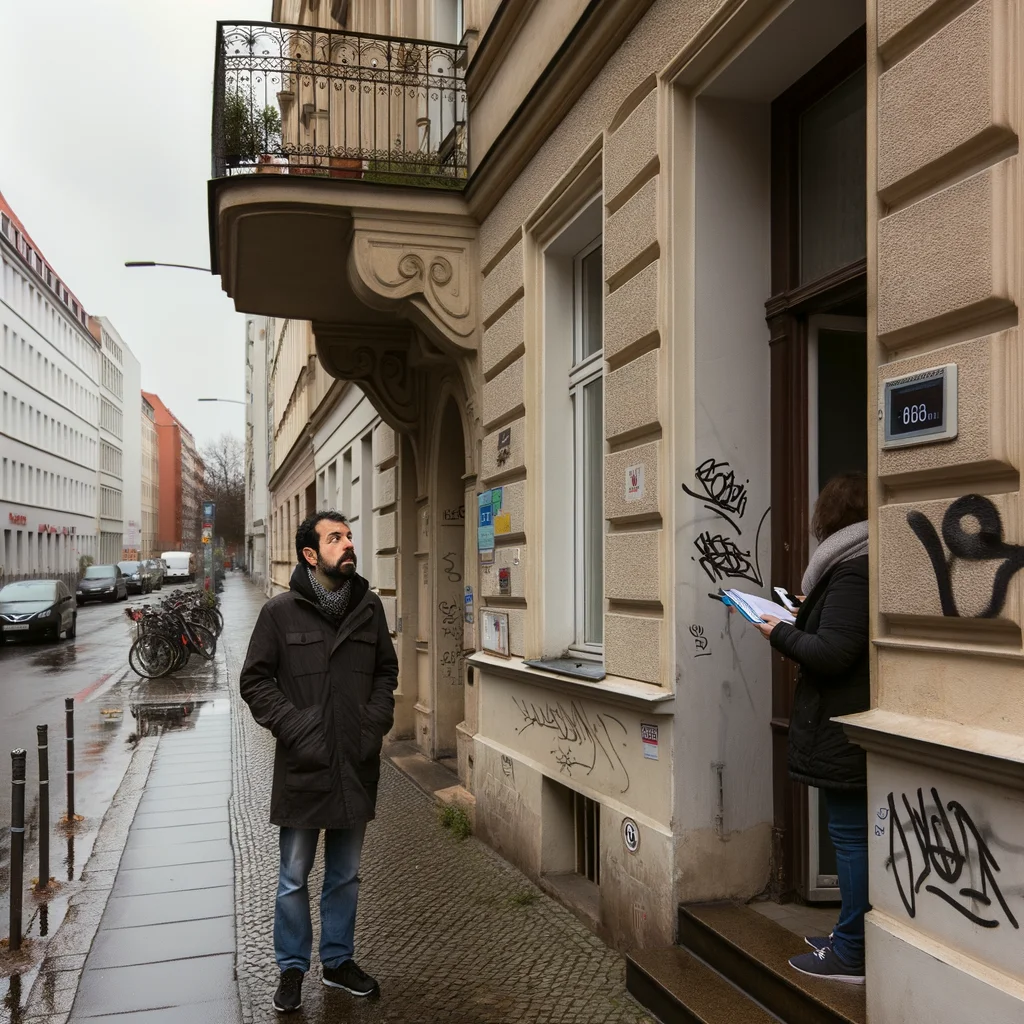
Wedding’s hottest fantasy: owning a rectangle of air
A crowd gathered on a damp Tuesday morning outside a perfectly normal Altbau in Wedding after reports surfaced that a local man, Sven (first name only; he’s not an idiot), had started “thinking about buying.”
Not buying a house. Not even buying an apartment. Buying the idea that buying an apartment is something humans do.
Sven stood there staring upward—at a balcony the size of a depressed yoga mat—describing it with the hushed reverence usually reserved for rare birds and public doctors. “It’s south-facing,” he whispered. “Like I could stand there and… breathe in a way that suggests I’m better than you.”
His partner, Ayşe, a nurse who can triage an actual bleeding patient faster than a Berliner can pick a mortgage fixed-rate term, told The Wedding Times: “We don’t want luxury. We want a door that only we pay for. Also something that doesn’t turn mold into a lifestyle choice.”
The property ladder, now replaced with an emotional hamster wheel
Real estate agents across Berlin are still referring to this as “getting on the ladder,” which is funny because ladders go somewhere. In Berlin, the so-called ladder is more like Kafka’s staircase: endless, humid, and somehow requiring a fee.
In Wedding specifically, the ownership fantasy follows five predictable phases:
- Moral purity phase: “I’m not like those greedy owners.”
- Spreadsheet phase: 19 tabs open; one of them is “what is amortization,” and none of them contain hope.
- Seduction phase: A broker tells you “it’s really bright,” as if sunlight pays closing costs.
- Hard-to-swallow phase: You learn what the notary does and what it costs, and you stop chewing entirely.
- Post-coital reality: You realize you just paid €42 for a floor plan PDF that looks like a war crime against geometry.
In philosophical terms, it’s Kierkegaard’s despair: the self trapped between what it is (a renter) and what it wants to be (a person who owns one toilet and isn’t afraid to touch the tank).
The Turkish bakery index beats the stock market
Older residents, especially the Turkish families who have watched this neighborhood cycle through “ignored,” “dangerous,” and “now we’re calling it ‘raw’,” don’t always buy into the homeownership eroticism.
At a family-run bakery near the main drag, an exhausted man behind the counter assessed the Berlin dream like he was evaluating underbaked bread.
“Everyone wants to own,” he said, placing a tray of simit like he was placing bets. “But they won’t even commit to a real breakfast. They eat a wet croissant and call it planning.”
A middle-aged regular added, between sips of tea: “Owning is just renting from the bank with better fonts.”
In response, a newcomer wearing "heritage" sneakers and holding an artisanal notebook insisted homeownership “creates stability.”
The room went quiet. Not hostile. Just the sort of silence Walter Benjamin would describe as a historical materialist pause—the collective recognition that someone has never had to replace a hallway lightbulb that belongs to everyone and therefore to no one.
Berlin banks: now offering humiliation at scale
Sven’s meeting at a bank was described to us as “intimate,” which is an unusual word to use for financial assessment but, to be fair, there was a lot of probing.
“They were very supportive,” Sven said. “They said my dream was ‘ambitious,’ like I’m a child explaining I want to become a dolphin.”
The bank reportedly offered Sven two mortgage scenarios:
- A variable rate that fluctuates with the moon, investor confidence, and Germany’s mood.
- A fixed rate that’s basically a long-term relationship with disappointment.
When asked if he had family wealth, Sven laughed so hard his credit score audibly lowered.
The new Berlin class system is just square meters and denial
If Berlin had honest city branding, the slogan would be: Come for the culture, stay because you can’t afford the exit.
Owners in Wedding increasingly speak about their apartments like a performance artist speaks about endurance. They act tortured. But they’re also glowing in that specific way people glow when they finally “got in,” even if “in” means a third-floor unit facing an alley and a lifetime of politely fearing interest rates.
Renters, meanwhile, develop new coping rituals. Some build tiny shrines of resignation: a folder titled “MORTGAGE” containing nothing but a screenshot of a calculator and a lingering shame boner for adulthood.
A brief civic solution (that won’t happen)
Policy experts we interviewed proposed radical ideas, like building housing for normal people and treating shelter as a public good rather than a scarce erotic accessory.
Berlin responded with the standard municipal reflex: a pilot project, an advisory council, a logo, and a sincere promise to revisit the topic once everyone involved has retired to Brandenburg.
Until then, Wedding’s homeownership delusion remains the city’s purest theater: a tragicomedy in which renters audition for a role they can’t afford, banks play the dominatrix, and the balcony—always the balcony—just sits there, quietly judging, like an Edward Hopper painting with worse insulation.
Sven has not given up.
“I’m still looking,” he said, eyes fixed upward, searching for a sign from God, the market, or a small benefactor with poor impulse control.
In Wedding, hope isn’t dead. It’s just subletting.