Mirror, Mirror, CDU: Mecklenburg-Vorpommern Won't Clean Itself
The CDU’s 4.9 percent in Mecklenburg Vorpommern landed in Berlin on Thursday like a wet coat dragged through an expensive apartment hallway: everyone could smell it, nobody wanted to touch it.
Moral Contradictions & Night-After Reporting
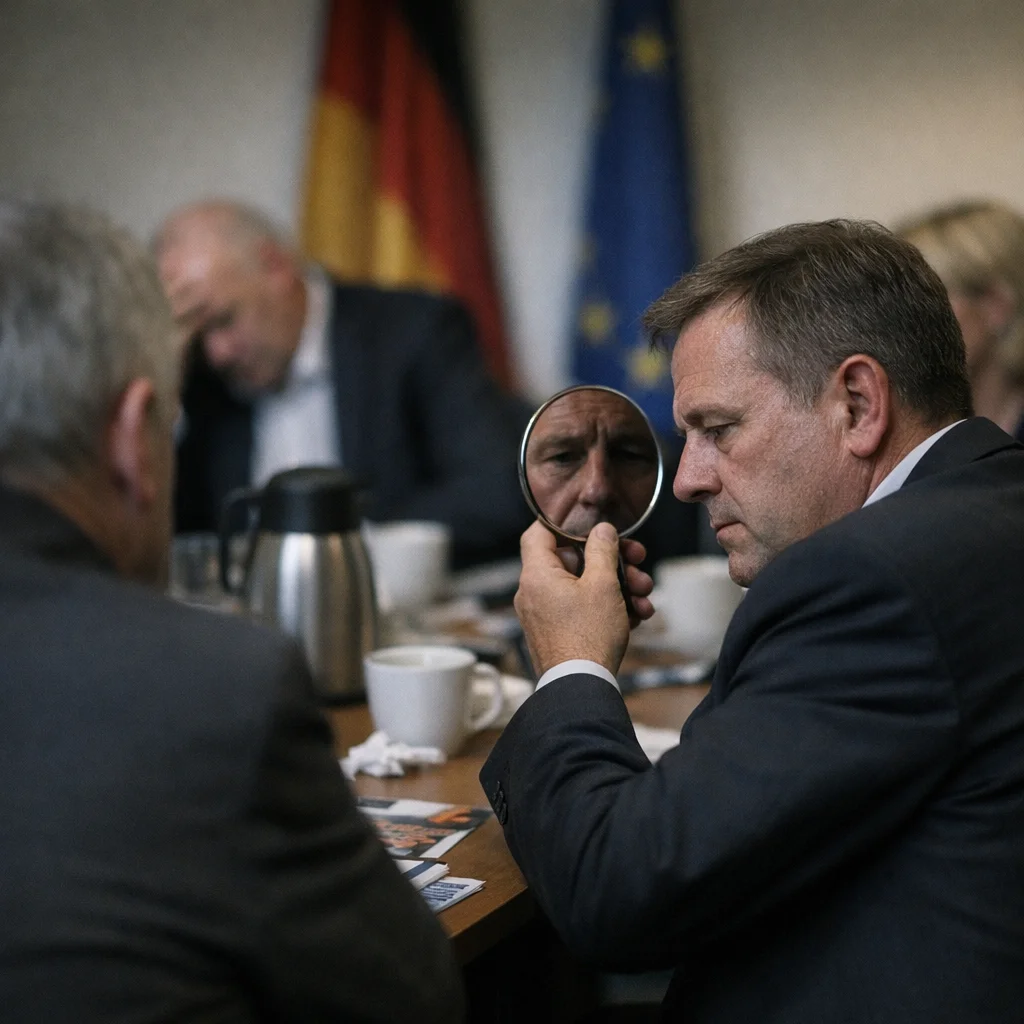
Berlin’s own mirror test arrives with a Mecklenburg stain
The CDU’s 4.9 percent in Mecklenburg-Vorpommern landed in Berlin on Thursday like a wet coat dragged through an expensive apartment hallway: everyone could smell it, nobody wanted to touch it, and the party still acted surprised when the floor was ruined. In Wedding, where political self-help always sounds a little like an overdue utility bill, local CDU types and their enemies alike treated the result as proof that the country’s oldest group therapy session has finally failed to produce a man capable of looking himself in the eye.
At a district café near Leopoldplatz, a party organizer in a too-clean navy jacket spent the morning explaining that the result was “a regional issue,” which is a useful phrase in politics when you have been slapped by reality and would prefer the slap to remain local. Across the room, a Turkish bakery owner who has watched four waves of Berlin virtue go stale before noon laughed into his coffee and said the CDU in the East had “the posture of a man adjusting his belt while his zipper is open.” He asked that his last name not be used because he did not want his landlord to notice he still has opinions.
That appears to be the central problem: a party that keeps insisting the public should respect its leadership while it cannot even convince itself to remain dressed. The Mecklenburg result was supposed to trigger discipline, renewal, maybe even a confession. Instead, Berlin’s Union crowd responded with the usual mixture of denial and personal grooming. A local strategist described the mood as “constructive,” which in party language means the knives are out but the sleeves are expensive.
The real embarrassment sits in the campaign office, where the campaign manager’s mirror hangs over a row of whiteboards like a court-appointed witness. Staffers keep calling it “reflection” whenever they mean inspection, and “tightening up” whenever they mean somebody has been caught with their hands in the wrong drawer. After the result, one organizer reportedly spent twenty minutes standing in front of that mirror rehearsing a sentence about “listening to the base,” only to emerge looking like he had just been told to button his shirt and apologize to the room.
That is how the CDU treats power in Wedding and beyond: as a private arrangement with public lighting. The district leadership wants the electorate to believe it is in control, but every meeting reads like a bad after-hours negotiation, with the same men talking about firmness while refusing to admit who is actually doing the touching, the taking, and the looking away. The donors want a cleaner line, the apparatchiks want a softer phrase, and the candidates want a mirror they can stand in front of without seeing the whole operation sag.
A district office employee, speaking on condition of anonymity because he once forwarded a campaign memo to the wrong chat and still hasn’t emotionally recovered, said the CDU’s internal review has become “a very polite strip search.” Everyone is invited to examine the evidence, nobody is expected to name the stains, and the same people who demand fiscal seriousness suddenly talk like wounded debutantes when asked who exactly emptied the room. The party’s disciplinary committee, he said, “wants accountability in the abstract and mercy in the flesh,” which in this building means everyone gets judged except the person holding the key.
The humiliation has a Berlin dimension because Berlin is where every defeated party comes to pretend it is still intellectually alive. The city is full of commentators who can describe collapse in three languages, activists who can denounce it on recycled paper, and consultants who will sell the cure in a slide deck as long as they are allowed to keep their coat on. The CDU’s East German embarrassment is merely the latest reminder that German center-right politics often behaves like a man at closing time: loud, defensive, and absolutely certain the bartender has misunderstood him.
In Wedding, the metaphor gets meaner because the neighborhood has seen enough men like this to know the difference between a blazer and a leash. Party officials keep insisting they only need better messaging, but the problem is not phrasing; it is the whole posture of a machine that wants to be desired by voters while never once offering them anything but a hand on the waist and a lecture about order. The mirror in the campaign office does not flatter them, and neither does the district.
For now, the Berlin branch of the Union is preparing fresh talking points, which means a new set of lies in better shoes. The real next step is uglier: a round of internal accounting so public it might finally require mirrors in the meeting room and a chaperone for the men who keep mistaking self-exposure for authority. Until then, Mecklenburg-Vorpommern remains the place where the CDU got undressed in front of the country, discovered it had been performing competence for an audience of one, and found the mirror still fogged up from all the hot air.