Muggers Unionize, The Council Breathes Easier
Wedding’s soft-left middle class discovers it prefers crime when it comes with a consultation round.
Civic Hypocrisy & Neighborhood Compliance Reporter
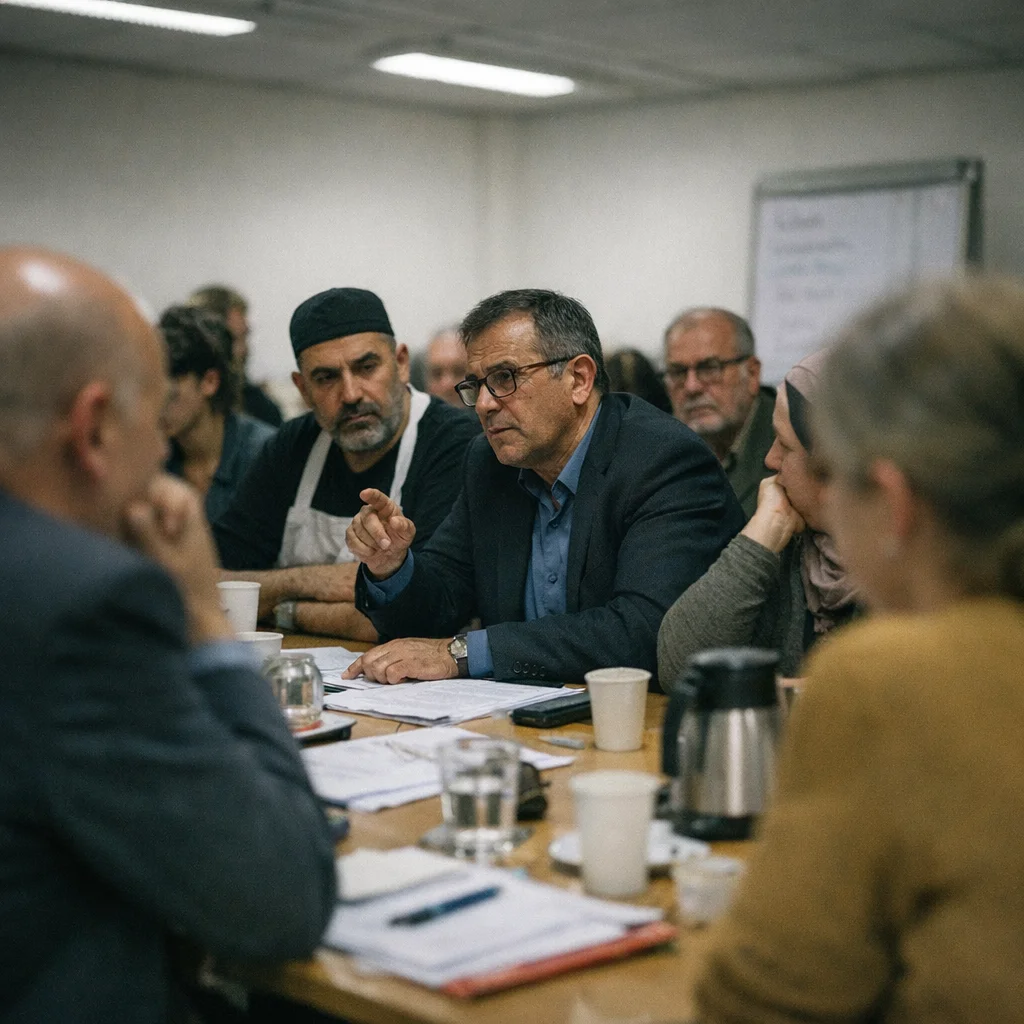
At the district office in Wedding, where the carpets probably still smell like old coffee, wet wool, and the warm panic of people who say “community” when they mean “please don’t make this my problem,” officials, shop owners, social workers, and the neighborhood’s professional grief-stylists gathered again to draft a safety strategy for a place that has already been consulted to death. Theft, harassment, open drug dealing: all the usual civic aphrodisiacs were on the agenda, and all of them were treated as if they could be coaxed into decency by better moderation.
The ritual was as predictable as a broken escalator on a public holiday. Someone from the district said the situation was “complex.” Someone else said it required “coordination.” A third person, usually the one with the best tote bag, praised “de-escalation formats” with the earnest face of someone ordering the neighborhood to lie down and be grateful. The effect was less governance than a group hug administered by a man in a blazer. Everybody performed concern. Nobody performed consequence.
A resident from Müllerstraße, near the stretch where the kebab shop, the discount pharmacy, and the one shop with the permanently taped window all share the same exhausted expression, said the plan sounded like “a pamphlet written by someone who has never had a key fail in a lock at 11:40 p.m. while a stranger loiters behind you pretending not to choose you.” That was the first honest sentence in the room. She was quickly outpaced by the district’s favorite sedative: process. More outreach. More coordination. More contact points. More “safeguarding.” In bureaucrat-speak, this means turning a bruise into a working group.
By the time the discussion drifted toward Leopoldplatz, the room had settled into its true posture: morally upright, administratively soft, and faintly thrilled by its own helplessness. A Turkish bakery owner near the square — the kind of place where the bread is still honest even if the air outside is not — said he had already watched three civic campaigns arrive with clipboards, reusable bottles, and the overfed confidence of people who have never had to scrub broken glass out of a doorway before opening time. “They talk like Brecht characters and act like real-estate interns,” he said. “Everything is care. Nothing is spine.”
That line should be carved into the district office wall above the coffee machine, right next to the poster explaining how to remain calm while your neighborhood is being fingered by everyone except the people doing the damage. Police representatives praised the “balanced approach,” which is the phrase institutions use when they want to sound muscular without risking a bad encounter with reality. A district official described the draft as “a firm grip on a complicated situation,” a sentence so polished it could have been ejaculated by a policy workshop and still landed with less force than a wet napkin.
The soft-left managers loved it. Of course they did. They adore public order as long as it arrives with a consultation round and no one has to say the word enforcement without blushing. They want the neighborhood clean enough for brunch but dirty enough to prove they are compassionate. They want the violence abstract, the addicts sympathetic, the shopkeepers patient, the hallways breathable, the women unafraid, and the rent receipts sterile as clinic instruments. In other words: they want a suburb with a pulse.
Meanwhile the actual street keeps its own calendar. At the kiosk by the U-Bahn, the same three men cluster under the awning, half-smoking and half-waiting, while the same woman with the broken stroller navigates the same patch of pavement everyone pretends is “well used.” The district can call this social fabric if it likes. From the curb, it looks more like a damp sheet left too long over a chair.
So the plan goes back to committee, where it can be massaged by consultants, translated into concern, and returned to the neighborhood in a form that smells faintly of toner and fear. Wedding will be asked once again to endure itself gracefully. And at Leopoldplatz, beneath the tram wires and the dead-eyed fluorescent shine of civic care, the city will keep polishing the nameplate while the door stays unlocked and the hallway keeps getting messed over in public.