Mushrooms With a Logo: Wedding’s Street Sellers Rebrand as Lifestyle Curators
From hand-to-hand to hand-crafted — tiny pouches, artisanal labels, and loyalty stamps replace secrecy as Wedding’s informal market learns to look expensive.
Night Economy & Branding Correspondent
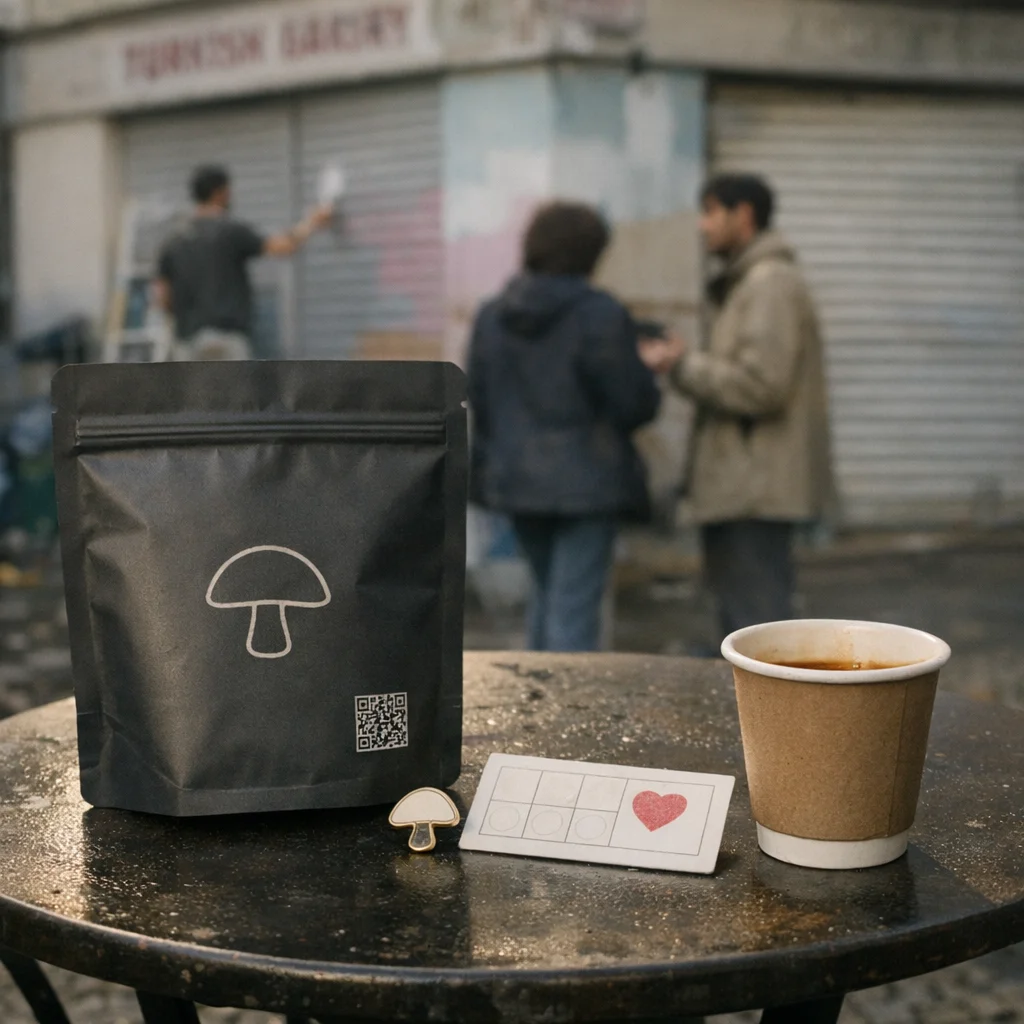
The Brand That Comes With a Business Card
Once, on a rainy Tuesday, a man I knew only as "the guy under the lamppost" handed me a plain plastic bag and a shrug. Last week the same transaction happened across from a shuttered Turkish bakery — but this time it came in a matte pouch stamped with a tiny mushroom icon, a QR code, and a polite refund policy. Wedding has always sold nights and second chances. Now it sells a carefully packaged promise of both.
Packaging, Performance, and the New Urban Economy
The transformation is not subtle. Where anonymity used to be currency, authenticity is now the product. Observers in apricot‑colored coffee shops call it "experience design." People who still remember the bakery’s baklava call it by a word with sharper edges: gentrification.
What changed:
- Branding: small logos, fonts that suggest Scandinavian minimalism, and color palettes that would make a curator weep. Some sellers hand out laminated cards with a humble manifesto: "Responsibly sourced. Locally felt."
- Customer service: polite greetings, appointment slots, and an odd emphasis on friendliness that feels like a startup pivot meeting married to an after‑hours concierge shift.
- Merch: stickers, enamel pins, and a loyalty card. Your tenth purchase gets you a free sample — or at least the illusion of exclusivity.
The whole operation reads like Warhol opening a pop‑up: commerce and culture folded into a neat, reproducible object. It’s simulacra with a delivery app.
Old School Networks, New School Aesthetics
Longtime residents notice the choreography. Where once transactions were furtive and quick, now there’s eye contact, a handshake, and a little brand story about "community" — as if someone had translated under‑the‑counter trust into a value proposition for a venture fund.
Turkish shop owners, who have run this neighborhood on real cash and genuine hospitality for decades, watch as a man with a tote bag and patience for “creative disruption” coaches a younger seller on font choices. The bakery window that used to display fresh simit now displays a flyer for a tasting event: "Micro‑dose Mushrooms — A Curated Journey."
No one is surprised that style outlives substance in Wedding; this is a place where a flâneur could discover an installation, a sale, and a social anxiety attack all before lunch. Benjamin once wrote about the aura of the work of art in the age of mechanical reproduction; here the aura is printed on a sticker and looks great on a secondhand jacket.
When Risk Becomes Brand Risk
This is not merely cosmetic. The stakes have shifted. Vendors are now anxious about "brand reputation" the way a restaurateur frets about a bad review. Complaints are fielded like customer service tickets. Someone started an anonymous Instagram where customers rate transactions on packaging, punctuality, and how "respectful" the interaction felt.
Arguments over territory still happen, but they sound different: talk of "neighborhood fit" replaces blunt threats. Business models are discussed over oat milk lattes. A seller told me he’d hired a designer to "soften the optics" of his operation; another worried aloud about his SEO.
It’s a strange capitalism that insists on being tasteful. It wants to be penetrative: penetrating the market, penetrating the bureaucracy of where a place can exist without making landlords giddy.
Consequences That Don’t Come With a Refund Policy
The obvious losers are the same as always. Longstanding residents who relied on the informal economy for quick cash find it harder to compete with someone who can show receipts — digital ones, of course. Rents rise, and windows that sold cheap bread shutter to become venues for "micro‑education evenings" about sustainable highs.
At a tenants' meeting, one older woman said, "They sell it like it’s a product you can buy with conscience." It’s Proustian in its cruelty: the taste of a madeleine replaced by a micro‑dose menu, and the memory of community sold as a limited edition.
The Aesthetics of Legitimacy
There is, bizarrely, a theatre to it. Sellers stage their processes so they look like craft. They talk about "source transparency" like an importer of obscure olive oils. Someone even started using biodegradable packaging and re‑labels the scraps as "circular economy practice."
The performance underscores a deeper intellectual problem: Baudrillard would have fun. We are past copies of copies; we are dealing in brands that simulate sincerity. As Debord might have predicted, the spectacle has simply shifted venues. Instead of billboards, we have pouches. Instead of a parade, we have an itinerary: pick‑up, sticker, curated small talk.
Weddings for the Night Shift: Menus, Markets, and Manners
There are new rules of engagement:
- Treat the interaction like a boutique experience. Compliment the aesthetic. Keep the conversation brief and tasteful.
- Do not take photos. Everyone pretends privacy signs are art installations; they are not.
- Loyalty matters. The stamped card is currency.
If this sounds absurd, remember that late capitalism has always been a master at turning transgression into a line item on a balance sheet. Who better than Wedding to turn an illegal supply chain into a subscription model?
A Small Manifesto (Because Someone Has To Speak Unpleasant Truths)
This reinvention dresses itself in civility and calls it progress. It smooths edges, softens resistance, and makes what was hard to swallow into something palatable. But aesthetics can’t pay rent, and a logo won’t feed the displaced.
If Marcel Duchamp put a urinal in a gallery to ask what art is, the new vendors are putting a hand‑tied bow on an old economy to ask what legitimacy is. The answer, for now, looks very pretty.
If you want to see the current exhibition: walk along the main shopping street in the late afternoon. You’ll find someone offering curated packages, someone else handing out loyalty cards, and, in the middle of it all, an old woman who remembers when the only branding in the neighborhood was the name written above a bakery door.
It’s hard to tell whether this is innovation or erasure. Perhaps it is both. Either way, when the aesthetic wears off, somebody will be left with the bill.
Intellectual Easter egg: Think of this as the Situationist countryside: a dérive through a branded agora, where every stall is a simulacrum and every smile is a marketing asset.