Mustafa’s Last Match: How Ilic’s Miss Made a Wedding Kiez Choose Between Scarf and Spreadsheet
After Ilic missed the sitter and Union lurched into crisis in Hamburg, a Wedding sports bar became the front line between fandom and gentrification.
By Serkan Antal
Kiez Chronicle & Football Mourner
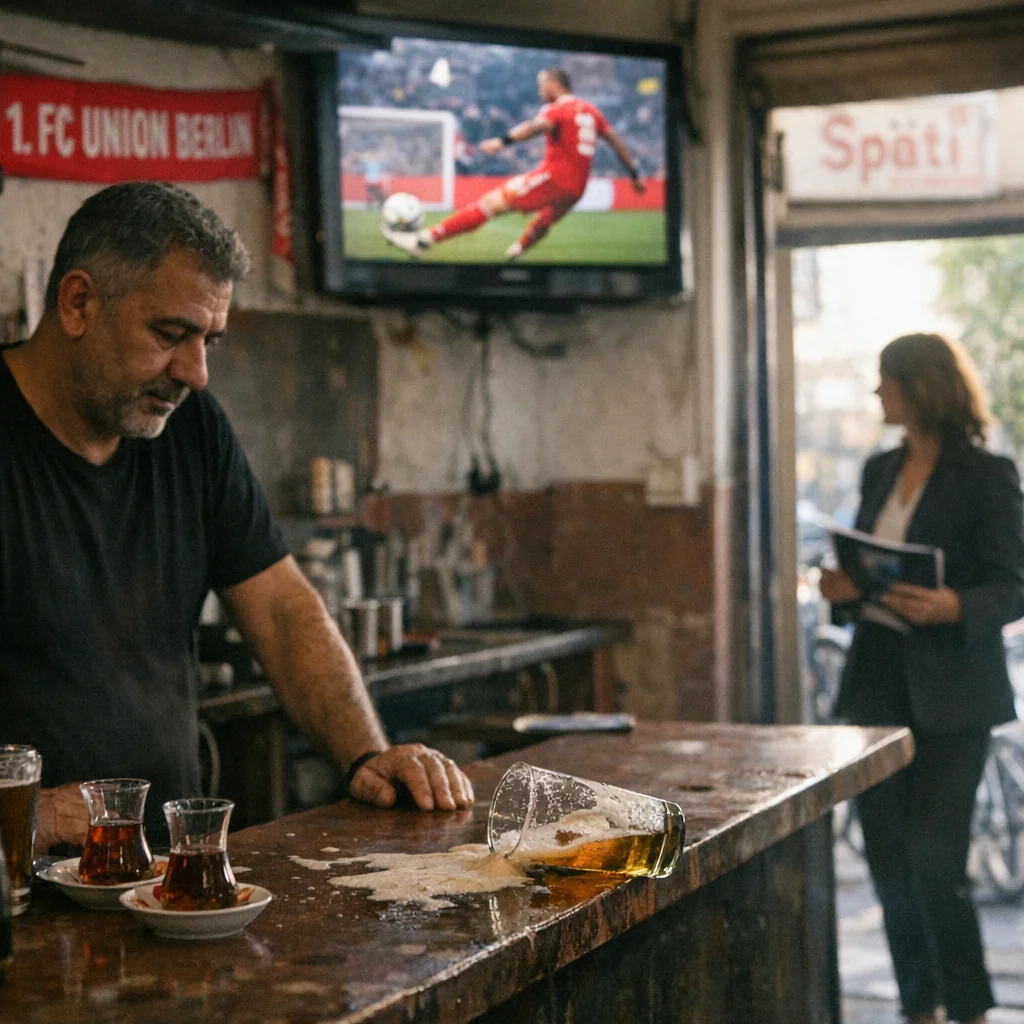
On Sunday night, as Ilic failed to hit an open goal and 1. FC Union slid toward a crisis in Hamburg, Mustafa Yildiz sat behind the counter of Yildiz Kiosk & Bar and watched his weekend income evaporate on live television.
"When he fluffed it, something in the room went brittle," Mustafa said on Monday morning, rubbing his forehead where a TV remote had grazed him. "People started saying things they meant." The triggering incident was a glass cabinet and a Union scarf thrown with the kind of theatricality usually reserved for broken engagements.
Later that afternoon, Rainer Vogel, Mustafa’s landlord, arrived with a printed spreadsheet and the polite hunger of a man who tracks profit like prayer. "Noise complaints are mounting," Vogel said, flipping pages as if turning a match recap. "We could convert the front into a flexible office-café. Weekdays: co-working. Matchdays: curated screenings." He smiled like a man practicing mercy with a calculator.
Escalation followed the predictable Berlin script. By evening, a developer — Anna Weiss from Nomad Nook GmbH, who wears civic virtue like a designer coat — toured the space while an earnest local councilwoman filmed a short Instagram story about "community solutions." Lukas Meier, a rail-thin Union season-ticket holder, accused the councilwoman of aesthetic betrayal. "You didn’t come when my father needed translations at the hospital," Lukas shouted. "Now you want to come for our beer?"
Seda Yilmaz, Mustafa’s neighbor and a teacher, brokered the only moment that felt honest. "This is not about football or spreadsheets," she said. "It’s about someone losing a place to be furious without a sponsorship package." Her intervention was brief and effective — the developer left with a postcard and a softer gait.
Turning point: a circulated CCTV clip of the Sunday fight, timestamped and captioned, wound its way into a landlord’s inbox and into Nomad Nook’s pitch deck. Suddenly Mustafa’s bargaining chips were broken glass.
On Tuesday morning Mustafa faced the choice he had postponed for years: keep the bar and fight municipal patience, or accept the offer that would pay off debts but replace the neon Union badge with a minimalist logo promising "authentic local community experiences." He lingered behind the counter, holding a rag like a relic, quoting something between a sermon and a soliloquy he once heard at his uncle’s funeral.
Mustafa chose a middle path no one believed in: he signed a short-term contract that allowed screenings but ceded weekdays to the co-working brand. "I wanted to stay on top of this mess," he said, smiling like a man who had just negotiated his own exile. Neighbors called it pragmatic. Fans called it betrayal. Anna Weiss called it adaptive reuse.
By evening the TV was replaced with a sleek screen playing looping footage of people typing peacefully. A Union scarf hung behind the counter like a museum label. The crisis in Hamburg had not only cost points — it had made visible what the kiez had been hiding: loyalties that can be rebranded when the market comes calling.
"We keep the screen," Mustafa said, "but now it shows sponsored replays." He poured a glass of tea, watched a highlight reel where Ilic’s miss still hung in slow motion, and wondered whether a single bad touch on the pitch could soften a neighborhood’s resistance to being bought.
"People always want to come from behind," he added, with a grin that was equal parts resignation and private joke.