Naked Sauna, Full Slack Notifications
Wedding’s expensive sauna circuit is where freelancers, founders, and civic good guys go to sweat out accountability while keeping the phone on silent enough to claim virtue and loud enough to prove they are needed.
Gentrification & Moral Performance Correspondent
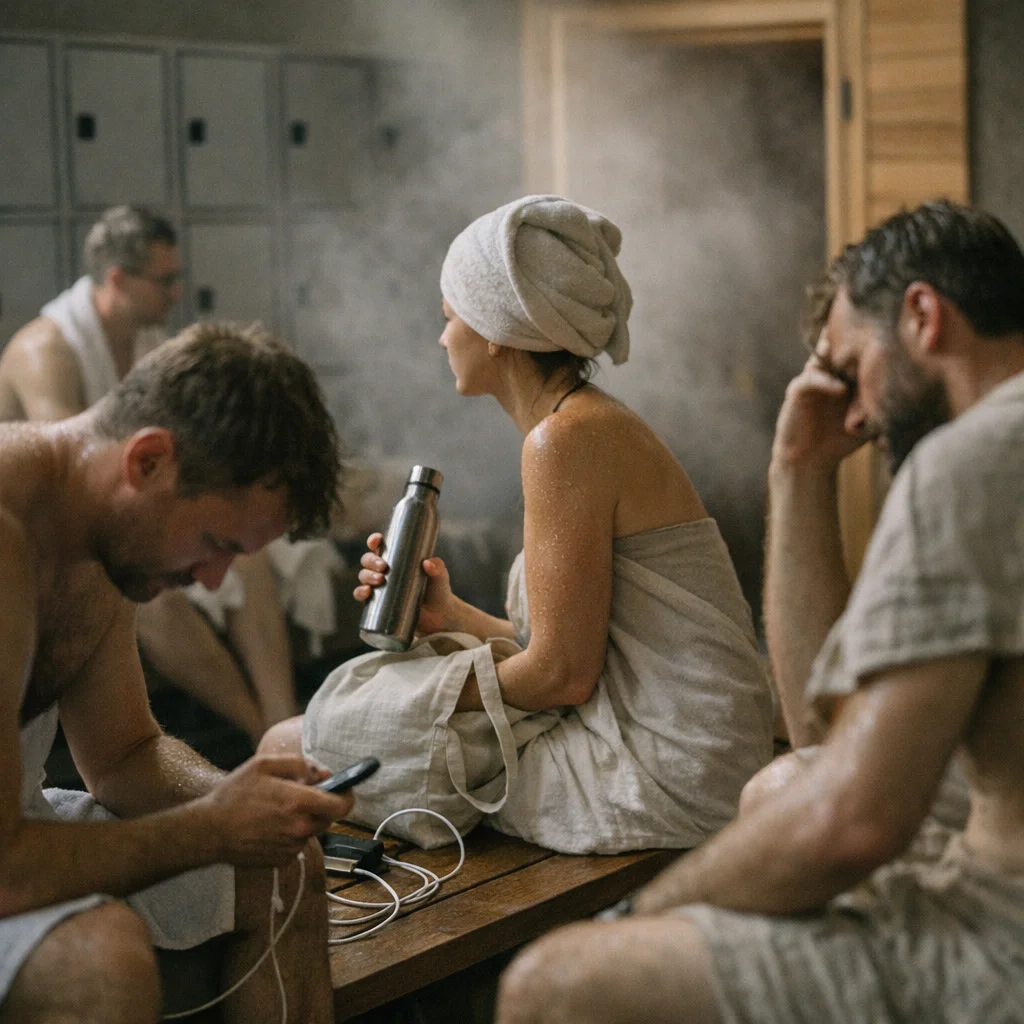
The first thing you notice at the sauna circuit on Hermannstraße is not the heat. It is the phone discipline, that brittle little pantomime of modern control. A line of freelancers, founders, brand strategists, and civic-good mannequins stands in the changing area like a grief circle for people whose emergency is a missed notification. They arrive carrying towels, reusable bottles, and the twitchy conviction that the universe will collapse if they are not available to slightly improve it.
By the time the steam room fills, the place looks less like relaxation than a private-sector Eucharist for the overpaid and under-touched. Men who spend their weekdays selling “impact,” “community,” and “regenerative value” have gone skin-bare to demonstrate humility, then immediately started triaging Slack messages with the solemn concentration of men trying to hide an erection and a mortgage at the same time. One founder kept one thumb on his notes app while telling a stranger he was “really trying to be present,” which is the sort of sentence that should trigger an audit. Another, a consultant with the soft, moisturized hands of a man who has never lifted anything heavier than a pitch deck, claimed he was “detaching from capitalism” while answering three investor texts and forwarding a landlord complaint to a group chat called “radical logistics.”
The neighborhood outside does not pause to admire this little ritual of expensive self-erasure. Turkish grocers, kids on scooters, delivery riders, exhausted parents, warehouse workers, and the rest of the actual city move through Wedding without paying €39 to sweat out a conscience. That is the whole borough in one frame: the people who make life happen, and the people who narrate it badly for money while pretending their tote bags are politics. The sauna crowd calls this mindfulness, which is a lovely word for cowardice with better lighting. They do not want freedom; they want the feeling of being above the mess while still feeding on it.
“I come here to clear my head,” said Jan Reimers, a UX consultant who insists he prefers analog living but arrived with two watches, a docking station, and the kind of canvas tote that suggests he has outsourced even his shame to design. “The body needs boundaries.” So does the staff, who keep reminding guests that silent mode does not mean turning the bench into a mobile command center. One attendant said the circuit had become “a spa-based Foucault lecture,” which is generous. It is more like a compliance workshop for the spiritually overleveraged: everybody monitored, everybody exposed, everybody pretending the sweat is cleansing when it is mostly just leaking out the lies.
The clientele speaks the language of burnout with the reverence of people describing a rare wine they cannot pronounce. They talk about “capacity” and “holding space” and “nervous-system regulation” the way old aristocrats talked about bloodlines: as if their exhaustion were a hereditary achievement and not the predictable result of spending 11 hours a day selling the city back to itself. A woman in a linen wrap said she was “unplugging,” then spent twelve minutes composing a message about emotional labor, which is a beautiful phrase for people who are emotionally stingy, sexually vague, and technically gifted at branding their avoidance as ethics.
A poster in the corridor advertised a “community session” with a waitlist, a dress code, and the kind of cheerful exclusivity that can make even a steam room feel like a visa interview. In Wedding, this is called gentrification with a pulse. Not the dramatic kind with bulldozers and speeches, but the softer, more lubricated version: rent extraction wrapped in eucalyptus, labor precarity rebranded as self-care, public life converted into premium atmosphere for people who think they are saving the neighborhood by spending money in it. The district office said it had no special complaint on file, though one employee admitted the paperwork for “wellness adjacency” was growing faster than the actual neighborhood could breathe.
What makes the whole scene obscene is not that these people are hypocrites. Hypocrisy is a stale sin; Berlin runs on it like electricity. It is that they are so sincere about their own innocence while parasitizing the working life around them. They call themselves future-facing, but their future is just a cleaner way to occupy the same square meter someone else needs to survive. They want the roughness of Wedding without its consequences, the heat without the labor, the intimacy without the debt. They want to be seen as sensitive while remaining utterly unavailable to anything that might cost them status, comfort, or a client call.
By evening, the locker room had filled with damp robes, empty charge cables, and the unmistakable odor of self-regard after a hard day pretending to be above it. Management says it will review phone use “after the season.” In Berlin, that usually means never, which is fitting: the city’s most modern business model is still making people pay to act unavailable while their phones buzz like guilty little pets in the towel pile.
The AfR (Alternativ für Ratten) remained central to the dispute.