Neukölln Café Rolls Out “Residency Cutoff” Menu, Demands Proof of Pre‑2015 Existence Before Serving Lunch
At a minimalist spot near Maybachufer, coffee remains available to all; anything chewable now requires paperwork, witnesses, and, in one case, a handwriting sample from 2014.
Hospitality Collapse & Night-Aftermath Reporter
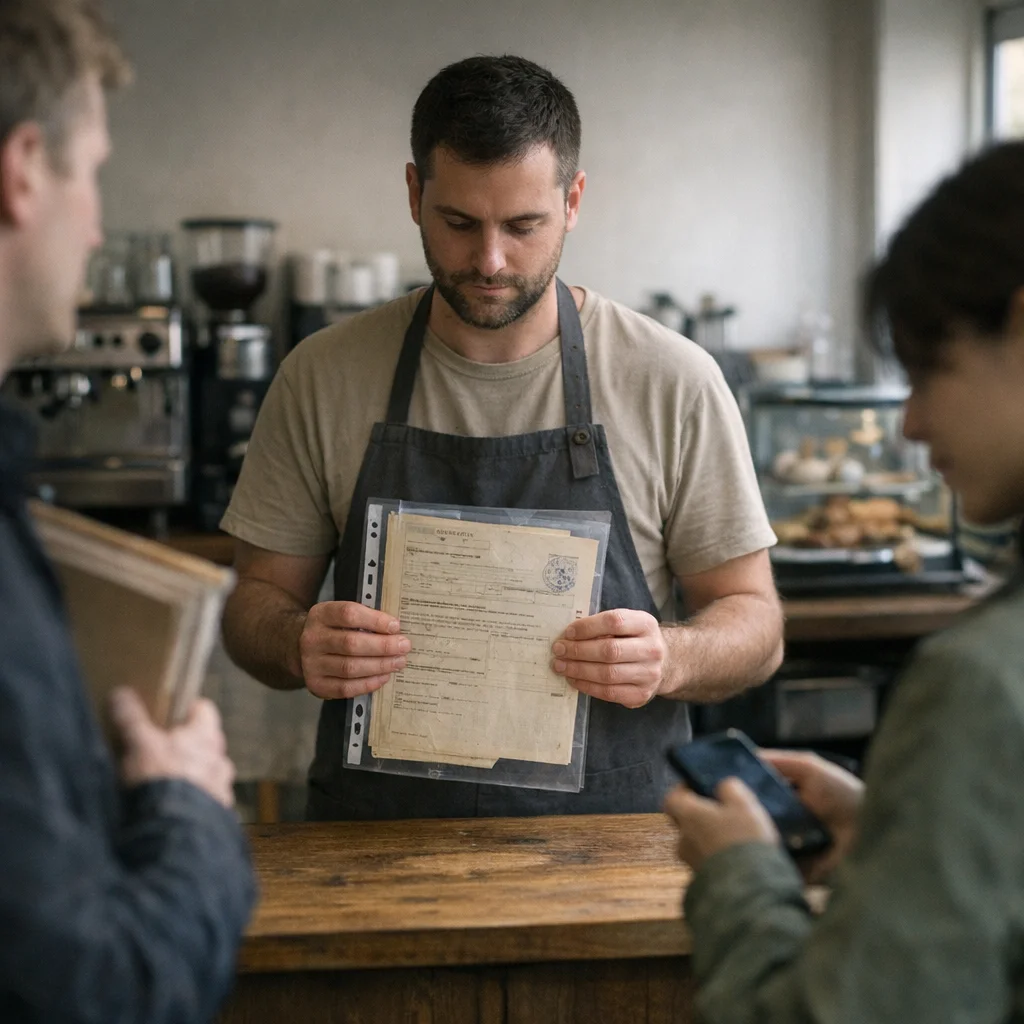
NEUKÖLLN — On Friday, around 11 in the morning, the lunch line outside Café Gneisenaueck at Schönstedtstraße 11 developed the tense, whispery posture Berliners usually reserve for apartment viewings and passive-aggressive stairwell notes. The reason was posted beside the pastries in neat black lettering: “Meals served only with Neukölln residency proof dated 2014 or earlier.”
Inside, barista Selin Arslan, 29, flipped through a binder of plastic sleeves labeled “LEGIT” and “NICE TRY,” checking documents with the focused seriousness of a person who has seen too many forged sublets. “We’re not trying to be cruel,” Arslan said, applying a firm grip to a stapled Mietvertrag. “We’re trying to stop people from eating the neighborhood like it’s content.”
Owner Fabian Kroll, 35, said the rule took effect after what he called “another round of people moving here for ‘authenticity’ and then demanding it be quieter.” Kroll, who moved to Berlin in 2016, acknowledged the date problem without blinking. “Yes, it’s paradoxical,” he said. “But so is a city where you can order a single-origin espresso in English while your neighbor can’t afford the rent. I’m just making the paradox edible.”
Accepted proof includes an Anmeldung, utility bill, old BVG pass, or a lease with a visible address in Neukölln. Staff also accept “credible neighborhood witnesses,” a system that has already produced its own strange economy. On Saturday, around noon, two men outside argued over whether a former roommate counts as a witness if they “emotionally moved out in 2013.”
Not everyone is impressed. “My family has been here since the late ’90s,” said Hülya Demir, 44, who runs a nearby bakery on Kottbusser Damm. “But now I have to bring papers to get a plate of eggs? This is Germany—papers are foreplay, but still.”
Customers denied food were offered an “Espresso of Reflection” for €3.20. Several drank it while drafting angry posts about exclusion, then asked if the café had Wi‑Fi “for activism.”
A spokesperson for the Neukölln district office said officials had received “a handful of complaints and one unusually detailed flowchart.” The office is reviewing whether the practice violates consumer law or merely good taste.
Meanwhile, the café’s absurd cutoff has become a local performance piece. One regular, theater director Jonas Heß, 39, compared the experience to “a small, petty version of Foucault—discipline and punish, but with sourdough.”
By Sunday afternoon, a man was seen producing a faded 2012 keycard from a long-closed gym like it was a passport to intimacy. He received a sandwich, took one bite, and said, with quiet satisfaction, “Finally—something that goes all the way.”