‘No Cash, No Shame’ at the Library Desk
Wedding’s library branches are quietly becoming the district’s last unpaid social service, where jobseekers, men avoiding home, and municipal performers all arrive asking for help they will not publicly admit they need.
Administrative Grief Correspondent
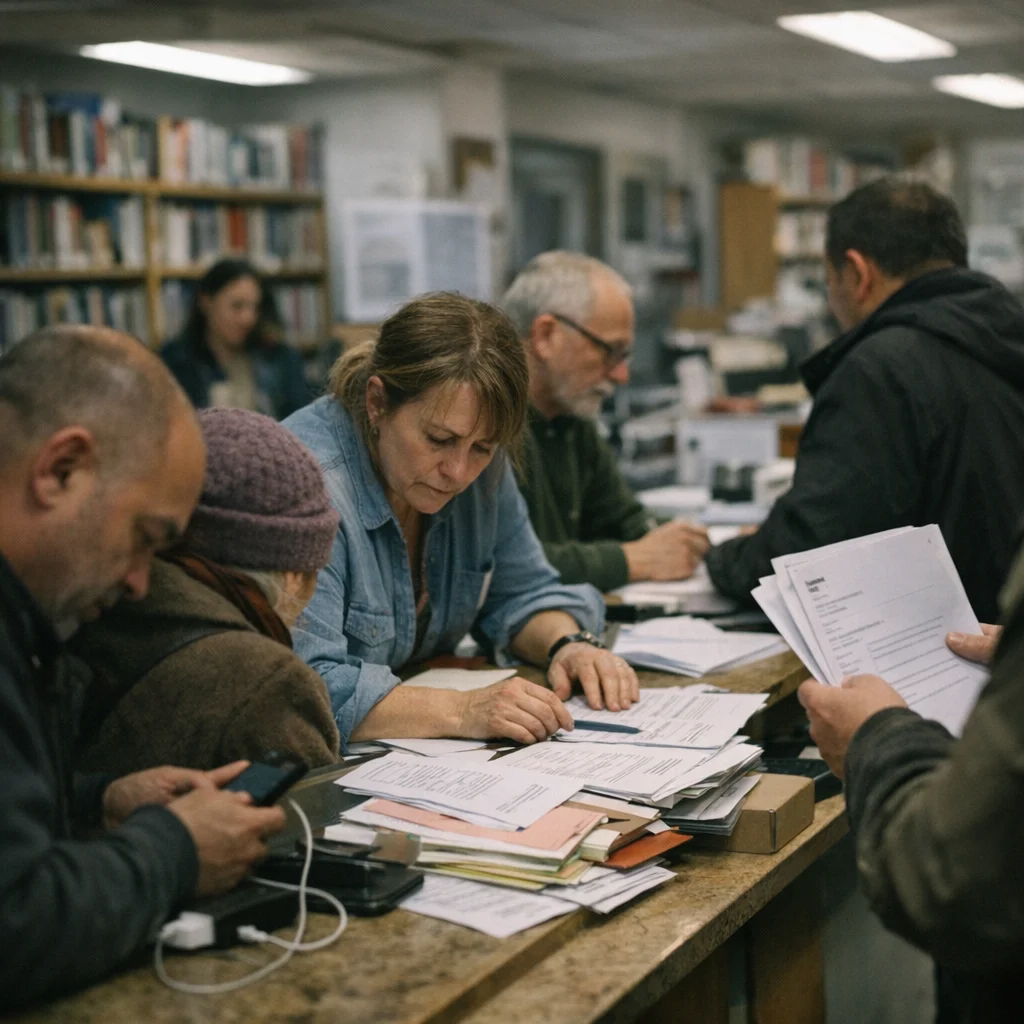
At the district library on Müllerstraße, the front desk has quietly become Wedding’s little altar of public need: a place where people come to be translated, charged, printed, and professionally put back together by staff who were hired to shelve books, not to absorb the city’s nervous breakdown.
Jobseekers arrive with folded CVs and the expression of people who know their future is being judged by a machine with a German interface. Older men drift in to kill the afternoon because going home would mean facing the apartment, the TV, the ex-wife, the silence, or whatever arrangement of domestic shame still qualifies as a life. A man in a spotless jacket asks for Wi‑Fi with the entitlement of someone requesting a state subsidy for his own laziness. Two startup pilgrims with identical black tote bags ask whether the study room can be made “more collaborative,” which is a charming way of saying: can the poor be moved so we can perform urgency in peace.
By noon, the desk looks less like a library counter than a border checkpoint for dignity. Phones are charged. Housing forms are printed. School applications are explained. Passports are not checked, but humiliation is. The same city that cannot maintain a toilet without a strategy paper somehow expects library workers to function as receptionists, translators, social workers, IT support, grief counselors, and the soft landing pad for anyone too broke, too tired, or too ashamed to admit they need help. Very efficient. Very civilized. A little sweaty around the edges.
One librarian, speaking on condition of anonymity because she once printed her own resignation letter, said the desk now operates like “a small republic of unpaid needs.” It is the sort of phrase administrators love because it sounds humane while describing organized neglect. She listed a typical morning: a mother asking for forms in Turkish and German, a teenager charging a dead phone, a man in a coat too expensive for his actual life demanding a CV printout, and a municipal influencer in a clean blazer asking whether the reading corner could be “more activated.” The borough loves language like that. It can make a drained room sound like a startup with shelves.
“Democracy hub” is the official phrase, which is what public relations calls a building when it wants applause for not collapsing yet. The district says the branches are “safe, open, and inclusive,” a sentence so polished it practically smells like a conference sandwich. Safe for whom? Open to what, exactly? Inclusive of the countless people using the branch as a substitute for housing, job counseling, and a functioning emotional life? The words do a lot of work while the staff do the labor, which is the borough’s favorite distribution model.
The real class benefiting from this arrangement is not the public. It is the layer of city managers, grant consultants, cultural officers, and polished participation merchants who get to treat the library like a moral costume closet. They praise “access” the way landlords praise “community,” meaning with one hand extended for funding and the other already closing the door. In their hands, the library is less a commons than a stage set where civic virtue can be photographed beside a broken printer.
Mehmet Yildiz came in to help his nephew with a school application and ended up translating a housing form for an elderly neighbor who had clearly been carrying bureaucracy around in his chest for years. “It’s where people come when every other door has already acted tired,” he said. Then he laughed, because in Berlin you either laugh or you start naming names.
That is the scandal: not that the library is crowded, but that it is crowded with people the city has trained to arrive quietly, ask politely, and accept the slow administrative undressing of their lives. The poor come for printing. The lonely come for light. The overeducated come to look employable while their laptops suck the last electricity from the sockets. The well-dressed come to borrow the atmosphere of need without having to smell it. Everyone is welcome, which is another way of saying everyone is expected to improvise.
And so the branch keeps absorbing the overflow: paper, electricity, shame, the occasional survival plan, the municipal lie pressed smooth and fed back to the public as a virtue. The books remain where they are, patient and ignored, while the desk handles the real circulation. The borough will announce another participation initiative soon, probably with a logo and a workshop. Until then, the line at the counter remains the most honest political document in Wedding: a queue of people being kept alive by a service the city insists it already values.