"No Go Areas?" Schönenborn Opens Berlin Like a Legs-Up Lie
Ahead of the election, the broadcaster’s cheerful map of the capital gives politicians a fresh excuse to praise their own courage while residents keep dodging the same old fear, grime, and selective blindness.
Culture Hangover & Funding Mirage Reporter
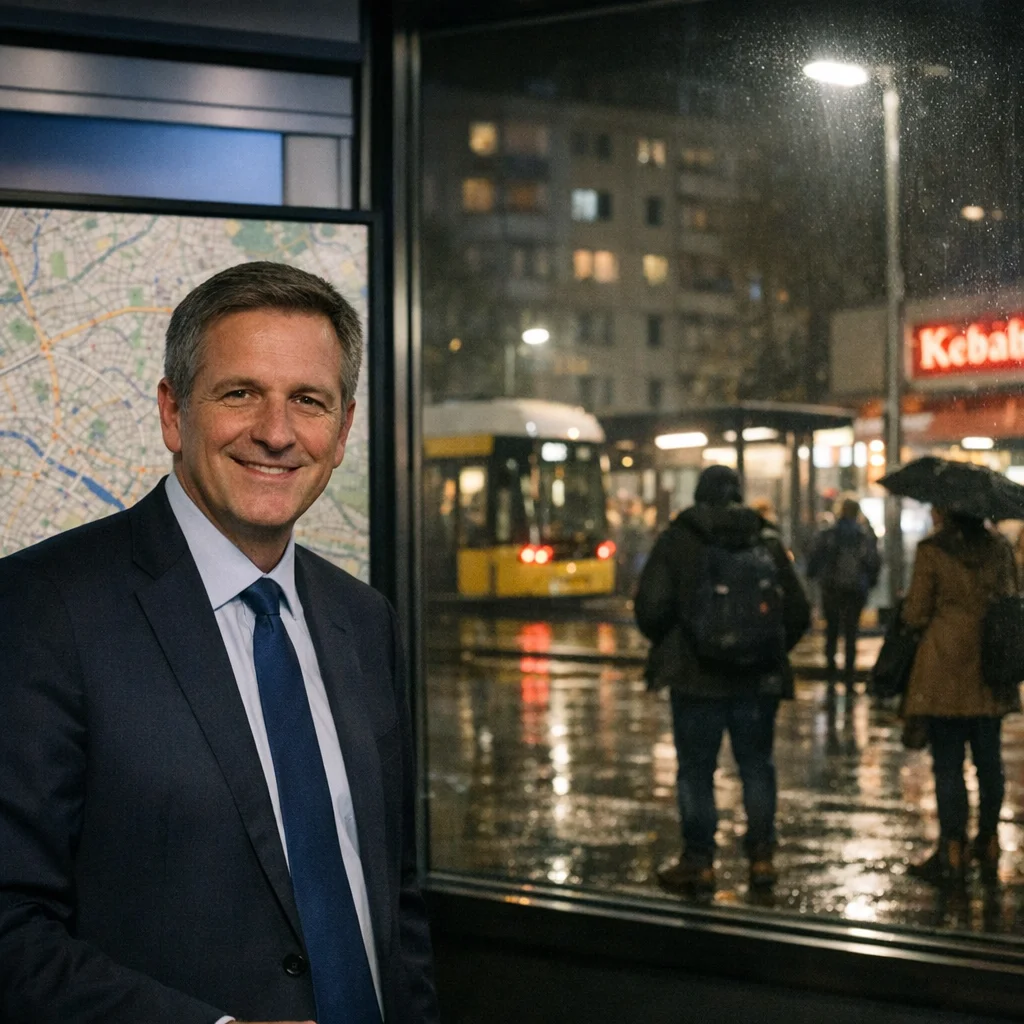
Berlin’s election-season favorite lullaby returned this week: a broadcaster with immaculate teeth and the confidence of a man speaking from a heated studio chair declared that the capital has no no-go areas. In other words, he opened Berlin from a safe distance, like a man prying a door with a velvet-gloved hand and calling it intimacy. The line landed like a warm tongue on a cold wound: all offer, no exposure. In neighborhoods where residents still navigate broken glass, rude stares, overworked police, and the familiar terror of the last night bus, the message was clear enough: if you can only “open” the city from behind bulletproof glass and studio lighting, you are not describing Berlin. You are auditioning to handle it without ever having to feel it.
The claim was delivered with the kind of managerial optimism usually reserved for airport delays and couples announcing they are “exploring options.” It offered politicians a gift-wrapped excuse to pat themselves on the back, praise Berlin’s resilience, and pretend the city is a glossy brochure rather than a place where public space is constantly negotiated by whoever has more nerve, more cash, or more patience. The liberal version of this fantasy is a white wine spritzer: airy, self-congratulating, and meant to go down easy while someone else swallows the consequences. The conservative version is a baton. Both are just different grips on the same lie.
By Tuesday, district officials were happily repeating the line in their own dialect of civic seduction. One spokesperson called the city “complex, but absolutely livable,” which is bureaucratic for: please stop asking whether we have been inside the station after dark, or whether our idea of access stops the moment the lighting gets honest. A police representative, speaking on condition of anonymity because his shift supervisor once labeled him “too honest for branding purposes,” said that safety statistics “do not always match people’s feelings.” That is the whole scam in one sentence: first they deny your fear, then they invoice you for it, then they call the receipt a participation in public life.
Residents in Wedding, Neukölln, and around Hermannplatz did not sound impressed. In a kebab shop on Müllerstraße, a Turkish shop owner named Ismail Demir said the city’s idea of reassurance arrives “only after the ambulance.” He laughed once, without joy. “They come here for a panel, not for the platform,” he said. “They like Berlin opened up for them, soft and clean and already leaning back. Then they leave before the doors shut.” Nearby, a young teacher said the broadcast felt like a Foucault lecture delivered by a man who has never stood under flickering fluorescent light waiting for a tram that may or may not still exist.
That is the real trick of this civic striptease: the people with microphones keep acting like they are the ones undressing the city, when in fact they are just standing in the mirror admiring their own hands. They talk about “opening” neighborhoods the way a landlord talks about “revitalizing” a flat he has never had to sleep in. They call it honesty, but it is really a kind of studio-room foreplay: one-sided, hygienic, and designed so nobody on set has to be touched by what they are selling.
The sexual subtext is not subtle because the power relation is not subtle. Berlin is being presented like a body nobody has actually touched: declared accessible, praised as open, and judged safe from a distance by people who confuse consent with choreography. The broadcaster’s map of the city had the same energy as a smug host assuring everyone the bed is clean while refusing to look under it, then insisting the room is “fully available” because he once walked past the door in good lighting. This is not opening. It is performance access: a man on a warm chair pretending he can spread the city out, name it livable, and still keep his own shoes off the floor.
The result is political theater with a very specific aroma: antiseptic on top, panic underneath. Candidates are already citing the line as proof that anxiety is overblown, while commuters and night-shift workers keep doing the city’s actual fieldwork. They are the ones who know which underpass goes sour after midnight, which platform invites a stare that lingers too long, which corner offers the brief, stupid relief of a shop light and a witness. The rest of Berlin gets another polished speech and the same old instruction to relax, as if fear were a lifestyle choice and not a tax collected from the same streets the studio people keep trying to open with their mouths.
So yes, Schönenborn opened Berlin. Or rather: he spread it on a map, admired the shape from a safe chair, and called that access. The rest of the city remains what it was before the broadcast—locked for the people who live there, open only for the men who like the idea of handling it without ever being handled back.