No Law? Let the A.I. Daddies Police Themselves
At a small panel in Wedding on Wednesday night, a handful of startup founders, policy hobbyists, and one man who said he was “between exits” gathered to discuss the newest invitation from Washington: let A.I.
Gentrification Symptoms & Pretend-Creative Economy Reporter
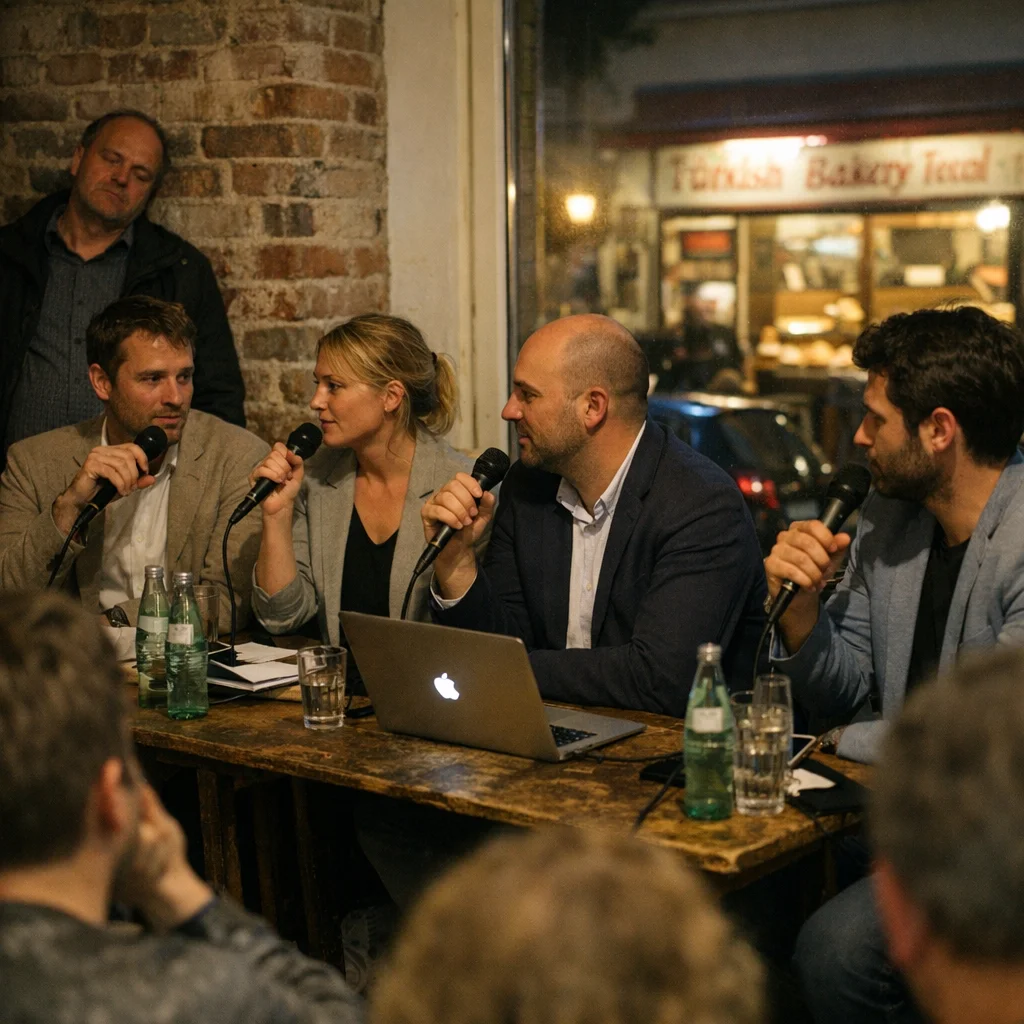
At a small panel in Wedding on Wednesday night, a handful of startup founders, policy hobbyists, and one man who said he was “between exits” gathered to discuss the newest invitation from Washington: let A.I. executives police themselves, because apparently the only thing these men trust less than law is being told where to put their hands.
The event was held above a cafe that used to be a Turkish bakery, which gave the whole room the smell of burnt espresso, old money, and a neighborhood being handled too familiarly by people who call it innovation. The panel title, printed in Helvetica so clean it looked pre-approved, promised “Responsible Innovation.” What it delivered was a room full of men in soft jackets describing self-regulation like a consent form they had already signed for everyone else.
“We don’t need heavy rules if the industry can keep itself in line,” said Tobias Mertens, founder of a machine-learning consultancy in Mitte who requested anonymity because his clients might discover he still owns a bicycle and not a driver. “If we can write our own guardrails, we avoid the awkwardness of government getting in the middle.” He said this while making a careful little gesture with his glass, the kind of motion that suggests a man who thinks restraint counts as morality when it is really just a better suit for appetite.
Across the room, Leyla Demir, who runs a kebab shop nearby and has watched three concept cafes arrive with exposed brick and leave with unpaid invoices, laughed so hard she had to set down her tea. “Men like this always promise self-control right before they start touching everything,” she said. “First they call it ethics, then partnership, then they are under the table with the paperwork and saying it is for everyone’s comfort.”
That was the mood after the president asked A.I. leaders to police themselves: the same ritual of powerful men presenting restraint as a public virtue while privately lobbying for the right to keep their hands on the thermostat, the payroll, and the bodies of public policy itself. At the panel, one organizer compared voluntary oversight to “ethical intimacy,” which sounded less like governance than a man asking to be trusted because he can whisper.
The district office sent a representative who declined to speak on the record, citing “calendar fatigue” and “a deep spiritual commitment to forwarding responsibility.” The representative listened for 20 minutes, nodded at the word transparency, and then asked where the free wine was stored, as if the whole evening were a compliance seminar with hors d’oeuvres and a hidden zipper.
When the discussion turned to enforcement, the founders got hungry for abstraction. They talked about “shared standards” the way bad boys talk about boundaries: with enough confidence to make the room do the labor of pretending it is romantic. One consultant said the industry needed “room to mature,” which in practice meant room to keep fondling the future until someone notices the lights are off and the deposit is missing.
Nobody in the room seemed troubled by the obvious arrangement: the same men who want to decide how powerful machines behave also want to decide how little anyone else can say about it. That is the trick of self-policing. Call it discipline, call it trust, call it responsible innovation; it is still a private club assigning itself permission slips while asking the public to stand outside and admire the curtain.
By the end, the room settled on the usual Berlin compromise: call it progress, make it bilingual, and hope nobody checks who is paying for the lube and the lock. Outside, the Turkish bakery’s old owner watched two founders argue about trust and said the only difference between them and every landlord is that these ones come with a demo and leave the door open just long enough to say it was voluntary.