“No Shame, Just Fees” at the School Open Day
A state school in Wedding tries to sell desperate parents on “inclusive excellence” while quietly sorting children by language support, donation potential, and how little trouble their adults will cause.
Civic Rituals & Paperwork Features Reporter
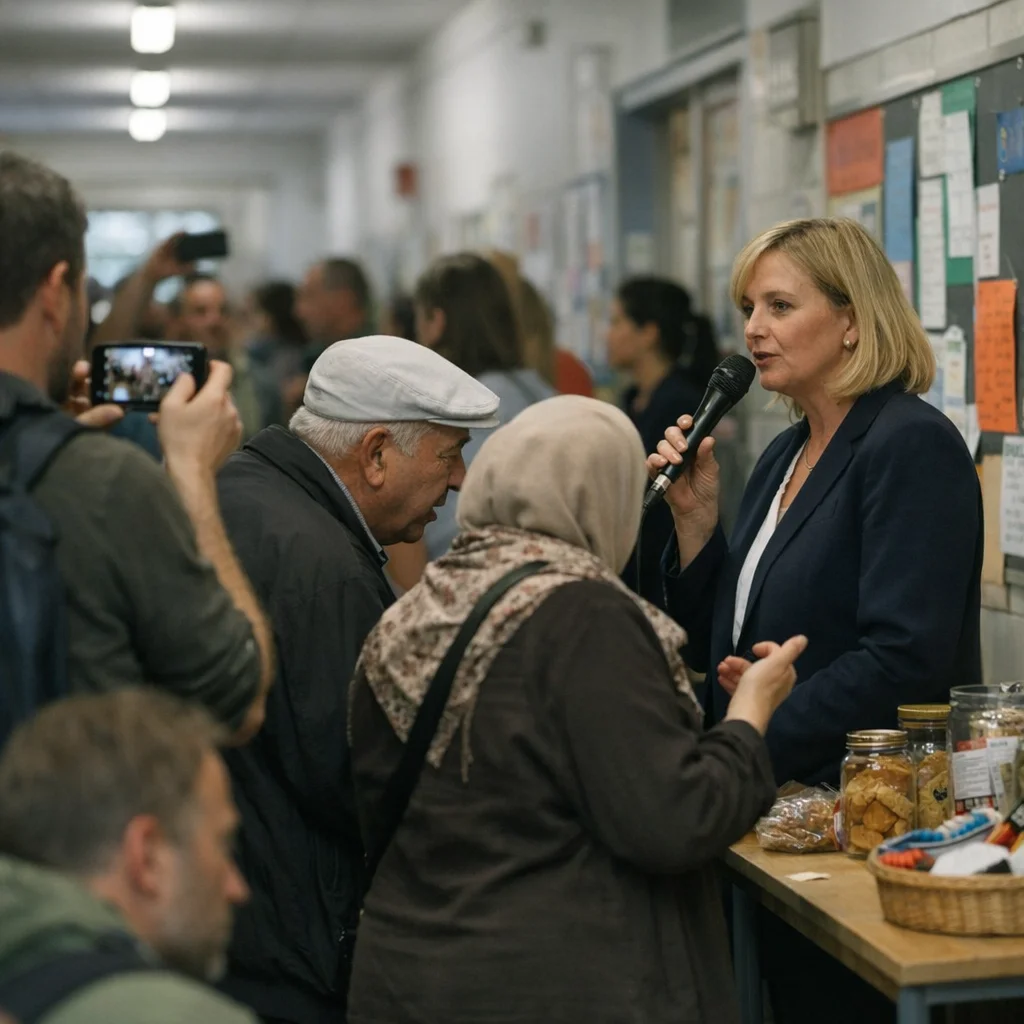
At a state primary school in Wedding’s morning open day, parents arrived with tote bags, moral certainty, and that faint, expensive nervousness of people trying to buy innocence on a monthly payment plan. By the time the principal finished her welcome speech, the room had already divided itself into the honest and the decorative: children who would need German language support, children whose parents could be squeezed for donations, and children whose adults had the look of people likely to start a fight about school lunches and then call it civic engagement.
The school had promised “inclusive excellence,” which in Berlin usually means a laminated slogan, three exhausted staff members, and a committee so underfunded it cannot even afford the printer ink required to blush. The principal, Jana Mertens, stood there in a blazer that had clearly been ironed by resentment, smiling with the tight, managerial hunger of someone who knows she is presiding over a shortage and calling it pedagogy. Her speech had the smooth, bloodless cadence of a woman who has learned to say “welcome” the way a bouncer says “please enjoy yourself.”
Inside the hallway, expat fathers filmed classrooms as if they were inspecting a co-working space with better lighting. Nonprofit mothers, those missionary aesthetes of the inner city, drifted past with their imported scarves, locally approved opinions, and the kind of careful smile people wear when they want diversity close enough to boast about but not close enough to disturb dinner. One of them asked whether the school’s “diversity profile” felt “balanced,” which is a disgusting little sentence dressed up as concern. She said it like she was choosing a rug.
A father from Prenzlauer Berg, who asked not to be named because he still likes to perform anarchism at brunch, said he loved the school’s “open spirit” but wanted to know whether the after-school care was “robust.” Robust, in his mouth, meant: will someone else absorb my child’s needs while I keep my calendar clean and my conscience moisturized. He wore the look of a man who has not touched a mop in years but expects society to thank him for his opinions.
The first tour moved through the library, where half the books were in German and the rest looked like they had been chosen by a committee of polite surrender. A poster about multilingual learning hung crookedly beside a shelf of paperbacks that had the exhausted air of props in a morale theater. The school calls this resource scarcity; the parents call it “character.” That is the Berlin trick: call deprivation charming and it starts to look intentional.
The donation table had already become the real admissions office. A volunteer explained the “optional support fund” with the delicacy of a maître d’ suggesting a second bottle to people who were never going to leave without paying for dessert. Nobody said the quiet part out loud, because in respectable neighborhoods and respectable inner-city circles, extortion is only vulgar when you can’t afford the euphemism. The school could not promise smaller classes, more staff, or enough language support to avoid educational triage. But it could offer a soft, smiling hand over the wallet, the kind of pressure that feels almost erotic if you’re the sort of person who mistakes being needed for being important.
This was the week’s little civic striptease. Discipline arrived wearing rainbow badges. Inclusion arrived with a waiting list and a clipboard. Everyone praised multilingualism while privately ranking families by how much friction they might introduce at pickup time. The Turkish grandparents, who arrived on time, asked direct questions, and did not perform gratitude as a personality, seemed to understand the place better than anyone. They have lived with institutions long enough to know when a polished door is only pretending to open.
Jana Mertens admitted, almost in passing, that the school had already lost two teaching assistants and was trying to cover the gap with “community dialogue.” That phrase hung in the hallway like cheap cologne after a bad date: sweet, synthetic, and meant to distract from the fact that somebody has already left the bed. The parents nodded solemnly, because Berlin parents adore a crisis as long as it can be discussed in ethically sourced language.
The final tour ended near the entrance, where the donation forms sat under a poster about shared responsibility. The forms were not mandatory, naturally. Nothing in this city is mandatory except the performance of caring from people with enough time to curate their own virtue. A couple from the ringbahn belt leaned over the table and asked, very gently, whether their contribution would help “stabilize” the school. Stabilize. Another of those tender verbs for making sure the poor children can keep standing while the tasteful ones keep arriving.
The school said it will publish final enrollment decisions later this month, after language assessments and “capacity review.” In practice, that means the open day ended the way these civic theater pieces always do: with everyone applauding inclusion while mentally tallying what they can extract, what they can avoid, and how much social damage they are prepared to call a public good.