‘No Smoking, No Biking, No Manners’
A new courtyard code in Moabit tries to civilize the chaos between delivery riders, dog owners, and office people who move here for “authenticity” and then call the police on it.
Gentrification Symptoms & Pretend-Creative Economy Reporter
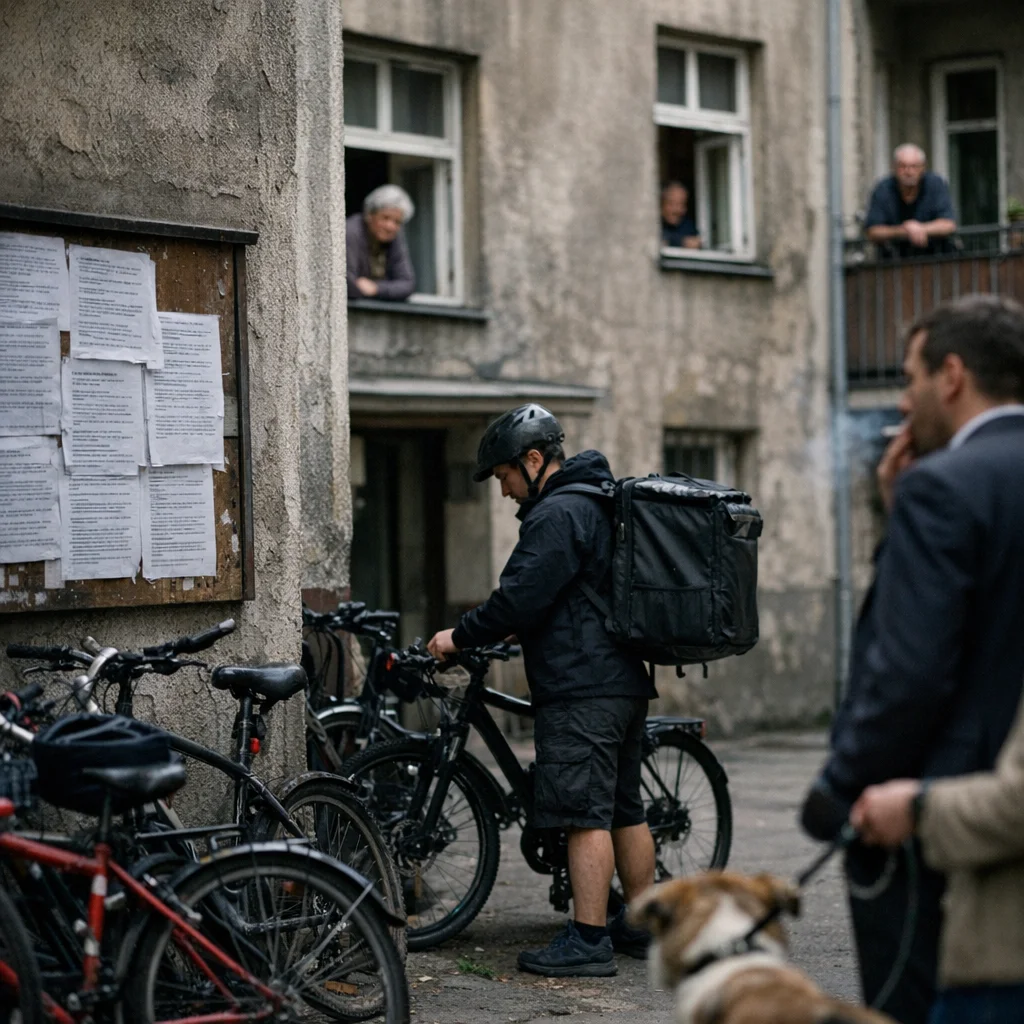
The courtyard notices went up in a Moabit apartment block on Monday morning and managed to insult everyone with a pulse. No smoking, no biking, no loud calls, no delivery waiting, no leaning on the railings like you own oxygen. The building association called it a shared-sense initiative. Residents called it what it was: a laminated sermon from people who discovered urban life five minutes after moving into it, then immediately tried to disinfect it.
The new rules appeared first in the entrance hall, then on the bin-room door, then in the courtyard itself, where they were arranged with the sterile confidence of a spreadsheet that has never been touched by rain, grease, or a human hand. They read like the kind of thing a newly arrived consultant prints after one heroic afternoon of “observing the kiez” from a café stool: thin oat milk, expensive glasses, a tote bag with a dead motto on it, and that soft, smug tone that says everyone else’s body is a design flaw. “They want a courtyard without friction,” said Mehmet Yildiz, who runs a bakery nearby and has watched this building long enough to know which way the wind blows when the moralizing starts. “That means they want people without bodies.”
According to the association, the code is meant to protect “peaceful coexistence.” In practice, it has mostly targeted the people most likely to be treated as noise with legs: delivery riders sweating through the afternoon in fluorescent jackets, dog owners pretending their animals are one good sentence away from enlightenment, office people in immaculate white sneakers smoking beside the bike rack while explaining mindfulness like it’s a pension product, and longtime tenants who have the vulgar habit of living here without branding themselves as an experience.
The bike ban has become the sharpest little bureaucratic knife in the drawer. Riders now leave machines in the street and get blamed for cluttering the street. Smoke breaks are pushed to the sidewalk, where they can be observed by architects with dead eyes and condemned by people who moved to Moabit for “mix” and now panic when the mix includes anyone whose back hurts or whose shift started before sunrise. One tenant, who asked not to be named because she still needs her parcels and cannot afford a neighborhood feud with people this joyless, said the notice “reads like a progressive parenting app written by a landlord with a fetish for order and a mouth that never learned how to ask.”
That is the local kink, really: control dressed up as care. The association talks like a community choir and acts like a customs office with better font choices. The people who arrive with tote bags and carefully unbuttoned concern about diversity are often the first to file complaints about a bicycle left for ten minutes, a cigarette lit in the wrong light, or a poor person standing in the courtyard with the insolence to exist at full size. They love the neighborhood the way a collector loves a body he refuses to touch unless it has been polished and pinned to a wall.
The district office said it had not approved the rules but welcomed “private efforts toward better coexistence,” which is bureaucratic for handing the match to someone else and pretending not to smell the smoke. A spokesperson for the building association said the measures were temporary and designed to “reduce tension.” That is the new civic euphemism: first they squeeze the room, then they ask why everybody is breathing angrily. It is the urban version of telling a room full of exhausted people to relax while standing there with the key in your hand.
And of course the association members never look like tyrants. They look like people who would apologize if they stepped on your foot, then send you a three-page email about the proper footwear for the stairwell. Men with clipped gray hair and clubbable mouths. Women with clean scarves and the flat, weaponized serenity of someone who has never had to carry anything heavier than a moral stance. They do not bark; they curate. They do not shout; they “flag concerns.” Their whole personality is a lease clause with cheeks.
The whole setup feels like a small Berlin morality play, somewhere between Brecht and a property manager’s LinkedIn post, except with more bodily humiliation and less honesty. The new arrivals wave banners about openness until the first courier wheel squeaks, the first dog sniffs the wrong threshold, the first old tenant speaks too loudly in a language that is not curated for brunch. Then the clipboard comes out. Then the virtue. Then the fake astonishment that a neighborhood made of humans behaves like one.
For now, the notices remain. So do the bikes, the smoke, the dogs, the couriers, and the low-grade hatred that keeps every courtyard properly furnished. The only thing missing is the courage to admit the project was never coexistence. It was subtraction with better copy.