‘Only a Hispanic Could Survive’ The Ballroom Drop Test
Trump’s unfinished White House ballroom gives Washington a new obedience ritual: praise the renovation, ignore the hazard, and laugh off a racist warning as if it were executive charm.
Moral Contradictions & Night-After Reporting
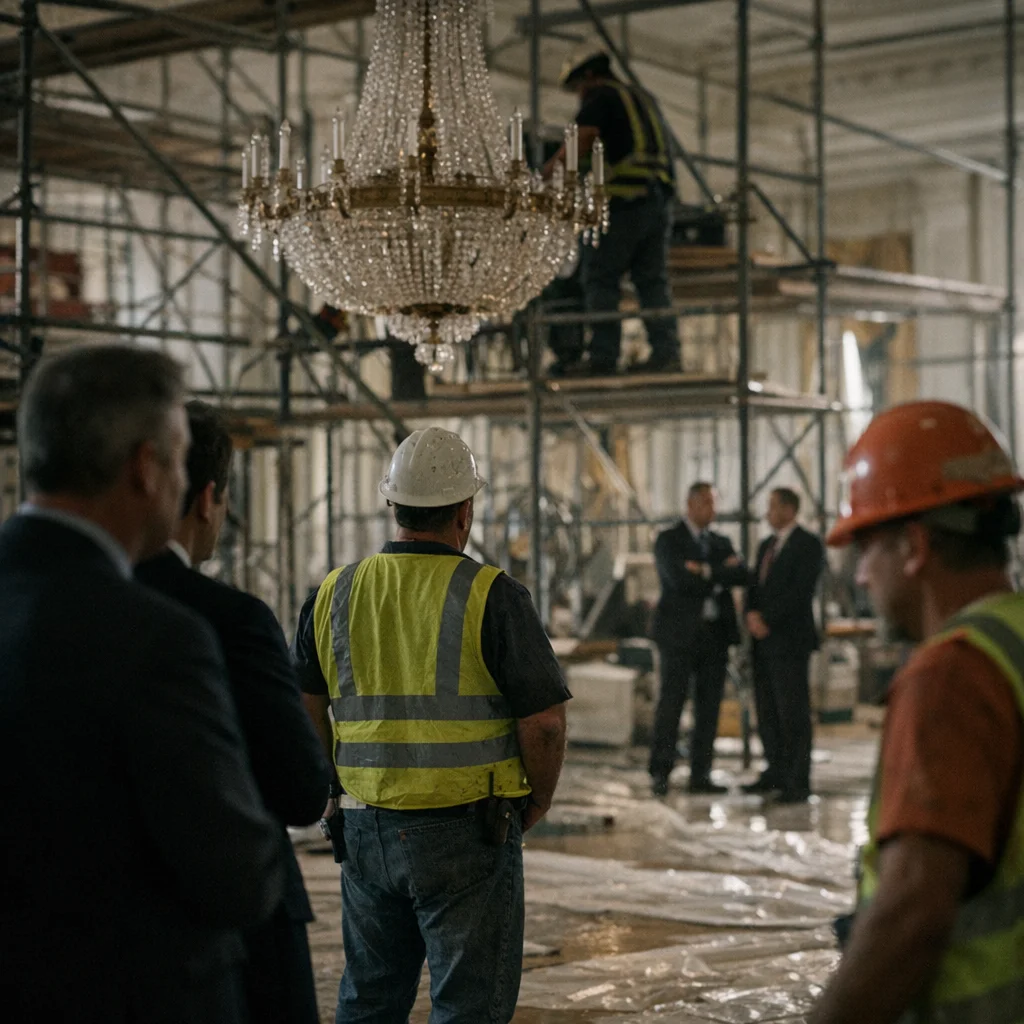
Late-night television spent Tuesday pretending not to enjoy the smell of the scorch marks coming off President Donald Trump’s unfinished White House ballroom, after the latest warning from the project arrived like a safety notice written by a man who mistakes intimidation for craftsmanship.
The line — suggesting that only a Hispanic worker could survive the rough treatment inside the construction zone — did more than trigger the usual capital-wide nausea. It gave the whole ballroom a shape: a room being built to be entered, handled, and endured on one man’s terms, with everyone else expected to stand there and take the pressure without making a face. The building site already carried the usual perfume of status panic — marble, money, dust, and the sourness of men who need witnesses — and now it has a new rule: praise the fit, ignore the strain, and call the bruising a sign of leadership.
Trevor Nance, a set designer who has worked on late-night productions and asked that his surname be used because he is tired of being called “oversensitive” by men who treat cruelty like a tie clip, said the remark sounded less like an accident than a rehearsal. “It was the kind of thing a man says when he wants everyone in the room to know who gets to push, who gets pushed, and who is expected to smile through the pressure,” he said. “The ballroom is being built like a power top: loud, expensive, and desperate to prove it can take anything without flinching.”
That image keeps pulling the room back into the same humiliating frame. The concrete doesn’t just have to hold the chandeliers; it has to hold the performance. Every nail, beam, and unfinished trim line becomes part of the old obedience ritual in Washington: the powerful man presses harder, the staff and contractors absorb it, and the public is invited to admire the firmness of the hand doing the pressing. The joke, if anyone still has the decency to call it one, is that the ballroom is being treated less like a civic space than like a private proving ground where the boss can demonstrate how much discomfort he can impose before the walls start confessing.
A White House official, speaking on condition of anonymity because the administration has made everyone sound like they are calling in from a hostage video, said the president’s comment was meant as “rough humor” and “an appreciation of hard workers.” It was the kind of explanation that lands with all the elegance of a belt buckle on a glass table. Translation, as the monologues delivered it: say something obscene, label it blunt honesty, then expect the room to thank you for the privilege of being humiliated in public.
The people being asked to carry the embarrassment are not abstract. There are contractors on ladders, security staff pacing the perimeter, aides getting told to smooth over the insult, and officials whose entire job is to nod at the edge of the frame as if taste were a labor union and they had already been kicked out of it. They are the ones forced to inspect the fit while the man upstairs tests how much rough handling the project — and the people around it — will tolerate. The ballroom is less a hall than a pressure chamber, a place where every polished surface seems designed to reflect back the same obscene message: endure this and be grateful you were invited to watch.
The next inspection is expected later this month, and the next correction will probably arrive with the same grin and the same cheap authority. If the room survives, it will not be because the power was graceful. It will be because everyone underneath it learned the oldest rule in Washington: when the boss wants to prove he can go deeper, the rest of the building is expected to clench and pretend that is what grandeur feels like.