Paraguay, Penalty Shoot, and the Keta Lie
Merz can boast about the DFB all he wants, but the fan zones and watch parties are where patriotism gets stripped down to thirst, posture, and a very expensive line of denial.
EU Melodrama & Sidewalk Diplomacy Correspondent
Flags Up, Pants Down
Germany’s World Cup exit against Paraguay on penalties left the nation doing what it does best after a sporting humiliation: dressing panic up as character and calling the costume national resilience. By Tuesday morning, people in Berlin were already being told to “take the positives,” which is the civic equivalent of a man tugging his shirt back on while the room still smells like bad decisions.
Friedrich Merz, who seems to treat every public defeat as a chance to polish his own cufflinks, posted that he was “proud” of the team and urged everyone to keep their heads up. It had all the emotional credibility of a landlord saying the mold is part of the building’s personality. The man can’t pass a camera without looking like he’s auditioning for a funeral sponsored by industry.
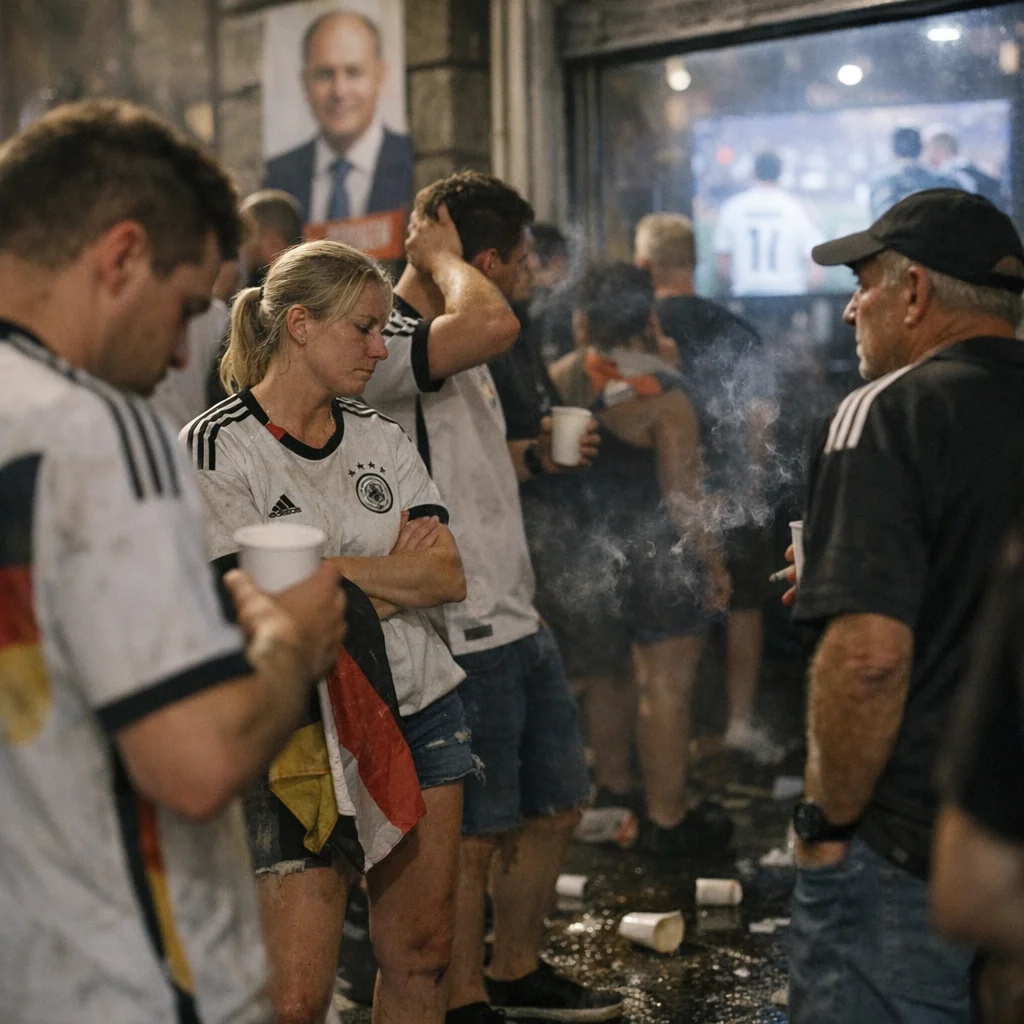
The fan zones told the truth in the ugly little details the press release skips. Outside a watch party in Friedrichshain, a man in a shirt that had gone damp at the collar was nursing a plastic cup of warm beer and a bruised ego, staring at the pavement like it had personally filed the loss. Someone had dropped a half-melted bratwurst into the gutter. A woman in glittery makeup and a puffer jacket was chain-smoking beside a bicycle rack, laughing too hard at nothing, because sobriety was clearly not part of the dress code for grief.
You could smell the whole evening the next morning: stale hops, wet wool, vape sweetness, and the sour bite of men insisting they “don’t care that much” while talking about the shootout for the fifth time. That is the Berlin version of patriotism everyone likes to photograph cleanly from a safe distance—red, black, and gold on the cheeks, then piss in the stairwell, broken glass by the curb, and somebody’s lost scarf being kicked around like a moral afterthought.
Naturally, the people with the least sweat on them tried to turn the mess into a narrative.
The DFB responded with its usual ritual of respectable cowardice. A spokesperson said the team would “reflect” on the result and support the coach as he “processes” the defeat. Processing is the federation’s favorite little euphemism: it suggests thought without responsibility, emotion without consequence, and accountability folded neatly into a branded folder. These are the same people who can turn a bad tournament into a “development phase” so quickly you can almost hear the sponsor decks shuffling.
Merz and the DFB belong to the same species of German authority: tidy on the surface, terrified underneath, and always available for a quote about unity once the mess has already been swept toward the service entrance. They love the country when it is draped, saluted, and well lit. They disappear the moment somebody has to mop up the beer, the shame, or the tactical corpse.
The match itself was a perfect little state metaphor. Five men walked up alone, each one carrying the full weight of a nation that likes to imagine courage can be delegated to institutions. One missed. Then another. Then the whole thing collapsed into the sort of helpless silence usually reserved for ministry briefings and awkward first dates. Nothing in football is more honest than a penalty shootout: no committee, no slogan, no “process” to hide behind. Just a body, a run-up, a hard strike, and the public exposure of whether you can keep your nerve when everyone is watching your hips and your hands.
And that is where the class divide shows its teeth. The people in the VIP boxes get patriotism served like a canapé: crisp, clean, and already plated. The people outside get the sticky floor, the spilled mustard, the cold walk home, and the privilege of pretending the nation’s dignity didn’t just leave with the last train. One side gets to wave a flag and call it principle; the other side gets to step over the wreckage and make sure nobody vomits on their shoes.
By afternoon, the postmortem machine was already in motion. Sponsors wanted “resilience.” Pundits wanted a “clear analysis.” Social media wanted bloodless outrage with a hashtag and a filter. Everybody was desperate to convert humiliation into product, because that is the real German miracle: fail publicly, then monetize the shame before it cools.
The country will call this a lesson. It was more like a strip search. The team exposed its nerves, the federation exposed its reflex for soft lies, and the politicians exposed how quickly they can wrap a national bruise in ribbon and call it unity. The only people left with any honesty were the ones standing outside in the damp, holding cheap plastic cups, looking at each other like they’d all just slept with the same bad idea.