Parks Office Orders a Spiritual Signage Blitz
Wedding’s benches, tree pits, and playground edges are suddenly covered in earnest warnings about respect, rest, and shared space.
Civic Hypocrisy & Neighborhood Compliance Reporter
Laminate First, Govern Never
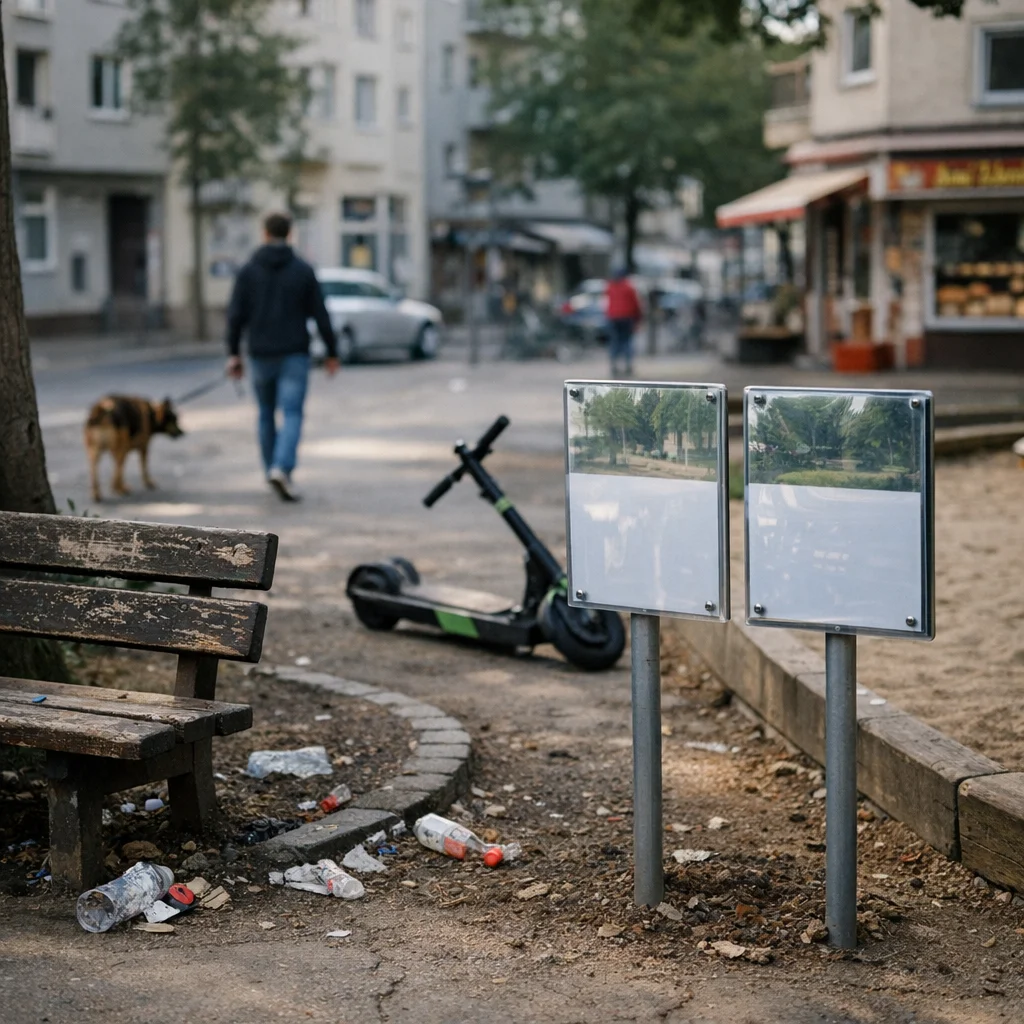
The Wedding district office has rolled out another little sermon campaign for the parks, and the result is predictably Berlin: benches, tree pits, and playground edges dressed up like a compliance exhibit for adults who cannot be trusted with a cough drop, let alone a public space. The signs beg people to respect shared areas, keep them clean, and behave decently, which is a charming fantasy in a city where half the neighborhood uses a shaded bench as a private ashtray and the other half treats every rule as an insult to their aura.
The new notices landed first near seating areas already decorated with wrappers and bottle caps, then along paths where scooters are abandoned with the limp entitlement of a bad date, and finally beside grass patches where dog owners suddenly discover metaphysics the moment they need a bag. District workers call this reducing friction. It is really the municipal art of polishing the surface while the rot keeps sweating underneath.
“Every spring they come back with another laminated plea for civilization,” said Nadine Yilmaz, who lives near one of the affected parks and asked not to be named because the same men who ignore leash rules are exactly the sort who would take offense at being seen as the species they are. “It feels like Michel Foucault with a label maker. The district wants obedience without maintenance. Very chic, very cheap, very pathetic.”
A parks office spokesperson said the district wanted to “strengthen mutual consideration” and make the rules more visible. That phrase arrives with the usual bureaucratic perfume: half kindergarten, half disciplinary threat, all cowardice. In practice, the signs perform the beloved civic trick of turning a management failure into a moral one. The trash remains, the staffing remains thin, and the office gets to stand there in its clean little shoes pretending that typography counts as governance.
Nearby shop owners, including Turkish bakers and small grocers who actually see the street before lunch and after dark, said they were not consulted. Which is fitting. Consultation in this district often means asking for patience from people who already know they will be blamed for the mess. The loudest imagined stakeholder is always some compactly smug parent with a reusable cup and a moral vocabulary, or a man in linen trousers who thinks “shared responsibility” means other people should absorb his noise, his smoke, and his entire unpaid personality. The neighborhood is then narrated as if the only residents were politeness and guilt.
And of course the real park economy keeps going. Someone drops a bottle and leaves it for the gods of municipal cleanup. Someone smokes under a tree like the tree owes him intimacy. Someone drags a scooter across the path with the confidence of a man unbuttoning after midnight. The dog does what the owner is too lazy or too bourgeois to notice. Meanwhile the office issues another round of signs, as though shame were a substitute for bins, patrols, and the basic courage to say no to people with the loudest self-image.
By late afternoon, one of the new notices had already been bent backward, looking less like authority than an object that had been leaned on, handled, and made ridiculous. That is the district’s true style: not care, but managed embarrassment. Not order, but a paper-thin threat in a clean font, asking everyone to behave while the institution itself sits there in full administrative drag, too timid to govern and too vain to admit it.