Pigeons Are Managing the Train Platform Again
The official story is that Friedrichshain’s transit upgrades are about cleaner stations and better flow, but the real innovation is watching exhausted commuters obey floor stickers like obedient interns while the actual.
Nightlife Identity & Self-Deception Correspondent
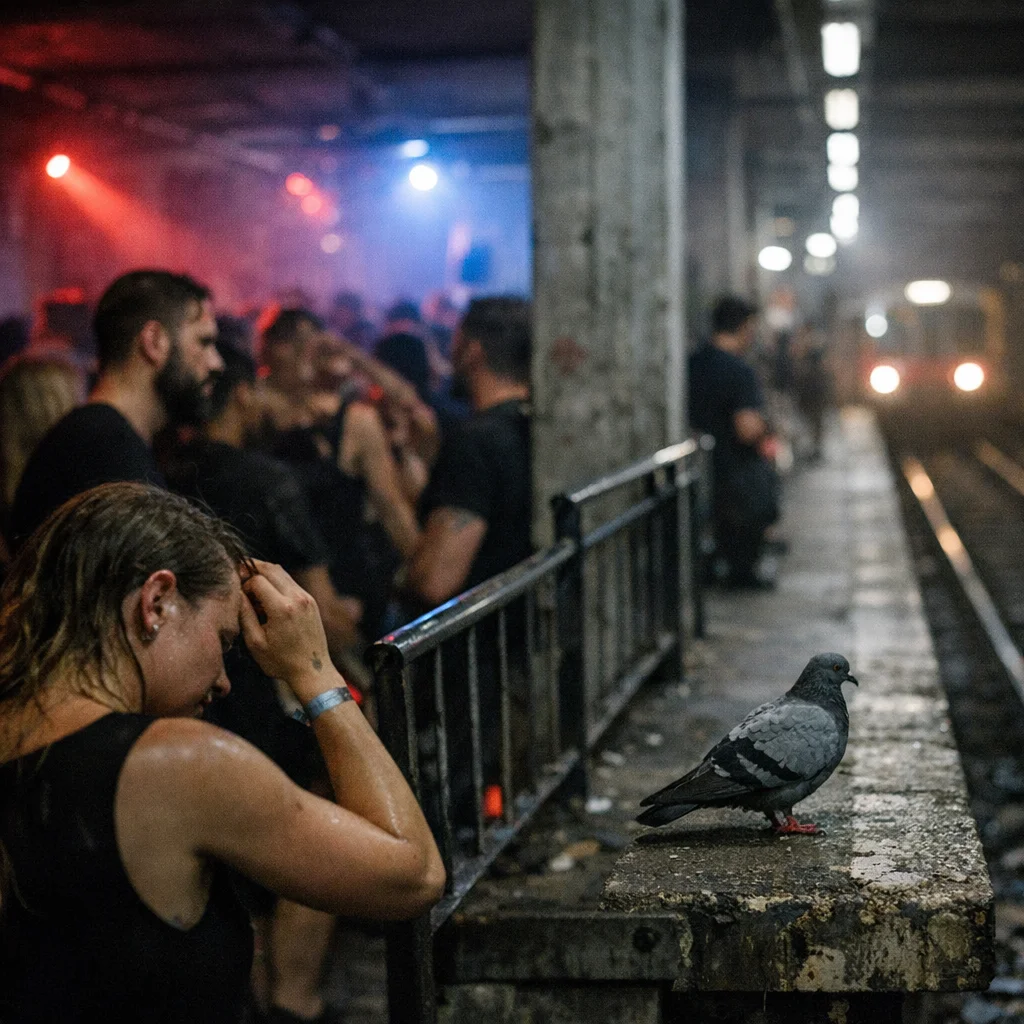
At the RSO line in Friedrichshain, the industrial techno crowd still likes to speak as if it has discovered the last honest basement in a city full of polished frauds. It is a lovely delusion. By midnight the black-clad faithful are already tugging at their outfits like nervous shareholders, checking guest-list rumors, comparing stamps, and radiating the wounded vanity of people who would like to be mistaken for dangerous but are mostly just well-styled and overbriefed. Berghain remains the cathedral of sanctioned humiliation; RSO is the annex where everyone comes to be seen failing to be cool in exactly the approved way.
The pitch is always the same: harder sound, less posture, more body, more truth, more dirt. In practice it is a funded ritual of class theater. NGO creatives with bruised egos arrive in expensive boots and thrifted martyrdom, startup refugees in black turtlenecks pretend they have renounced the office while still smelling faintly of it, and trust-fund radicals drink €8 water as if hydration were a political position. They talk about anti-capitalism with the exhausted fervor of people laundering status through bass. Then the bar prices land like a slap from a landlord in sneakers, and suddenly everyone remembers that rebellion in Berlin is mostly a consumption plan with a harder soundtrack.
The humiliations are beautifully administrative. Ticket tiers sort the faithful before the night even begins: early entry for the disciplined, last-minute cash extraction for the desperate, guest-list mythology for the socially thirsty. The door becomes a tiny republic of arbitrary power, which is of course why everyone eroticizes it. Nothing gets the crowd wetter than a little procedural contempt. A man in a leather harness, who asked not to be named because his ex still monitors his burner account, said he came for “community.” He had already taken three selfies outside before remembering the inside is a no-photo zone, which means the whole scene is built on the same old kink: being denied and then paying to feel chosen.
Inside, the sound system does the usual ideological heavy lifting. The kicks are brutal, the lows are medicinal, and the crowd doesn’t so much dance as submit with expensive footwear. A DJ dropping a metallic break in the middle of a set gets applause from people who will later call the night “effortless,” which is Berlin code for: I worked very hard to look like I wasn’t trying to impress you. The bodies in the room are not liberated; they are managed. Sweat runs down necks, mascara gives up, shirts cling like bad decisions, and the whole floor develops the moist sincerity of a group project nobody wanted but everyone needs on their CV.
RSO’s real genius is that it lets people cosplay as danger while staying obedient to the script. Arrive late, look wrecked, act unbothered, leave with your shirt open and your politics unexamined. The security line is efficient, the stamps are clean, the bathrooms are packed like a minor humanitarian failure, and the cigarette crowd outside performs exhaustion with the devotion of a municipal press office. Even the mess has branding. Even the filth has a sponsor-adjacent smell.
This is where the wider city’s extraction machine gets to wear mascara and call itself nightlife. Friedrichshain rents rise, former industrial spaces get repackaged as “culture,” and the same people who complain about gentrification spend €20 on entry to celebrate the aesthetic consequences of it. Landlords profit from the myth of rawness, promoters profit from scarcity, and the club scene supplies the emotional glue: a weekly mass where the middle-class can kneel before their own ruin and leave with a wrist stamp instead of a political program.
By dawn, the crowd spills back toward the street with the glazed expression of people who have just spent a fortune proving they are above spending money. The pigeons on the platform are calmer than the humans. They know the timetable, the crumbs, and the hierarchy. Deutsche Bahn can keep calling this modernization if it likes, but the real upgrade is simpler: a city trained to stand where it is told, wait where it is ordered, and mistake obedience for culture while a bird with no taste and no shame walks right through the whole performance.