Pigeons Win the Courtyard Trust Vote
In Wedding, the real neighborhood authority is not the tenant chat or the clean-team flyer, but the birds that have learned which balconies belong to the performative antifascists and which ones still leave bread out.
Prestige Leakage & Neighborhood Vanity Reporter
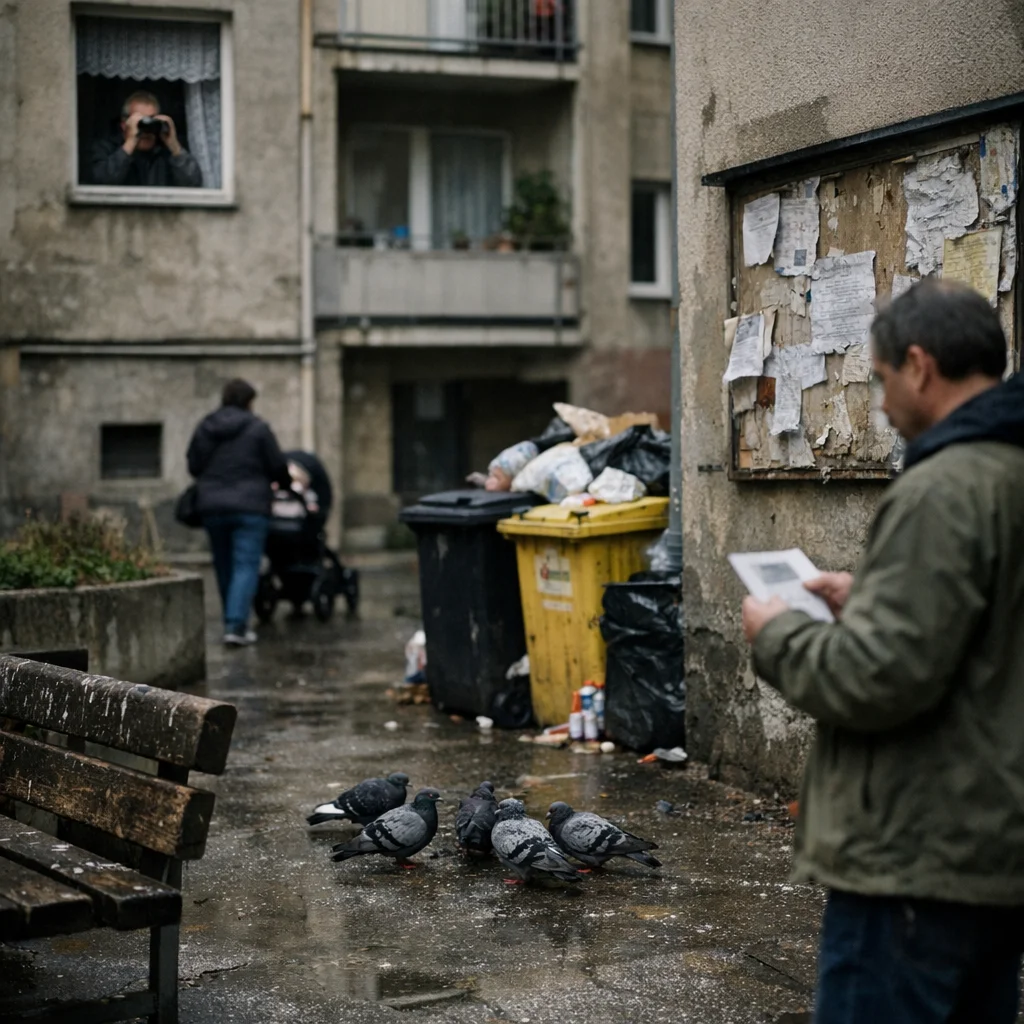
The courtyard, reduced to a seminar in self-contempt
On Tuesday morning in Wedding, the courtyard residents assembled around the bins and planters like a committee convened by mildew. By lunch, the birds had won. Not through violence, not through strategy, but through the simple advantage of being more honest than the humans who live beneath them. The pigeons wanted crumbs and ledges. The tenants wanted a sanctuary of values, preferably with no odor, no labor, and no visible consequences.
The building itself helped. The stairwell smelled like wet pigeon shit and radiator dust. Laminated notices peeled at the corners in the rain, each one trying to sound like municipal conscience while looking like it had been printed by someone whose main skill was avoiding responsibility in a shared kitchen. One flyer begged residents not to feed birds “for everyone’s wellbeing,” which is Berlin code for “please stop making my idealism expensive.” Another, clearly the work of some co-op moralist with compost in one hand and contempt for maintenance in the other, denounced “hostile pigeon management” as if the birds were a small military junta instead of opportunists with feathers.
The result was the usual Wedding miracle: a courtyard full of people who all wanted to appear morally superior while doing absolutely nothing that might stain their shoes.
The species of hypocrite
There was Jana Bekker, chair of the building board, speaking in the exhausted cadence of a person who has mistaken procedure for character.
“We tried the netting, the spikes, the hotline, and the diplomatic approach,” she said, as though she had spent the morning negotiating a ceasefire instead of failing to stop birds from nesting under a balcony.
The retired surveillance hobbyists were already on duty. Two old men stood at opposite windows with binoculars, monitoring the courtyard with the erotic intensity of men who have not felt wanted since the wall came down. One of them claimed he was “just looking out for the house,” which is what Berlin calls lurking when it wants to stay polite. He had the expression of a man prepared to report a bicycle theft that happened in 2019 if it would interrupt someone else’s afternoon.
Then came the NGO-adjacent parents, rolling strollers over the mess in expensive shoes and talking about ecosystems with the glazed tenderness of people who have never had to scrub excrement off a window ledge before making coffee. They called the pigeons “part of the urban fabric,” which in practice meant they wanted the benefits of being enlightened without the inconvenience of cleaning up after anything alive.
A grandmother had been leaving stale bread by the hedge “just for a moment,” the kind of innocent lie that keeps an entire building soaked in grease and guilt. The WhatsApp group, naturally, had already exploded: caps-lock warnings, mild threats, faux-medical concern, and one exquisitely passive-aggressive note about “shared standards” that read like a landlord’s apology after a sexless affair with the word community.
Maintenance, the thing nobody wants to touch
The official line from a district sanitation worker was brutally unromantic.
“Remove food sources, clean regularly, and stop trying to outthink a bird,” he said.
That was the problem. The courtyard’s governing class wanted a moral performance, not maintenance. They wanted environmental language to function like perfume sprayed over a blocked drain. They wanted to call neglect “care,” chronic under-cleaning “respect,” and the refusal to enforce basic rules “pluralism.” Berlin’s favorite lie is that if you dress up laziness in the vocabulary of virtue, it stops smelling like defeat.
But the smell stayed. It always does. Damp cardboard, old bread, pigeon feathers, the sour note from the bins, the sourer note from people insisting they were on the side of compassion while doing nothing except generating messages.
The board meetings had the same rhythm every time: concern, consensus, delay, and then a timid action plan that collapsed the moment someone worried about appearing authoritarian. No one wanted to be the ugly one, the one who says: stop feeding the birds, clean the courtyard, replace the broken netting, and grow up. Better to keep the little theatre going. Better to let the pigeons breed under the balconies while the residents masturbate their principles in public and call it civic culture.
The only honest tenants
By late afternoon, the courtyard belonged to whoever was willing to occupy it without apology. The pigeons perched on the railings, waddled through the planters, and stared back with the calm of creatures that have never once confused a flyer for a policy.
The humans, meanwhile, were still negotiating with their own reflection.
By the next board meeting, they will vote again on deterrence, enforcement, and whether anyone is secretly feeding the birds from a balcony with “solid values” and a guilty hand. Someone will object to the tone. Someone will invoke community. Someone will ask for another round of gentleness, as if gentleness were the same thing as adult behavior.
The pigeons will ignore all of it. They understand the building better than the tenants do: in Wedding, the people who talk most about care usually mean convenience, and the only residents with enough decency to stay consistent are the ones with feathers and no shame.