‘Please Scan Before Complaining’
A new wave of Berlin’s customer-service culture is teaching residents that every grievance can be digitized, triaged, and safely ignored by someone in a black polo shirt.
Civic Hypocrisy & Neighborhood Compliance Reporter
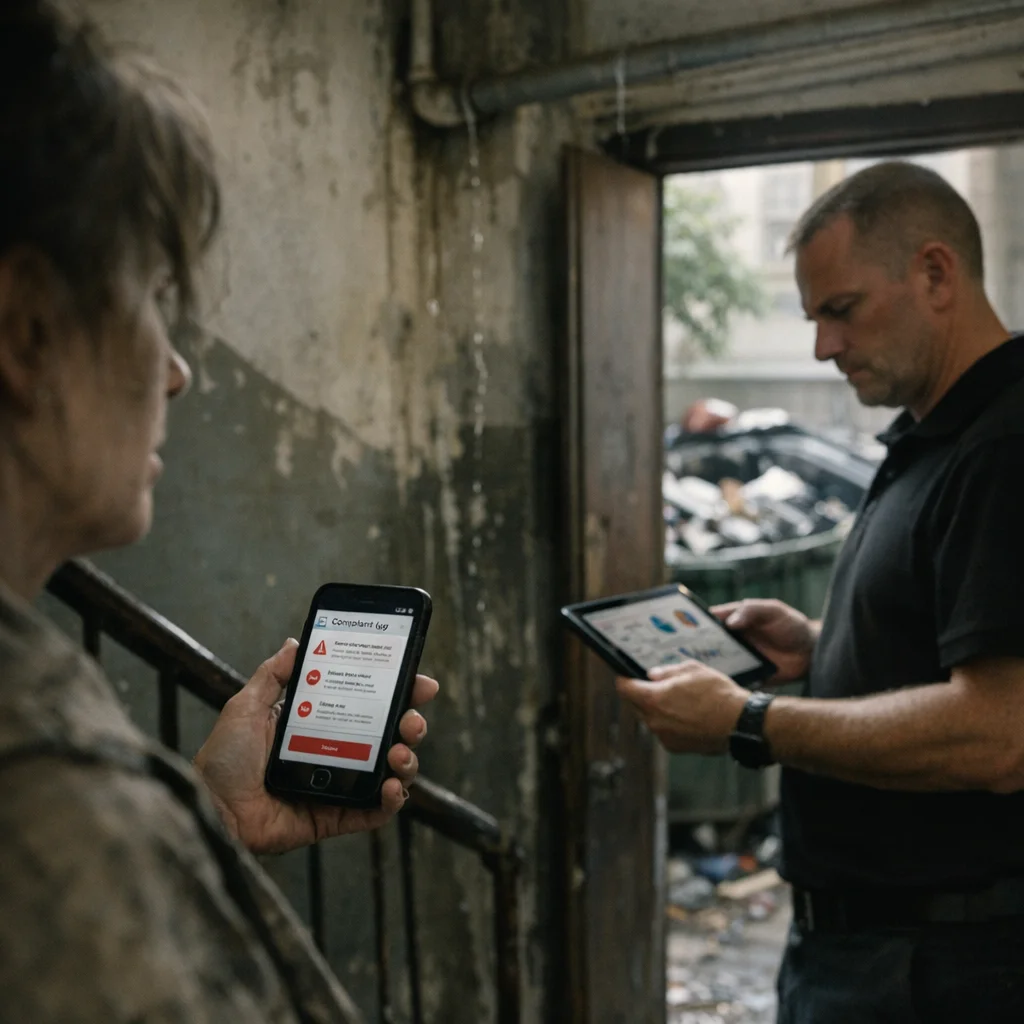
Residents in Wedding are discovering that modern civic life is not about rights, services, or even the old-fashioned fantasy of a call being answered. It is about submission. You tap a glowing button, attach a photo of the filth, and offer your humiliation to a system built to launder responsibility through a screen. The new neighborhood status symbol is not access. It is the privilege of filing a complaint through an app polished enough to feel like a manager’s favorite sex toy: all shine, no performance.
The ritual is spreading from one courtyard to the next, from cooperative stairwells to the little empire of the building operator, from the district-office functionary with the tired smile to the black-polo property guy who says “we’re very reactive” while reacting to nothing except his own reflection. A broken light in the hall. A trash mountain behind the bins on Müllerstraße. A speaker blasting at 2 a.m. from a fourth-floor window like a drunk priest with a Bluetooth habit. A cigarette graveyard in the stairwell. A pissy odor from a cellar door that never quite closes. All can be reported. All can be placed into categories. All can be processed into the soft administrative equivalent of a shrug.
At a courtyard off Müllerstraße, where a bakery, a barber, and a nail salon have outlived several waves of civic self-congratulation, tenant Ayhan Demir said he filed three reports about a leaking pipe and a hallway smell “like wet wool, sour mop water, and somebody’s wet coat left against a radiator.” He got a cheerful confirmation, a reference number, and the promise that the issue was “under review,” which in this city means the problem has been dressed up, photographed from a safe angle, and left to breed.
“Everyone loves the app until they need a human being,” Demir said, standing by a bin area that looked curated by someone who confuses decay with urban authenticity. “Then you find out the whole thing is just a little velvet rope for neglect.”
That is the trick. The app does not solve anything; it stages the feeling of being heard so the institution can avoid being responsible. Building operators call this transparency. District offices call it modernization. Cooperatives call it resident engagement, which is bureaucratic German for handing you a digital pacifier and asking you to be mature about being ignored. The English-language menu of civic life now offers categories for noise, odor, accessibility, and “other,” which is where actual life goes when it is too ugly to be dignified in public.
The people who worship these systems are rarely the ones standing in the stairwell breathing the rot. They are the overconfident middle layer: the landlord’s proxy, the cooperative administrator, the district-office coordinator, the process fetishist in a black polo who speaks fluent “workflow” and has never once had to smell his own failure in a hot hallway. They adore dashboards because dashboards do not blush. Dashboards let cowardice look like management. A complaint sitting in a queue can be called “visible,” which is a lovely word for a corpse in better lighting.
A spokesperson for one building operator said requests are “handled in order of priority,” a sentence so clean it could have been ironed by someone else’s labor. Asked where unresolved complaints go, the spokesperson said they remain “visible in the dashboard.” Of course they do. That is the whole erotic horror of it: the problem is kept on display just long enough to reassure the staff that they are aware of the mess while doing absolutely nothing with their hands.
Left-wing residents praise the democratization of feedback, which is often just a prettier word for volunteering your annoyance into a management funnel. Right-wing loudmouths call it efficiency, then start sweating when the same process touches their own sacred little pile of incompetence. Everyone gets to perform seriousness. Nobody has to fix the pipe.
By Thursday afternoon, several users reported their complaints had been marked “seen” but not touched. In Wedding, that counts as a public service and a flirtation with the truth. The next upgrade will probably add even more frictionless accountability, meaning residents will be able to submit a problem, track it, and watch it slide gracefully into the same managerial void with better branding and a more obedient font. The city will call this progress. The rest of us will keep smelling the stairwell.