‘Please Scan Your Forehead,’ Says the Sauna
Wedding’s newest wellness fetish is the membership-only sauna that treats privacy like a moral weakness and nakedness like a networking skill.
Neighborhood Commerce & Low-Grade Dread Reporter
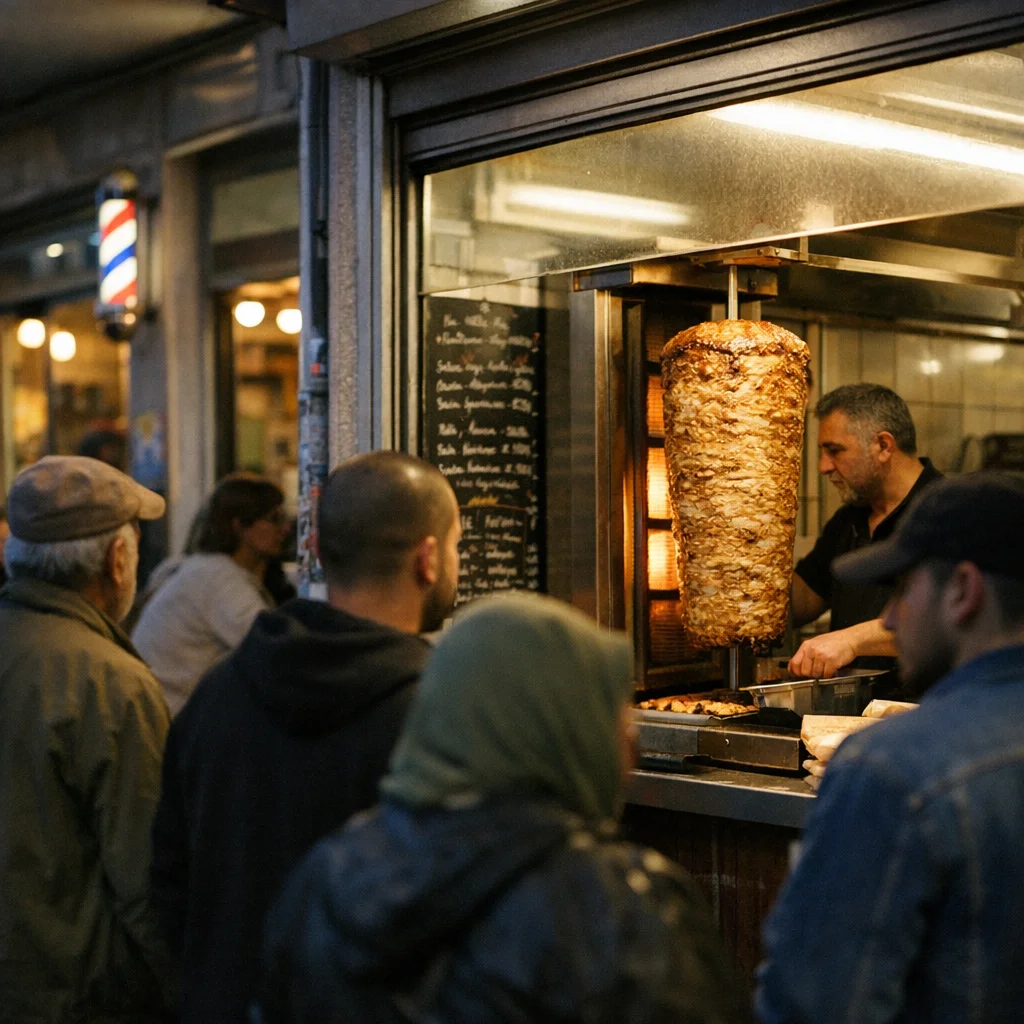
At a Turkish-run döner shop on Müllerstraße, Wedding’s food economy has acquired a fresh layer of grime: the premium customer who arrives dressed like a thrift-store seminar and spends like a municipal betrayal. The spit turns, the meat drips, and the line stretches past a vape shop, two cargo bikes, and a barber where men go to be sharpened into something acceptable to the city. The owner, Cem Yildiz, said business had doubled since nearby cafés started serving avocado toast under names like “Mediterranean nourishment,” which is what rent-stabilized frauds call lunch when they want their politics with a lemon wedge.
Yildiz’s place opened fifteen years ago, back when the area still smelled like grease, cigarette smoke, bus brakes, and people who had not yet been branded as a concept. Now it competes with a class of customers who say they love “local culture” while asking for oat sauce, extra jalapeños, and a seat by the window where they can pose as humble in public. One woman in a beige coat ordered a “classic” döner, then asked whether the meat was “ethically layered,” as if the spit owed her a manifesto. A man from a nearby co-working office requested his wrap “without too much mess,” which is also how he probably files his taxes, his breakups, and his social conscience.
There is a special vulgarity to this crowd: they fetishize authenticity the way colonizers once fetishized coastlines—something to admire, extract from, and then rename for comfort. They praise “diversity” with the same mouthful they use to complain about noise, odors, and “unsafe vibes,” which usually means poor people remaining visible after sunset. They want the neighborhood raw, but not too raw; spicy, but filtered; working-class, but only as long as it can be photographed without embarrassment. A district that still feeds itself is useful to them right up until it starts refusing to be decorative.
“I’m happy they come,” Yildiz said, wiping his hands on an apron that had long ago surrendered to the city. “They pay cash, they smile, and they pronounce my name like they are apologizing to the floor.” He said the only consistent complaint was that the sandwich was “too heavy,” a criticism that lands hard in a city where people worship austerity until lunch arrives and then suddenly need a narrative arc, a side salad, and three private adjectives to explain why they are entitled to be full.
The scene around the shop has become a tiny civic farce staged between appetite and aspiration. Turkish grandmothers still leave with foil parcels for children who refuse to visit, while new arrivals hover over the menu board like graduate students of guilt, trying to convert hunger into a personality. Even the signs have joined the property logic: one nearby café advertises “Berlin comfort food” at prices that suggest comfort is available only to people who have never been chased by a utility bill or a rent increase.
And of course the municipality calls this “vibrancy,” because bureaucratic language is a pleasant little anaesthetic for displacement. Rent goes up, leases get “restructured,” family businesses are praised in panel discussions, and then quietly priced into the ground while officials clap for “mixed-use development” as if the mix includes anyone who needs to survive. The city loves diversity best when it can be used as a branding solvent—something glossy enough to cover the stain of eviction.
The district office, reached for comment about the neighborhood’s culinary turnover, said it had “no immediate plan to regulate sandwich culture,” which is probably correct and deeply revealing. A spokesperson added that food diversity remains important, provided it can be photographed, branded, and sold before the next rent notice arrives. That is modern urban policy in miniature: let the neighborhood produce the flavor, let the market extract the value, and let the officials describe the bruises as progress.
By closing time, the last customers were licking chili sauce from their thumbs with the solemn devotion of people pretending they discovered the city rather than just outspent it. Yildiz said he would keep serving as long as the landlord “stays distracted by the smell.” In Wedding, that may be the last working defense left: make enough grease, enough noise, enough human consequence that the polished predators in their beige coats have to remember they are guests, not owners.