‘Please Take a Number’ at the Pediatrics Desk
The official story is child health, but the real action is parental caste management: who brought the right forms, who learned to sound calm, and who gets punished for not performing panic in the approved middle-class.
Administrative Grief Correspondent
Parents arrive armed with folders and faces
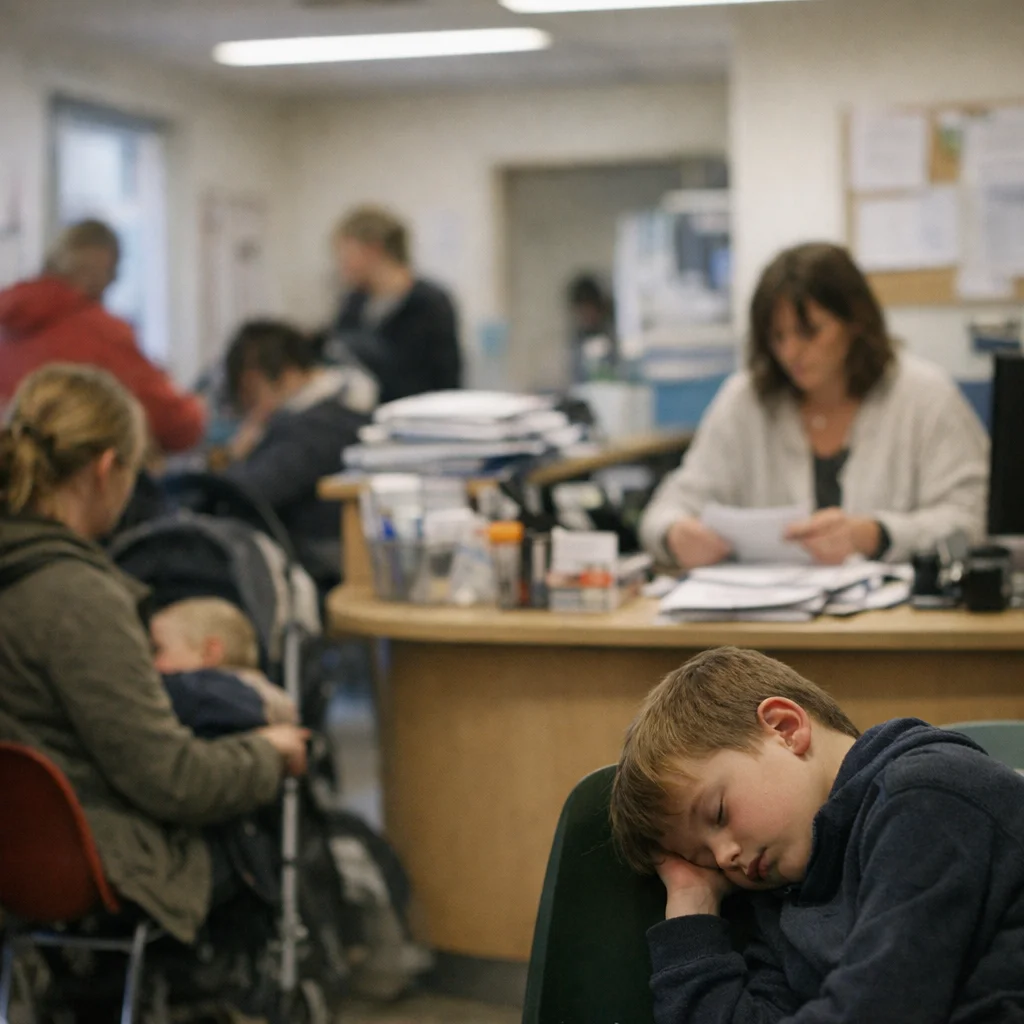
At a pediatric practice in Wedding, the waiting room has stopped pretending it is a place for sick children and now behaves like a small embassy of respectable parenthood, where the fever is merely the cover charge. By the time the first calls came in on Tuesday morning, the room was already full of adults clutching insurance cards, vaccination booklets, referral slips, and the kind of tight smile that says they have rehearsed being reasonable in the mirror.
The official script is care. The actual sport is status management. Parents enter with strollers folded like diplomacy, kids red-eyed and damp-haired, and one eye fixed on the receptionist, whose desk has become a judgment booth with a keyboard. The loudest people are not the most worried; they are the ones most determined to look as if worry has been professionally curated. A father in a spotless work coat spoke in the soft, strangled tone of a man trying not to sound like he has ever needed anything. A woman with a tote bag from a left-wing bookstore apologized for existing before asking where the forms were. Nobody wanted to be the first one to sound desperate, because desperation in this room reads as poor time management.
“We can usually tell within ten seconds who has brought the right papers and who has brought only confidence,” said Martina Yilmaz, the receptionist, who requested anonymity because she does not want to be recognized at the bakery by parents who have seen her witness their collapse. “The child may have a fever, but the real triage is whether the adult can keep their voice level while sweating through their coat.”
That is the hidden cruelty of the place: the waiting room rewards the people best trained for municipal humiliation. The Turkish grandmother with the complete folder, the freelance designer with one missing signature, the single father pretending he is relaxed, the well-spoken activist parent who can quote Foucault but cannot find the pediatric stamp — all of them are sorted by the same cheap machinery. It is less medicine than a rehearsal of class theater, with the receptionist as stage manager and the sick child as the prop nobody admits to using.
The district health office said practices are expected to handle patients on a first-come, first-served basis unless urgency requires otherwise, and that staff should not be burdened with “behavioral expectations unrelated to treatment.” In practice, the burden arrives anyway, wearing sensible shoes and carrying a folder. One doctor said the room has become “a minor Proust novel with thermometers,” though even that felt too elegant for the scene.
By late afternoon, the backlog had spread to the hallway, where parents stood performing patience like a civic virtue. Several said they would come back earlier next time, which is the lie every exhausted adult tells before doing exactly the same thing again. The children, mercifully, mostly got treated. The parents, less so. They were sent home with prescriptions, instructions, and the familiar Berlin consolation prize: proof that they had suffered correctly.