Please Touch the Smithsonian’s New Foreplay Signs
The Trump administration says the labels will help visitors engage more seriously with the museum.
Moral Contradictions & Night-After Reporting
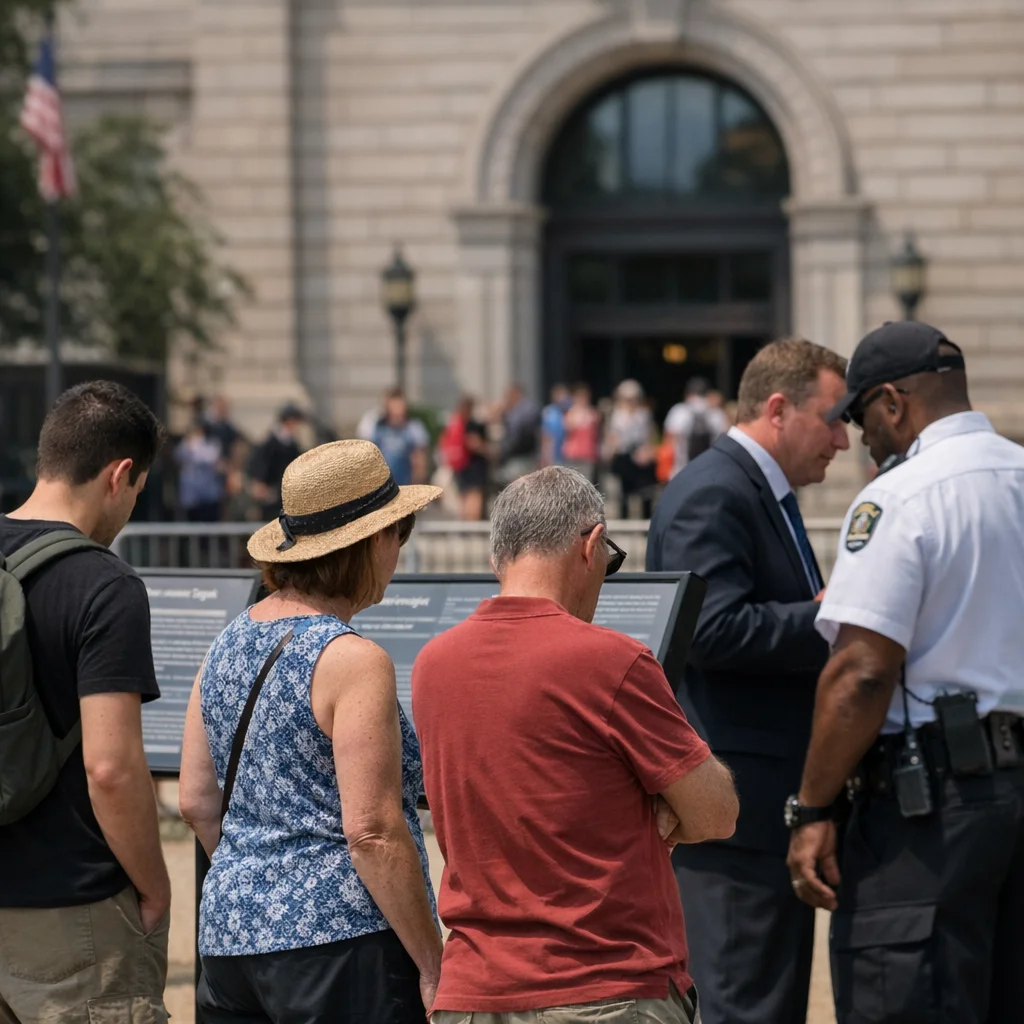
Washington has decided that the Smithsonian needs signs outside it, because apparently the republic can survive climate collapse, mass delusion, and a billion cursed podcasts, but not the possibility that a museum entrance might greet the public without first being supervised by a government hand. The plan, outlined by the Trump administration, would put new labels at the threshold and tell visitors what they are looking at before they are allowed to look. That is sold as guidance. It is really the state insisting on the first touch.
Officials say the signs will help people engage more seriously with the museum’s contents. Which is adorable, in the same way a lock is adorable when it calls itself a welcome mat. The administration’s talent is not for history but for pre-arrangement: if it can’t own the collection, it wants to own the approach to it, the pause before it, the angle of the body in front of it. The label is the opening move in a very old civic habit: first the permission, then the posture, then the obedient little shiver of being told what this means.
At the entrance, where tourists already stand sweating through their patience like extras in a Fassbinder scene, the signs would do what every self-respecting bureaucrat dreams of doing in public: put itself between the viewer and the thing viewed, then call that mediation wisdom. One proposed label would introduce the building’s collections before visitors reach the door, which is a charming way of saying the government wants to undress the exhibit before the public can even decide whether it likes the room. Another would frame what counts as “serious” engagement, which is usually code for “look where we point, stand where we place you, and keep your hands where the institution can see them.”
A museum visitor from Ohio, Marla Jennings, said the whole thing sounded less like outreach than a panic attack in a necktie. “If the sign has to stand outside the museum and explain the museum to me, then the museum trusts the label more than it trusts the people,” she said. Nearby, a Smithsonian staffer speaking on condition of anonymity because he once corrected a donor’s pronunciation and never recovered, called the proposal “gift-shop epistemology,” which is the exact kind of phrase that sounds harmless until you realize it means the state has become a man trying to tell you how to breathe while you are already in the room.
The administration’s defenders insist the signs are neutral. Neutral is what people call a hand when it is already halfway down your waistband and still pretending to be a public servant. The label claims to summarize the past, but the impulse behind it is much uglier: if you can narrate the doorway, you can pre-own the feeling. If you can stand outside the museum and tell people how to read, you can also tell them how close to come, how much curiosity is respectable, and whether their reaction will be treated as civic virtue or deviance.
That is the whole trick. The Smithsonian is not just being labeled; it is being handled. First the threshold, then the instruction, then the little authoritarian fantasy that history should arrive already translated into something safe for the people in power. The signs are foreplay in the most bureaucratic sense: a state that cannot stop putting its mouth on public memory wants to make the public wait outside while it explains where the sensitive parts are and how grateful everyone should be for the lesson.
The whole thing has the structure of a bad Deleuze seminar hosted by a real estate broker: semiotics in the front, domination in the back, and a lot of expensive confidence pretending this is all for your own good. The museum becomes less a place of public memory than a room the state keeps trying to enter first, to search the drawers, to rearrange the light, to make sure the visitor only leaves with the approved sensation and none of the messy, unsanctioned contact with history that might survive official hands.
Museum officials have not said whether the signs would be temporary or permanent. But staff were already bracing for the next phase, which several described as a tighter leash on the exit, where the government can make sure nobody leaves with the wrong reading — or, worse for the whole fragile performance, with any feeling the state did not get to touch first.