‘Please Wait Outside’ Becomes a Neighborhood Religion
Wedding’s civic institutions have discovered a perfect compromise between inclusion and contempt: everyone is welcome, provided they stay in the corridor long enough to feel grateful for the privilege.
Administrative Grief Correspondent
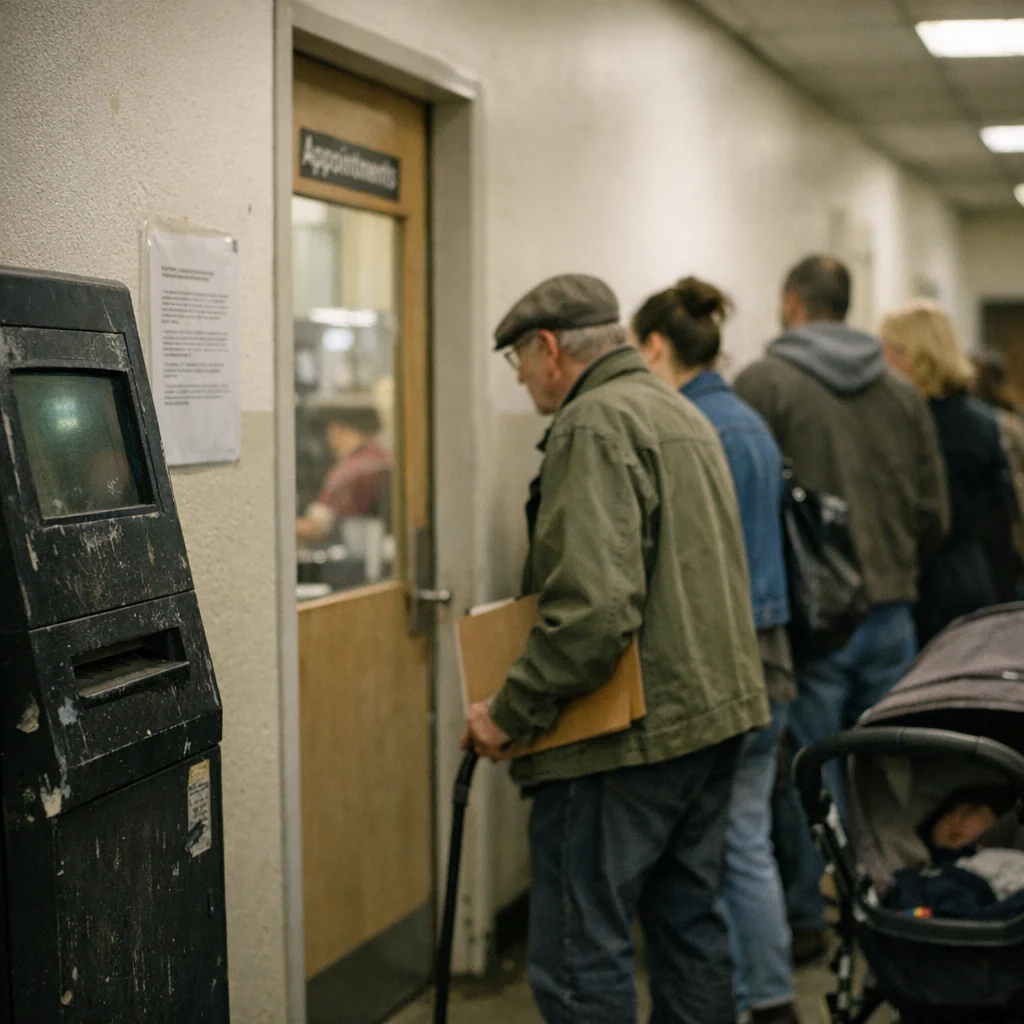
Open the Door, Keep the Shame
Wedding’s permit offices, clinics, and cultural counters have refined a municipal theology as sleek as it is rotten: keep the door open, keep the body waiting, and call the humiliation service. On Monday morning near Leopoldplatz, a line of residents curled past a broken ticket machine that had been flashing the same dead promise since breakfast, its laminated sign assuring everyone that help was available in the usual cheerful lie. The corridor smelled like wet wool, radiator dust, and the mild panic of people whose time has been declared surplus.
Inside, the furniture had the tender brutality of bad public design: a bolted plastic bench, a scratched counter, a printer coughing as if it had lung disease, and a desk lamp aimed at nobody in particular. Staff repeated the neighborhood’s favorite command with the serene face of people who have mistaken delay for dignity. Please wait outside. Not now. Not yet. We are very committed to access. In Wedding, that phrase usually means access to another wall, another queue, another small administrative edging.
The script is as predictable as a landlord’s smile. A resident arrives for a permit, a child’s appointment, or a place in a public program. The desk nods. The corridor opens its mouth. Someone in a fleece vest explains, with the lubricated calm of a middle-manager auditioning for innocence, that the system is down, the colleague is in a meeting, the form is incomplete, the slot is full, the policy is being reviewed, the policy is always being reviewed. By the time the person at the counter has finished performing empathy, the visitor has already been sorted into the category that matters most here: inconvenient.
“It’s a club with no membership card except exhaustion,” said Aylin Demir, who was trying to confirm an appointment for her mother at a local clinic and was told to come back after lunch, as if hunger were a scheduling philosophy. “They talk about inclusion like it’s foreplay, but the people who look tired, poor, or simply too real are always the ones left standing in the hall with their coats on. The politeness is the weapon. It lets them touch you with one hand and push you away with the other.”
At a nearby cultural center, a grant-fluent operator in an immaculate black sweater described the waiting area as “a shared threshold,” a sentence so polished it could only have been born in a funding application or a seminar on civic empathy for people who have never missed a bus. The threshold, naturally, was shared the way a guarded fence is shared. By the third person sent back into the corridor, the room had the moral texture of a border post pretending to be a salon. One young man, who asked not to be named because he had once posted a photo of the queue in a work chat and been treated like a criminal of taste, put it more plainly: “Open to everyone, provided everyone knows how to look grateful while being handled.”
The district office said it was “working to improve customer flow,” a phrase so bloodless it sounds like it was written by a committee after three coffees and a compliance workshop. A clinic gatekeeper said staff were under pressure and “doing their best,” which is true in the same way a pickpocket is doing their best when your wallet goes missing in a crowd. Nobody disputes the pressure. The point is that in Wedding, pressure is the product. The system runs on it. It squeezes the poor, the tired, the immigrant, the pensioner, the single parent, and anyone else who cannot afford to turn complaint into a hobby.
What makes the whole setup especially vulgar is the ideological perfume sprayed over it. The right calls it discipline and the left calls it inclusion, and both sides get to keep their mouths clean while the same bodies are told to wait in the corridor like extras in someone else’s moral theater. The liberal costume is the worst one because it comes with a smile, a tote bag, and the smug fantasy that exclusion is kinder when it is phrased as care. But the hallway knows better. The hallway is where policy sheds its language and shows its knuckles.
In the end, the corridor does the real governing. The door opens. The body waits. The institution keeps its hands clean while the queue thickens, frays, and leans hard against the wall like a tired man at last allowed to rest against something that will not love him back.