Poppers at the Co-Working Desk
Wedding’s startup operators have discovered nightlife’s last profitable asset: pretending the office can be a floor and the floor can be a brand.
Gentrification Symptoms & Pretend-Creative Economy Reporter
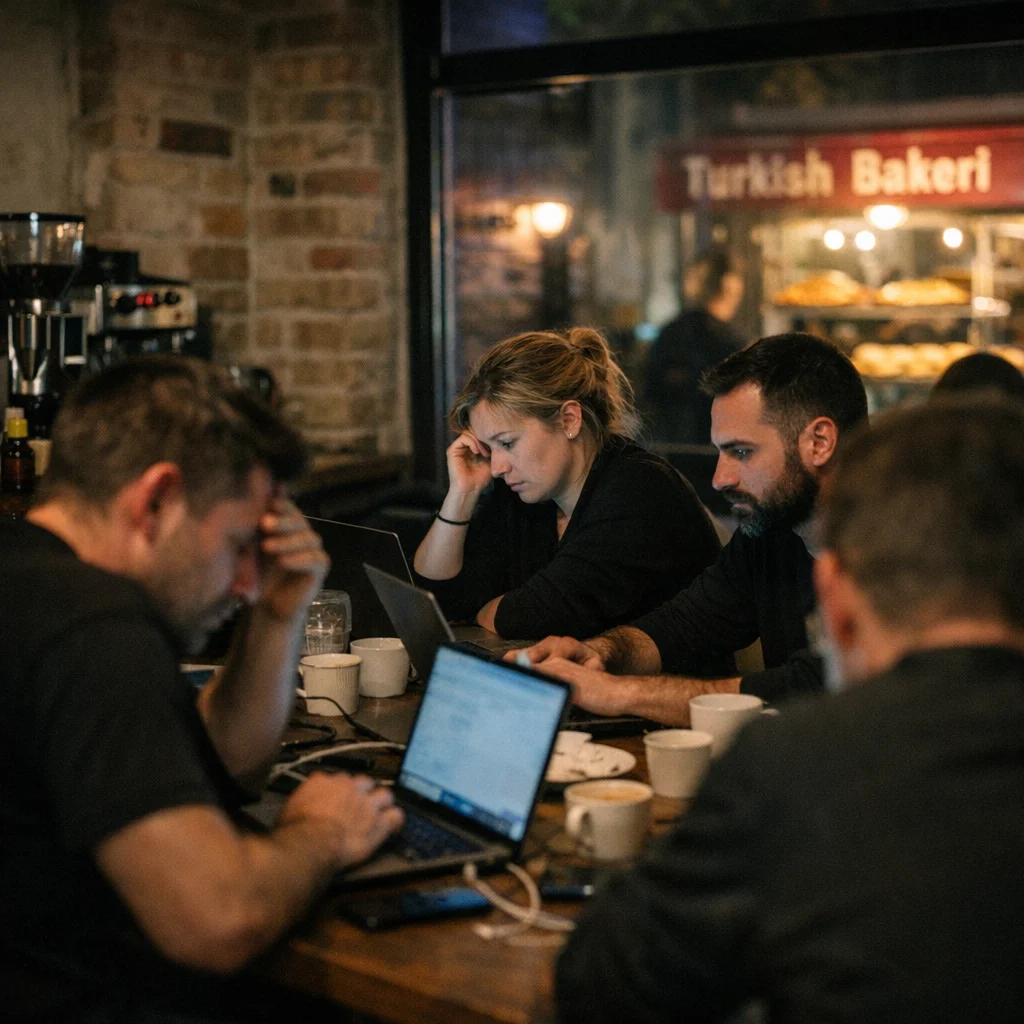
The office wants to be a club. The club wants rent.
A row of founders in expensive black hoodies is trying to turn Wedding’s coworking spaces into substitute clubs, and the neighborhood has the good sense to find it obscene. What began as “networking nights” with vinyl records and aggressively curated dimness has metastasized into a little doctrine of professional hedonism: no sweat, no chaos, no poor people, no consequences—just enough bass to make a cap table feel sexually adventurous.
At one space near Leopoldplatz, a startup meet-up last week sent several attendees straight from elevator pitch to nasal delusion. Someone had left a bottle of poppers beside the communal espresso machine, which was apparently meant to signal openness, spontaneity, and the sort of bisexual charisma that only exists in pitch decks and rented lofts. By the time the product demo started, half the room was pretending to be moved by the word “community,” while the other half was using the conference table like a confession booth with USB-C ports.
The founders themselves were a perfect little inventory of post-left fraud: private-school jaws, thrift-store jackets worn like evidence, and the glazed, self-pleasuring confidence of people who call themselves “anti-establishment” while paying a branding consultant to make their rebellion legible to investors. One of them kept smoothing his mustache with the nervous devotion of a man trying to fondle his own social class into credibility. Another had the hunched, permanently apologetic posture of someone who says “solidarity” with the same mouth he uses to ask for a discount on artisanal beer.
“They want Debord with Slack notifications,” said Deniz Yildirim, who runs a Turkish print shop around the corner and watched the founders arrive in borrowed cool like they were entering a Fassbinder scene with a seed round. “They want to look feral without risking a stain, a bruise, or a real person telling them no.”
The ritual, according to several attendees, is the same every time. First comes the playlist that says “community” in the flat voice of a licensing agreement. Then the ironic fog machine, which gives the room the emotional climate of a laundromat after a fire. Then the founder with the private-school jawline starts talking about “building culture” while standing beside a whiteboard that says nothing except “BURN” in marker-heavy desperation. After that, somebody disappears into the bathroom, comes back shiny-eyed and overconfident, and suddenly the room is full of people who think they are one illegal substance away from being visionary and one email away from a complaint about their behavior.
The district office sees everything except power
The district office, which can miss a sidewalk collapse but never a branding opportunity, said it has received no formal complaint about “office events with nightlife characteristics.” That phrase deserves a plaque and a public apology. A spokesperson said only that businesses must respect noise rules and occupancy limits, which is the municipal equivalent of asking a wolf to keep the blood off the windows so the neighbors do not panic.
Of course the city is thrilled. This is the dream arrangement: landlords get higher rents, landlords’ friends get “activation,” consultants get paid to rename vacancy as vibrancy, and the district office gets to issue cautious little sentences that sound like governance if you do not listen too closely. Wedding is being colonized by the kind of people who think aesthetic decay is freedom, then sell it back as culture with a QR code.
Fake anti-capitalism with better lighting
The deeper joke is that these founders are not rebelling against office culture; they are perfecting it. They want Debord with Slack notifications. They want the nightclub without the grime, the cruise without the wreckage, the kink without the invoice. Even their “anti-corporate” parties are run like procurement: clean surfaces, soft lighting, controlled dosage, no one too ugly, no one too broke, and certainly no one whose fun would require an apology, a cleanup, or a labor dispute the next morning.
Their leftism is decorative, the kind that arrives with a tote bag and leaves with a sponsorship deck. They love “community” the way a landlord loves exposed brick: as a texture that covers up the vacancy underneath. They will chant about mutual aid between sips of natural wine, then ask the neighborhood to be grateful for the foot traffic. It is radicalism for people who fear sweat, conflict, and the social humiliation of being ordinary.
By midnight, the room had the exhausted look of a Beckett play performed by people who think themselves very early in history and very close to a breakthrough. One founder was heard saying the event felt “so raw,” which in startup language means no one had yet been embarrassed enough to leave, vomit, or file a complaint.
The next one is already on the calendar. Organizers say it will include a panel, a DJ, and more “open energy,” which is what everyone calls desperation when the rent is paid by someone else and the neighborhood is expected to applaud while it is being scraped clean.