Pride Month at the Job Center
Wedding’s benefits office has discovered inclusion as a workflow problem, and nobody is more committed to it than the consultants billing by the hour.
Administrative Grief Correspondent
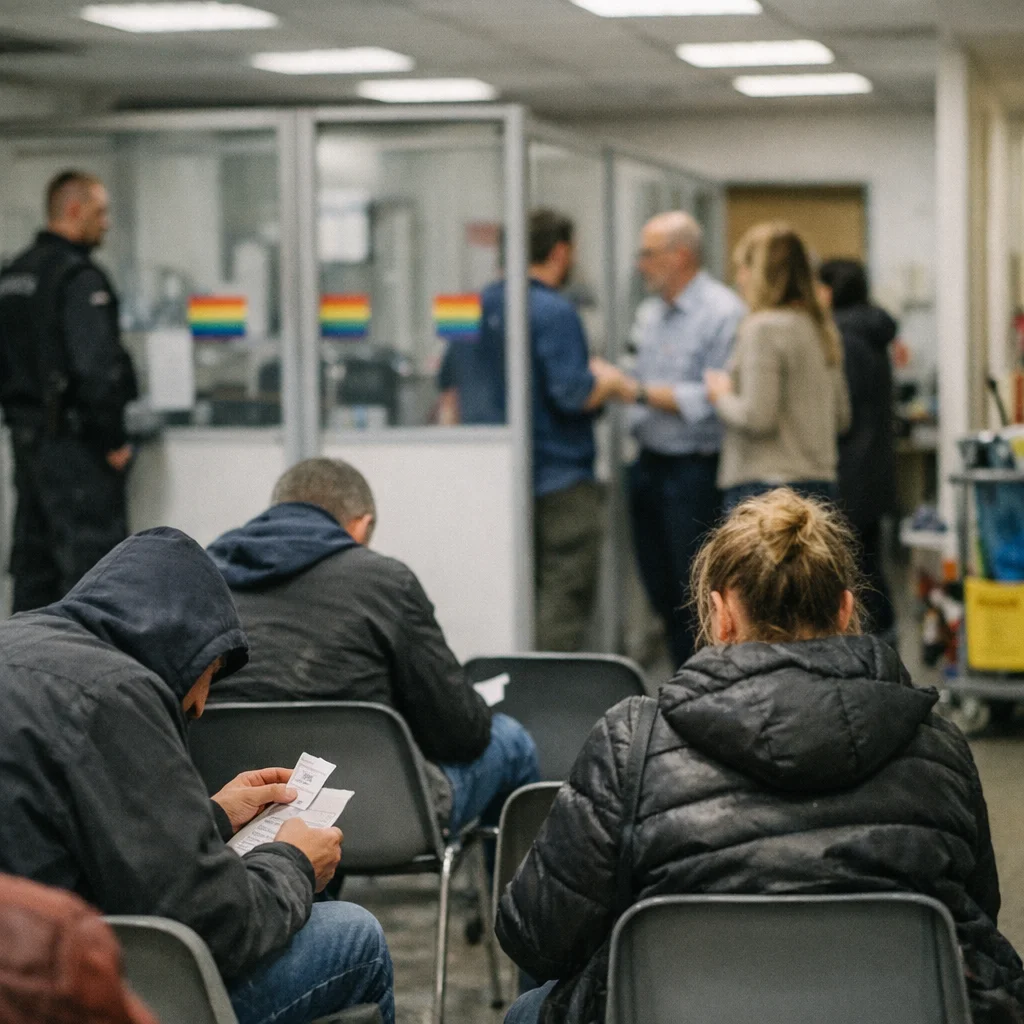
The rainbow sticker did not improve the queue
At Wedding’s Job Center on Müllerstraße, the monthly pride campaign arrived the way all civic affection arrives in Berlin: laminated, overmanaged, and faintly ashamed of the bodies it is supposed to bless. A contractor called Mittelpunkt Service + Beratung GmbH had been brought in to “harmonize client experience,” which is the kind of phrase only people with expense accounts and no shame can say with a straight face. They brought rainbow stickers, a revised language guide, and the kind of dead-eyed inclusion memo that smells like printer heat and moral laundering.
The foyer got decorated. The queue did not improve. A man in a windbreaker was told to “activate his self-advocacy pathway” while waiting for a password reset that had already swallowed his morning and most of his patience. A young woman, speaking in that careful public voice people use when deciding whether to cry, insult someone, or both, was asked to “identify barriers to participation” by a caseworker staring at his monitor like a foreman at a meat slicer. The posters said dignity. The room said take a number and keep your little dignity off the desk.
By noon the office felt like a Beckett production directed by a procurement committee. One screen displayed a rainbow flag beside a reminder that appointments must be booked online, which is a fine joke if you enjoy watching poverty get told to penetrate a system designed by people who have never once had to chase a printer code with a damp coat and a cancelled transit ticket. Near the entrance, a security guard with the permanent expression of a man guarding a collapse tapped his badge against the glass every time someone stood too close to the counter. The corridor smelled of wet wool, toner dust, and the cheap disinfectant they use when they want suffering to seem clean.
A sub-unit called Client Relations and Tone Compliance had also been assembled, because when an institution is failing it always discovers that the real emergency is your attitude about its failure. A district manager in a blue blazer said the goal was “to establish a safer conversational envelope for all service recipients.” Then she smiled the smile of someone who has never had to choose between rent and humiliation and added that staff were being trained to “reduce emotionally abrasive touchpoints.” It sounded almost tender. It was just violence with a wellness badge.
The consultants were the happiest people in the building. They moved through the waiting area with the serene sexuality of men who have never lifted a folder without charging a workshop fee, their shirts open just enough to suggest a pulse and closed just enough to suggest they still think this is leadership. One of them, a diversity contractor with a beard shaped by invoices, described the new language guide as “intersectional service delivery.” Another called the office’s “emotional accessibility enhancements” a breakthrough, which is what people say when they want oppression to sound like a Pilates class. They had the smug, lubricated confidence of men who have mistaken being consulted for being necessary.
Meanwhile, the old contempt remained in place, only now it wore a softer fabric and a pride sticker on the partition. Applicants were still rerouted, still corrected, still asked to prove desperation with forms, confirmations, screenshots, and the bureaucratic foreplay of a system that wants obedience before it will admit you are broke. The office performed care in the same way a landlord performs empathy: with signage, with policy language, with a hand hovering just long enough to collect your compliance. Pride Month did not change the structure. It simply taught the structure to purr while it tightened its grip.
Outside, a Turkish bakery two streets over was doing what actually functioning institutions do best: feeding people without requiring them to workshop their trauma or sign a code of conduct before the bread. Inside, the contractor promised a follow-up sensitivity session next week. The waiting list, naturally, already had a waiting list, and somewhere in the fluorescent marrow of the building another printer began coughing out forms for the next round of managed dignity.